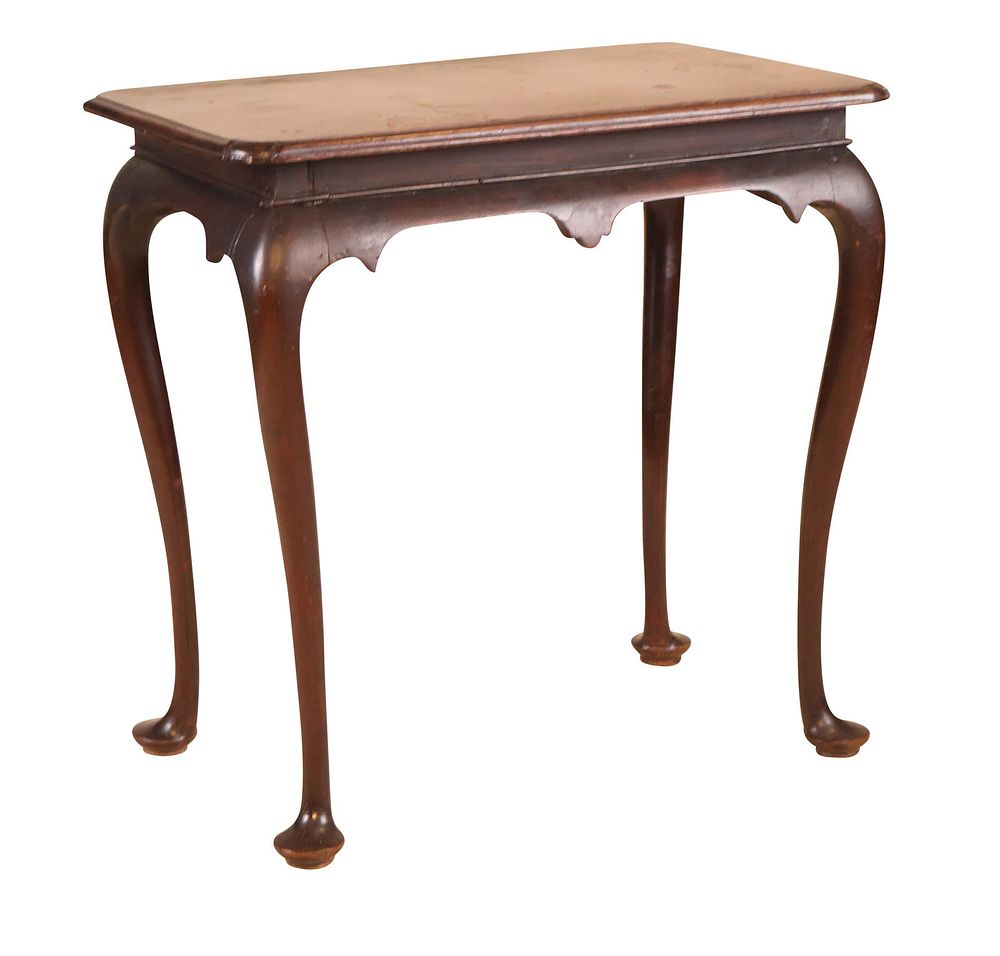
Bidspirit auction | Queen Anne Mahogany Tea Table
Queen Anne Mahogany Tea Table - Queen Anne Mahogany Tea Table Philadelphia, 1740-1760. With special thanks to Erik Gronning and Sotheby's, please see the following catalogue note: Fashioned of dense mahogany, this tea table's sophisticated and dynamic design is enhanced by its quarter-round molded top with inset rounded corners, bulged apron centering an integral drop pendant and prominent peaks flanking each leg. It stems from a very small group of surviving Queen Anne tea tables of rectangular form that were made in colonial Philadelphia. The tables in this group share a number of distinctive stylistic and construction details that tie them to an as of yet unidentified avant-garde Philadelphia cabinet shop. Although its original owner is unknown, this table has a long history of ownership in the family of Thomas Sully (1783-1872), the Philadelphia artist known for his portraits of the social elite. He was born at Horncastle, England the son of Matthew and Sarah Sully, and emigrated to America in 1792 to begin his studies in painting. He returned to Europe in 1809 to study in the London studio of Benjamin West and was back in Philadelphia by 1811 working in the style of the English portraitists Gainsborough, Reynolds and Lawrence.1 His will of 1865-1866 indicates that he bequested a number of objects to family and friends, including a palette stand with the same early history as this table.2 Both were owned by Francis T. Sully Darley, Thomas Sully's grandson, and next by Samuel W. Woodhouse, Jr. of Philadelphia, a medical doctor, scholar, Acting Director of the Philadelphia Museum from 1923 to 1925, Associate Director until 1927, and Advisor in the 18th century Industrial Arts until 1928. He sold both pieces as part of his collection at Freeman's in 1928. The sale also included the Sully portraits, Mr. and Mrs. Griffin, which suggests Woodhouse knew Darley and probably acquired this table and the palette stand from the Sully family. The table was apparently purchased at the Freeman's sale by Willoughby Farr, the Edgewater, New Jersey antiquarian dealer. He was perhaps acting as the agent of Mrs. J. Insley Blair, to whom he sold the table soon thereafter. Much of this history is recounted in Mrs. Blair's cataloguing for this table, in which she described it as a ”Mahogany Tea Table. Queen Anne. Philadelphia. All original condition. Once belonged to Thomas Sully. From Dr. Woodhouse Coll. & Sale. April 1928. W. Farr. Edgewater. N.J.” Perhaps the most closely related example to the presently offered lot is a mahogany tea table with drawer in a distinguished private collection with a history of descent from Thomas Sully to his daughter Rosalee with Sully family history inscribed in drawer represents a common shop tradition.3 In addition to exhibiting a closely related design in the quarter-round molded top with inset corners, bulged apron centering an integral drop pendant on each side of the skirt, prominent peaks flanking each leg and sinuous cabriole legs ending in large pad feet raised on a wafer, that table also displays the construction feature of visible pins on the knees that help to secure the mortise of the apron to the upper leg stock. A mahogany tray-top table at the Philadelphia Museum of Art with a history of descent in the Branson family of Philadelphia also stems from this group of related tables.4 It may have been part of the dowry of Elizabeth Branson, who married Lynford Lardner in 1749, and may be the ”squared tea table” in the inventory of their Second Street house.5 Like the present table, it displays the secondary wood of tulip poplar. It retains three of its original vertical glue blocks and exhibits the same design vocabulary in the bulged apron with integral drop pendants on each side of the skirt and prominent peaks flanking each leg. A tray-top tea table in the collection of the Newark Museum also stems from this group as it features many of the same attributes. A Philadelphia mahogany small sideboard table in a private collection originally made with a wooden top and currently with a replaced marble top displays a common design vocabulary in the bulged apron with integral drop pendants on all four sides and prominent peaks flanking each leg. It also exhibits the Philadelphia features of a shell motif on its knees and squared claw-and-ball feet. The cabriole legs are articulated with a profile and stance similar to those of the present table. Another Philadelphia marble-top table with the same distinctive drop pendants on its side aprons and claw feet descended in the Chew family at Cliveden. This table and the Rosalee Sully example stand on cabriole legs ending in bold pad feet, a feature occasionally known on Philadelphia tables and case furniture and more frequently found on seating furniture. Pad feet articulated in a closely related manner are found on an early Philadelphia mahogany armchair in a private collection with through-tenon joinery.