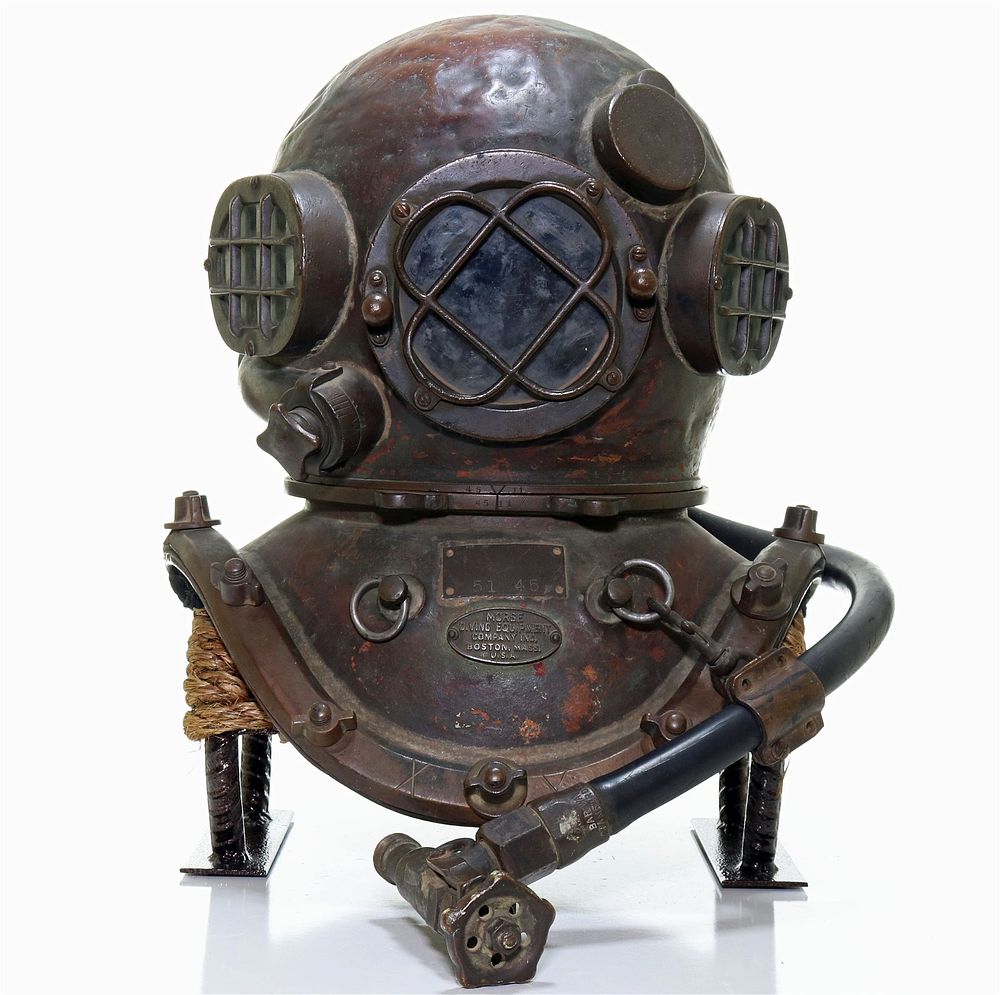
Bidspirit auction | Morse Diving Helmet Used To
Morse Diving Helmet Used To Salvage The African Queen - Merritt Chapman & Scott - This Morse diving helmet isn't just a vintage treasure; it's a participant in some incredible underwater feats. Crafted in Boston, MA, by Morse Diving Equipment in late 1942 or early 1943, it dates from a time when commercial diving equipment was scarce due to World War II military needs. The helmet's serial number (4511, present on multiple components) helps pinpoint its date of manufacture. The classic Morse ID plate adorns the helmet, but another ID plate reveals more clues to its fascinating past. The ”M.C. & S. Corp Construction 51-45” plate signifies ownership by the Merritt Chapman & Scott Corporation, a renowned salvage company nicknamed ”The Black Hose of the Sea.” Founded in the 1860s, M.C. & S. tackled some of the most challenging underwater construction and salvage projects in the U.S. One of those projects was the S.S. Normandie fire at Pier 88 in Manhattan and subsequent salvage projects by M.C. & S in 1943. With this helmet's production date and the huge undertaking employed by M.C. & S., it’s a safe bet this helmet was part of that epic job! Fast forward to 1959. The oil tanker African Queen hits a shole off the Maryland coast, and disaster ensues. The huge tanker breaks apart with the crew narrowly being rescued. Deemed unsalvageable by M.C. & S. itself, the wreck is abandoned. The following excerpt from Time magazine October 1959 illustrates what happened next: Armed with shotguns and carrying provisions, two men stole aboard the 400-ft. hulk of the Liberian tanker African Queen as she lay stranded and shoal-torn ten miles off Ocean City, Md. It was March, and the sea pounded against the rusting hull of the ship, which had run aground three months before. With 200 ft. of her bow ripped away, the 13,800-ton African Queen had been officially abandoned by her owners; now watermen from Ocean City poked about the hulk, prying at loose fittings, taking everything movable that seemed salable. The two newcomers watched patiently until the others went ashore at nightfall. From that point on, no one was allowed on board the African Queen without their permission—and Lloyd Deir, 45, and Belden Little, 36, enforced the rule with their shotguns. Their purpose: to float the African Queen, claim her under maritime salvage laws and sell her as scrap for, they hoped, more than $1,000,000. Their epic adventure had just started, and quickly, they realized they needed help. The duo brought on John W. Crisp, who became an invaluable member of the team. The following information about this incredible diving helmet was provided to us by Mr. Crisp's son: I am the only living son of John W. Crisp who passed away February 10, 2016. My father was part of the salvage crew that floated the sunken tanker “African Queen” 9 miles off the coast of Ocean City Maryland which wrecked and broke apart on a sandbar in the spring of 1959. This shipwreck gained international interest and was the subject of a book written by Jerry Korn ( “The Raising of the Queen”) published by Simon &Shuster in 1961. In addition, numerous magazine and newspaper articles were written giving accounts of the heroic efforts made over many months by amateurs to raise the vessel, which was said by professionals to be unsalvageable. My father came aboard with Mr. Duke Morris, a professional deep sea diver as his diving tender and apprentice diver. After surveying the situation Mr. Morris decided, given the circumstances, to send for a duplicate set of diving equipment since there could be the need for rescue or equipment failure. The duplicate equipment included this helmet being offered on August 10. It was during this lengthy mission that my father experienced his first dives as support for Duke Morris. Although there were 2 compressors topside, neither were particularly well suited for this job as they were old, and in some ways, unreliable. There was a scuba diver on site as well, but never were there two hard hat divers in the water at the same time. Once the diving was completed Duke Morris left the ship with his primary gear, however my father stayed on board by request, to continue working on the salvage. These were his first dives without the oversight of his teacher and mentor, Duke Morris, as he completed inspection dives before the ship was finally under tow. The city of Norfolk and other Tidewater / Virginia dignitaries provided a hero’s welcome and subsequently a parade to honor the salvagers in Downtown Norfolk on Oct 31, 1959. I recall my Mother and Father riding on the back of a Cadillac convertible in that parade as a 5 year old. The city recognized them both with a pin of the City Mace and a banquet. Dad purchased the gear from Mr. Duke Morris and that began a career as a deep sea diver for my father over the next 12-15 years. This included work on the massive Chesapeake Bay Bridge Tunnel project from the early 60’s.