Bidspirit auction | RAMBAN ON THE TORAH AND
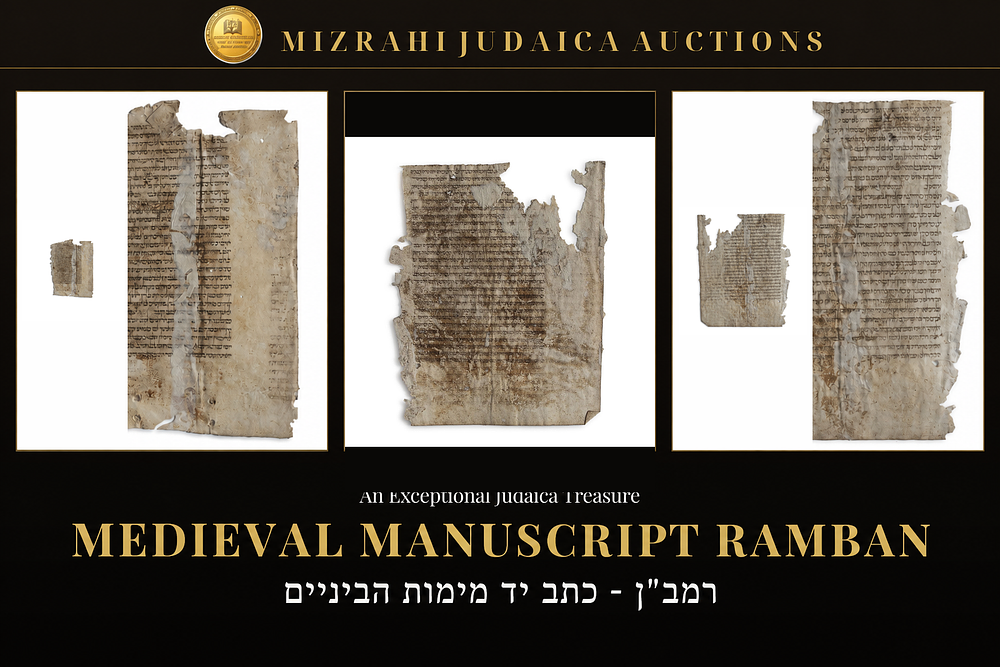
RAMBAN ON THE TORAH AND GUADALAJARA TALMUD FRAGMENT - A COLLECTION OF 45 MEDIEVAL MANUSCRIPT LEAVES - 13th-14th CENTURY, NAHMANIDES. MAHADURA BATRA OF PERUSH ON TORAH. - Textual description for this lot was researched and written by noted scholar, editor and author Ovadya Hofman Paleography, dating and expanded description by Louis Chaim Meiselman , the Judaica Special Collections Cataloging Librarian at the University of Pennsylvania Libraries Manuscript on paper (28 lines, no ruling, in a 14th century (or possibly late 13th century) Sephardic semicursive script) ”Of all the compositions of the great figures of Israel who arose after Maimonides, we have no book that was as universally accepted across all sectors of the nation—among Torah scholars and researchers alike—as the Ramban's commentary on the Torah.” Rabbi Chaim Dov (Charles) Chavel, in his introduction to his edition to the Perush ha-Ramban ‘al ha-Torah, translated from the Hebrew. A group of parchment leaves and substantial fragments from a medieval manuscript of R. Moshe ben Nachman (Ramban), Commentary on the Torah. Hebrew manuscript in brown ink, written in a compact semi-cursive hand, generally 27-28 lines to a page. Extensively worn and stained from their later use as binding material, with portions rubbed or cut away. Several pieces of other discarded Hebrew books remain attached, remarkably including fragments from the Guadalajara edition of Talmud, Tractate Ketubot, ca. 1480, among the earliest printed editions of the Talmud. Present are the sections of Bereshit and Shemot almost in their entirety, in the Mahadura Batra of the Ramban's commentary, with numerous variations and differences from known manuscripts and printed editions and many instances of a more refined and fluid text than our present printed editions . Few works of the Rishonim had a manuscript history quite like Ramban's commentary. Written initially in Spain, it continued to occupy its author after his arrival in Eretz Yisrael. Ramban revised and enlarged the work there, and copies of his additions were sent abroad to be entered into manuscripts already in circulation. The surviving manuscripts consequently preserve different stages of the commentary, sometimes retaining readings and passages which disappeared as the text moved toward print. The present leaves come from that handwritten world. The hand is visibly similar to that of the Ramban manuscript fragments preserved at Nonantola. Comparison with the manuscripts and printed texts has already proved rewarding. This copy evidently belongs to the Mahudrah batra versions and preliminary collation has revealed a number of significant variant readings , including readings which appear preferable to those of the standard printed text and are not recorded in Chavel 's edition, or the Oz Vehadar edition. For a work whose textual history is now known to have been unusually fluid during its manuscript circulation, even fragmentary witnesses can be consequential. For example, in Bereshit, in our printed editions, the Ramban quotes a Targum which does not exist in our versions. In this early manuscript version, the Ramban quotes an identical targum to our printed editions, indicating a likely corrupted text in the Rambans printed today. At some point the manuscript ceased to be useful as a book. Its parchment was cut up and passed into the hands of a binder. Thousands of medieval Hebrew manuscript leaves have been recovered from such bindings, a phenomenon now commonly termed the European Genizah. The name is somewhat deceptive. These manuscripts were not placed reverently in storage. They were discarded, cut apart, folded and pasted into other books. Medieval manuscripts of Ramban's commentary are themselves known among this material, including 14th-15th century fragments recovered from Italian bindings. The present group preserves an especially vivid example of the practice. Still attached to one Ramban leaf are pieces of printed Hebrew waste, including text identified as Ketubot 22b from the Guadalajara Talmud, printed by Solomon ibn Alkabetz, grandfather of the more celebrated R. Shlomo Alkabetz, around 1480. Fragments of these early Spanish Talmud editions have likewise survived through reuse in bindings (see accompanying lot in this auction). Here a handwritten copy of Ramban and a piece from one of the earliest generations of the printed Talmud ended up together in the binder's workshop, cut and pasted for an entirely new purpose. The Guadalajara fragment also supplies a firm terminus post quem: the two pieces could only have been joined after the Talmud was printed. The original codex is gone. What remains are sheets which a medieval reader once encountered as pages of Ramban, written and circulated during the centuries before the printed editions established the text familiar today. Aprox. 45 leaves, some partially torn at borders, others vertically down the page; many complete.