Bidspirit auction | SEMAG (R. Moshe of Coucy)
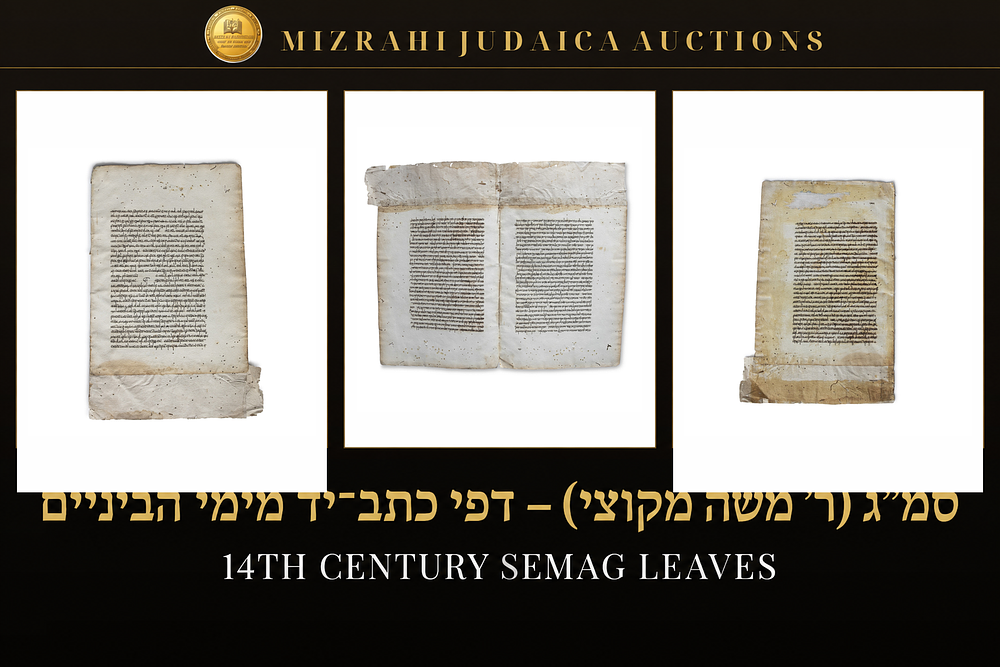
SEMAG (R. Moshe of Coucy) MEDIEVAL MANUSCRIPT FOLIOS, CIRCA 14TH CENTURY. - Textual description for this lot was researched and written by noted scholar, editor and author Ovadya Hofman Paleography, dating and expanded description by Louis Chaim Meiselman , the Judaica Special Collections Cataloging Librarian at the University of Pennsylvania Libraries A group of manuscript folios from an early copy of one of the fundamental halakhic works of medieval Ashkenaz. Written in a handsome, compact oriental rabbinic hand, with approximately 28 lines to a page. The script and mise-en-page bear a particularly close resemblance to -if not indeed belonging to- an early Semag manuscript recorded by the National Library of Israel, making the comparison useful for placing the present leaves within the medieval manuscript tradition. The Semag occupies an unusual place in the history of halakhic literature. Composed by R. Moshe of Coucy in the thirteenth century, it recast the 613 commandments as an expansive halakhic work, drawing heavily upon the Mishneh Torah while bringing the learning and traditions of the Tosafist world into its discussion. It became one of the most influential halakhic books of medieval Ashkenaz, copied and studied for generations before entering print. These folios preserve something of that earlier life of the Semag: the text before typography, densely copied across the page in the characteristic hand of the medieval beit midrash, with readings unrecorded in the manuscript apparatus of the modern critical edition . One variant is particularly intriguing. The critical editors, finding no such reading among the principal Semag manuscripts available to them, note instead that this alternative text appears in the Hagahot Maimoniot. Remarkably, the present manuscript preserves precisely that reading. Whether this reflects a textual tradition shared with the source available to the author of Hagahot Maimoniot, or perhaps some more direct relationship, cannot presently be determined. It nevertheless offers a tantalizing glimpse into the circulation of Semag texts among the medieval halakhic authorities themselves. 2 bifolia, written on all four pages. Approx. 28 lines per page. Oriental script, 14th century. Scattered wormholes, occasionally touching individual letters; staining and signs of age and use. Some marginal wear. Majority of text clear and readily legible. Individual leaves now preserved separately. Reference : National Library of Israel, Ktiv, PH 6075 (closely comparable Semag manuscript).