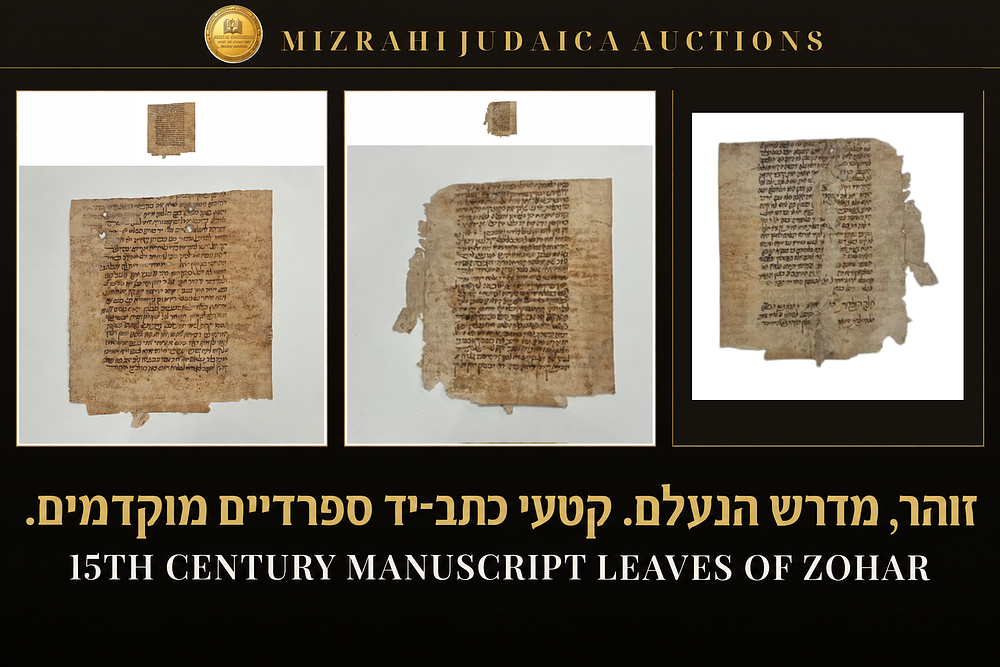
Bidspirit auction | ZOHAR, MIDRASH HA-NE'ELAM. EARLY SEPHARDIC
ZOHAR, MIDRASH HA-NE'ELAM. EARLY SEPHARDIC MANUSCRIPT FRAGMENTS. 15TH CENTURY. 10 leaves - Textual description for this lot was researched and written by noted scholar, editor and author Ovadya Hofman Paleography, dating and expanded description by Louis Chaim Meiselman , the Judaica Special Collections Cataloging Librarian at the University of Pennsylvania Libraries Manuscript fragments of Midrash Ha-Ne'elam, Zohar I, 15b–17a. Sephardic script, ca. 15th century. An evocative survival from the early manuscript transmission of the Zohar: a group of Sephardic manuscript leaves containing sections of Midrash Ha-Ne'elam on Bereishit, corresponding to Zohar I, 15b–17a. Midrash Ha-Ne'elam occupies a particularly intriguing place within the Zoharic corpus. Written partly in Hebrew and partly in Aramaic and cast in the form of ancient rabbinic midrash, it represents one of the earliest literary strata associated with the Zohar. Modern scholarship has increasingly treated the Zohar not as a book produced at a single moment, but as a corpus whose constituent works emerged, circulated and developed through a complicated manuscript history. Midrash Ha-Ne'elam stands near the beginning of that story. The present leaves belong to that manuscript world before the threshold of, the Zohar's transformation into a printed book . Their Sephardic hand appears consistent with the 15th century, an attribution for which important dated comparanda survive. The Zohar itself would not appear in print until the celebrated Mantua and Cremona editions of 1558–1560. Intriguingly, comparison with the extensive manuscript variants collated by Daniel Matt reveals a distinctive textual profile, with the readings of these leaves not consistently matching any one of the witnesses represented in his apparatus. The observation is especially suggestive in fragments of this apparent age, preserving another witness to a text whose wording was still transmitted through divergent manuscript traditions before the printed Zohar established its extraordinary reach. The leaves have a second history written directly into their surfaces. They appear to have been reused as binding waste, and bear the scars of that unlikely means of preservation: traces of adhesion and separation remain where sheets once pasted against other material were subsequently pulled apart. What was once discarded as serviceable old parchment-paper material thus preserved several leaves from an early Sephardic copy of one of the foundational works of Kabbalah. Manuscript on paper. Aprox. 10 leaves, written in a Sephardic rabbinic hand on both sides. Text corresponding to Zohar - Midrash Ha’Ne’elam (ed. Margolies), 15b–17a. Apparently 15th–16th century. Traces of reuse as binding material, including adhesion and separation losses. Several leaves with small holes, occasionally affecting a letter or two; others with vertical tears, though the substantial majority of the text remains present and legible. Staining and other signs of secondary use. Cf. BnF Ms. hebr. 782, a substantial Sephardic manuscript of Midrash Ha-Ne'elam and CUL Ms. Dd. 10.14, 5.