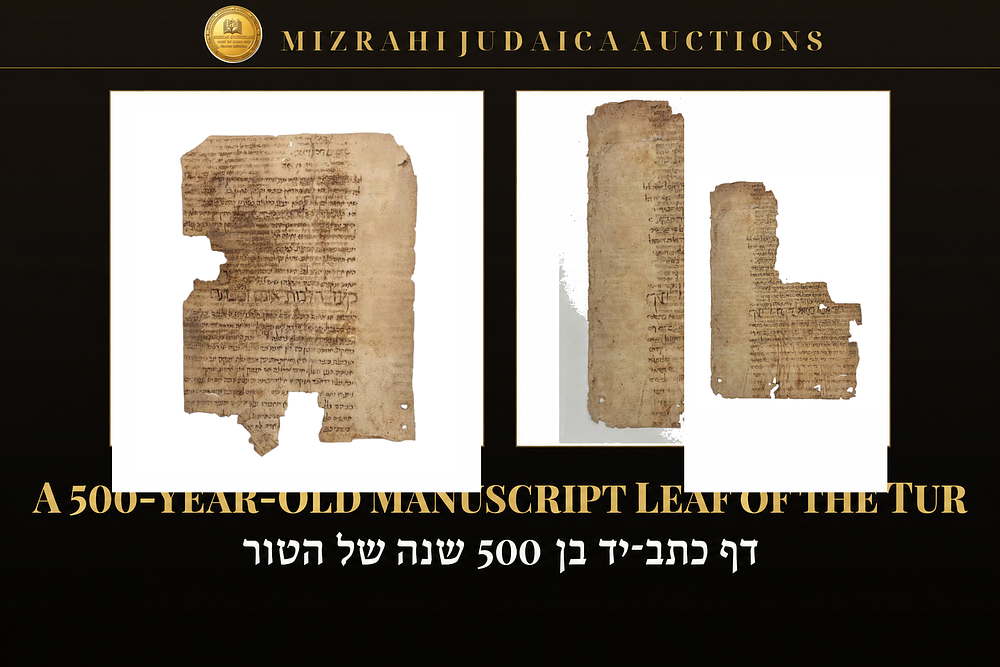
Bidspirit auction | A 500-YEAR-OLD MANUSCRIPT LEAF OF
A 500-YEAR-OLD MANUSCRIPT LEAF OF THE TUR. Even HaEzer 176–177. Sephardic Iberian hand, probably Provence, 15th century - Textual description for this lot was researched and written by noted scholar, editor and author Ovadya Hofman Paleography, dating and expanded description by Louis Chaim Meiselman , the Judaica Special Collections Cataloging Librarian at the University of Pennsylvania Libraries A rare early manuscript leaf from one of the foundational works of practical halachah, preserving Even HaEzer 176–177 in a handsome, professional Iberian hand. Written approximately five centuries ago, before the Tur became the familiar printed sefer found on every rabbinic bookshelf, this leaf once formed part of a substantial manuscript codex copied for serious study and use. Few halachic works have had a greater afterlife. R. Yaakov ben Asher organized the vast body of practical halachah into the four Turim, creating a structure so successful that it remains immediately recognizable today: Orah Hayyim, Yoreh De'ah, Even HaEzer and Hoshen Mishpat. The Beit Yosef was subsequently written around it, and the Shulhan Arukh retained its fourfold division. The familiar architecture of practical halachah thus still bears the imprint of the Tur. What is remarkable is how quickly this happened. The Tur was not a work that waited centuries to be discovered. Within decades of its composition, handwritten copies were already being carried from Spain to Portugal, Provence, Byzantium and Jerusalem. By the fifteenth century it had become one of the great successes of medieval rabbinic literature. The celebrated Torah scholar and chronicler R. Avraham Zacuto, writing around the time of the Spanish Expulsion, summed up R. Yaakov ben Asher's extraordinary success in a few words: “וזכה זה החכם יותר מכולם שהכל למדו מספריו”, “this sage succeeded more than all of them, for everyone learned from his books.” The present leaf belongs to that early world of the Tur. It was written in an accomplished Sephardic-Provençal hand, probably in Provence, at a time when owning a Tur meant owning a manuscript painstakingly copied by hand. Early dated witnesses demonstrate just how far the work had already traveled: an Even HaEzer was copied in Portugal in 1390 and another in Byzantium in 1400. The survival of a single leaf from another such early codex offers something increasingly difficult to encounter outside institutional collections: an original manuscript page from the formative centuries of one of the basic texts of Jewish law. Its survival is almost accidental. The manuscript was eventually dismantled and its leaves consigned to the binder's workshop as scrap. This leaf was recovered from the same remarkable cache of binding material that preserved medieval Hebrew manuscripts and early printed leaves. One manuscript leaf; paper, written on recto and verso, preserving portions of Even HaEzer 176–177. Early Sephardic hand, 15th century. From a professionally executed manuscript codex. Recovered from binding material, some text lost. Wear, adhesive staining and losses consistent with its secondary use. References: Zacuto, Yuhasin (London & Edinburgh, 1857) 224; Galinsky, And this sage merited (Heb.) Sidra 19 25–45.