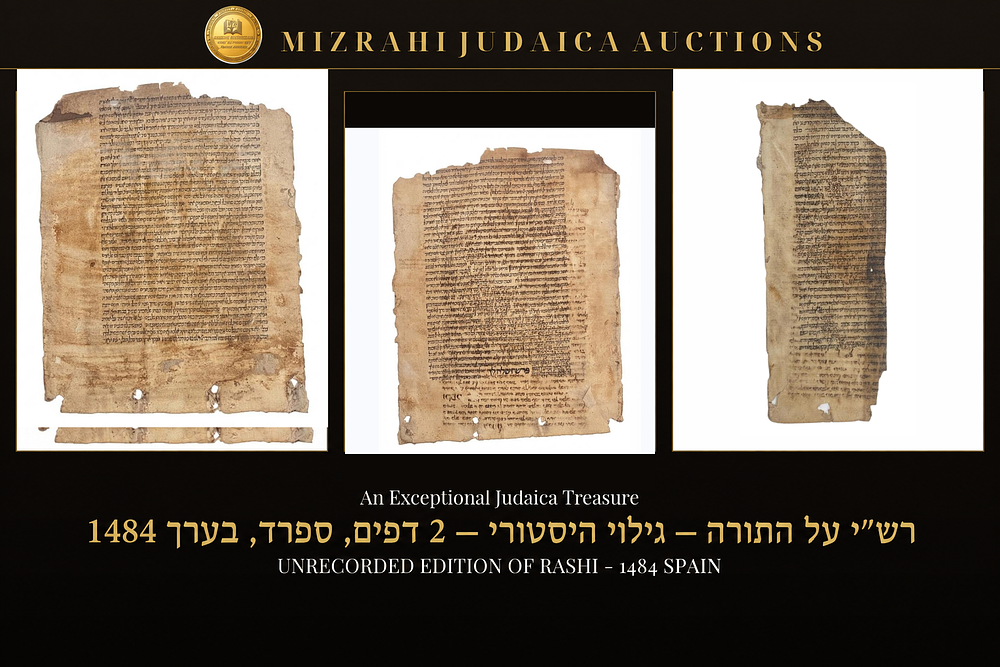
Bidspirit auction | UNKNOWN INCUNABULA of RASHI’S Commentary
UNKNOWN INCUNABULA of RASHI’S Commentary on the Torah — a historical discovery—2 pages, Spain, 1484 approximately. - Two leaves from an unidentified fifteenth-century Spanish edition of Rashi’s Commentary on the Torah — Parashiyot Beha’alotecha and Shelah Spain, circa 1484. Hebrew incunabulum. An exceptionally rare survival from the earliest era of Hebrew printing: two original leaves from an unidentified Spanish incunabulum of Rashi’s celebrated Commentary on the Torah, preserving passages from Parashat Beha’alotcha and Parashat Shelah in the Book of Numbers. The fragments derive from a remarkable and previously unidentified printing of Rashi’s Torah commentary, produced in Spain during the formative decades of Hebrew typography. The edition is of particular bibliographical significance for its distinctive Sephardic Hebrew type and for textual and typographical characteristics that distinguish it from the better-known fifteenth-century printings of Rashi. The importance of these leaves is considerably enhanced by the research of Prof. Jordan S. Penkower, one of the leading authorities on the textual history of Rashi’s biblical commentary. Penkower conducted a detailed study of the surviving leaves, comparing their text and printing characteristics with other known fifteenth-century editions of Rashi and with an extensive corpus of manuscript witnesses. His research was published in his study, Rashi’s Pentateuch Commentary: Ten Folios of a Newly Discovered Spanish Incunabulum In: ”Habent sua fata fragmenta” Author: Jordan S. Penkower Type: Chapter Pages: 227–241 Penkower’s investigation established the significance of these leaves as witnesses to an additional, previously unknown printing of Rashi’s Commentary on the Torah. The printing has been attributed to Spain and approximately 1484, placing it squarely within the extraordinary first generation of Hebrew printing. The physical and typographical characteristics of the edition provide a fascinating glimpse into the development of Hebrew typography in the Iberian Peninsula. The printing exhibits distinctive Sephardic letterforms and typographical conventions, including unusual forms of individual letters, characteristic combinations, abbreviations, and other features of early Hebrew typesetting. Such details are of considerable importance in identifying and dating otherwise anonymous Hebrew incunabula. Equally significant is the textual importance of the fragments. The fifteenth century represents a crucial period in the transmission of Rashi’s commentary, before the printed text had become fully standardized. Penkower compared the newly identified printing with the other known Hebrew incunabula containing Rashi, as well as with numerous handwritten manuscripts from Ashkenazi, Italian, Spanish, and Eastern Jewish communities. The present leaves consequently preserve evidence for the history and transmission of one of the most influential biblical commentaries in Jewish literature. The rarity of the material is further underscored by the survival rate of Hebrew incunabula generally. Early Hebrew books were printed in comparatively small numbers, and many surviving copies were subsequently dispersed, dismantled, or reused as binding material. Individual leaves from an otherwise unidentified fifteenth-century edition are therefore of exceptional bibliographical interest. Rashi, Rabbi Shlomo Yitzhaki (1040–1105), is the preeminent medieval Jewish commentator on the Torah. His commentary became fundamental to Jewish biblical study and was among the earliest and most important Jewish works to enter the world of Hebrew printing. The appearance of Rashi's commentary among the earliest Hebrew printed books is a testament to its unparalleled authority and popularity. The present two leaves are consequently important on several distinct levels: as examples of the earliest Hebrew printing; as evidence of the Sephardic printing tradition of fifteenth-century Spain; as textual witnesses to the transmission of Rashi’s Torah commentary; and, most significantly, as surviving fragments from a previously unidentified edition whose existence was brought to scholarly attention through the research of Prof. Jordan S. Penkower. Penkower’s research was based on 10 partial leaves, all of which survived with only the top portion of each page intact. These 10 leaves appeared at Moreshet Auction 7, Oct 28, 2015, lot 98. The present 2 leaves offered here were not present in the aforementioned lot and fill in exactly the gap in the pages that were discussed by Penkower, leaving us with the very likely possibility that these 2 leaves were from the same original copy. Of additional interest is that these leaves conclusively show that there are 35 lines per page and not 36 lines as surmised by Penkower in his article.