Bidspirit auction | INCUNABULA. GUADALAJARA TALMUD. 10 PREVIOUSLY
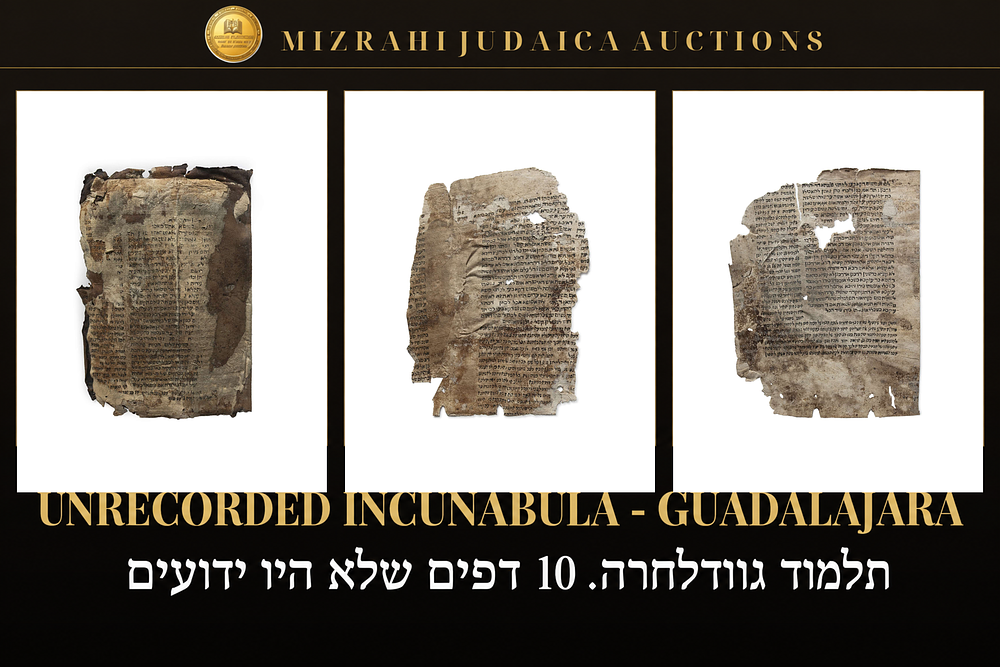
INCUNABULA. GUADALAJARA TALMUD. 10 PREVIOUSLY UNKNOWN LEAVES OF TRACTATE KETUVOT. - Guadalajara, Solomon ben Moses ha-Levi Alkabetz, after 1482. Incunable. description for this lot was researched and written by noted scholar, editor and author Ovadya Hofman and expanded description by Louis Chaim Meiselman , the Judaica Special Collections Cataloging Librarian at the University of Pennsylvania Libraries Before us is the most comprehensive collection of folios of the Guadalajara Talmud ever to come to auction, and one of the largest extant collections of it anywhere in the world. From the very dawn of the printed Talmud. Decades before the Bomberg edition established the familiar form of the printed Shas, the pioneering Hebrew press at Guadalajara produced a series of individual Talmudic tractates, among them Ketubot, accompanied by Rashi. The Guadalajara tractates rank among the earliest printed editions of the Talmud and today survive in extraordinary scarcity. Complete copies disappeared, and much of what is known of these Spanish editions has been reconstructed from scattered leaves and fragments. Their importance extends well beyond their rarity. The early Spanish editions preserve textual readings in both the Gemara and Rashi that differ from the later standard text , leading scholars to collect and reproduce the surviving fragments as important witnesses to the textual history of the Talmud. The present group is particularly substantial: five substantially complete leaves and two trimmed leaves, together with approximately twenty additional fragments, all from Tractate Ketubot, spanning from the end of the first chapter (15a) through 58b, with the bulk of the surviving material deriving from the second chapter. Most of the substantial leaves retain Rashi alongside the Gemara. The manner of their survival is itself part of the history of the Guadalajara Talmud. Like other recorded remnants of these exceedingly rare Spanish tractates, this copy was cut apart and recycled as binding material, in this case for a later printed edition of the Rif, from whose binding the pieces were subsequently recovered. One remarkable leaf preserves its Talmudic text on one side while the other literally became part of the outer cover of the later volume to which it was pasted. The same process that destroyed the original copy thus inadvertently preserved pieces of it for centuries: a cache of early printed Talmud rescued from the binding in which it had disappeared. Physical Description: Five substantially complete leaves and two trimmed leaves, together with approximately twenty additional fragments of varying dimensions, from substantial portions of leaves and long strips to small fragments. Corresponds to printed editions of Ketubot:16a, 21a-b, 22a-23b, 24a-b, 25a-b, 26b, 27a, 28a-b, 43a, 58a-b. Most printed on both sides; on others only one side is presently legible or exposed. Most of the substantial leaves preserve Rashi alongside the Gemara. Varying effects of their reuse as binding material, including trimming, losses, abrasion, adhesive staining and surface wear. References: Dimitrovsky, Sridei Bavli (1979), I, pp. 9, 13, 41–43, and II, Ketubot facsimiles; Heller, Printing the Talmud (1992), p. 28; Goff Heb-112; Offenberg 128, Adler, E.N., Talmud Incunables of Spain and Portugal, ” published in the Jewish Studies in Memory of George A. Kohut (1935), Bloch, J. (1938). Early Hebrew printing in Spain and Portugal. The New York Public Library, Tishby, Isaiah (Yisrael). ”Hebrew Incunabula in Israel Libraries: Additions and Corrections” (Incunabula Ivrit be-Sifriyot Yisrael: Hosafot ve-Tikunim). Kiryat Sefer (KS), vol. 59, 1984, pp. 946–58, Zafren, Herbert C. ”Bible Editions, Hebrew Printing, and Bibliographical Studies.” Studies in Bibliography and Booklore, vol. 12, 1979, p. 45. Opening bid: $25,000