Bidspirit auction | MEDIEVAL MANUSCRIPT LEAVES. RAMBAM. MISHNEH
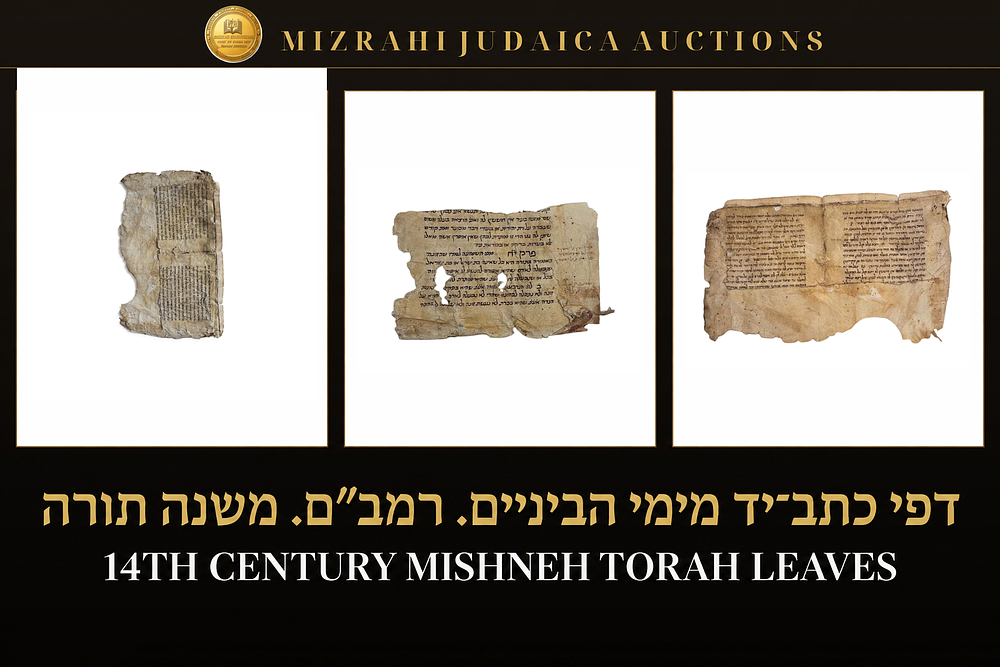
MEDIEVAL MANUSCRIPT LEAVES. RAMBAM. MISHNEH TORAH, HILKHOT ISSURE BIAH; ca. 14th CENTURY MANUSCRIPT. ORIENTAL SQUARE SCRIPT. 3 LEAVES. - Textual description for this lot was researched and written by noted scholar, editor and author Ovadya Hofman Paleography, dating and expanded description by Louis Chaim Meiselman , the Judaica Special Collections Cataloging Librarian at the University of Pennsylvania Libraries Fragments from a fourteenth-century manuscript of Maimonides’ Mishneh Torah, preserving portions of Hilkhot Issurei Biah, with early marginal references to the Talmud. An ancient textual witness to Rambam’s monumental code, preserving variant readings apparently unrecorded in the modern critical edition. Few works transformed Jewish law as profoundly as Rambam’s Mishneh Torah. Conceived as an unprecedented codification of the entire halakhic tradition, its authority also made the precise transmission of its text unusually consequential. Long before the work reached the printing press, generations of scribes copied, corrected and studied the Mishneh Torah, producing a complex manuscript tradition whose early witnesses remain essential for establishing Rambam’s text. The present fragments survive from a single medieval manuscript of Hilkhot Issurei Biah, containing portions of chapters 17, 18 and 21. Comparison with R. Yitzhak Shilat’s critical edition is particularly noteworthy: no corresponding manuscript witness appears to be represented among the manuscripts recorded there, while these fragments preserve a number of textual variants apparently absent from his apparatus. These include differences in the sequence of individual halakhot, offering a small but tangible witness to a textual tradition of Rambam apparently otherwise unrecorded. A close comparison may be made with NLI Ms. Heb. 4°1372, another fourteenth-century manuscript of Mishneh Torah containing Hilkhot Issurei Biah, catalogued as possibly Oriental. The resemblance extends beyond the general character of the script to the arrangement of the text and lines, the treatment of chapter headings and, strikingly, the presence of marginal annotations. The margins of the present fragments likewise contain references, principally identifying Talmudic sources for Rambam’s rulings, written in a somewhat later but apparently still early hand. Like thousands of medieval Hebrew manuscript leaves rediscovered in European bookbindings, these fragments survived only after the codex to which they belonged had been dismantled and its leaves recycled as binding material. Such discoveries have recovered portions of an otherwise vanished medieval Jewish library, in some instances preserving textual witnesses and even works unknown from any other source. The present leaves belong to precisely this history of textual loss and accidental preservation: remnants of a medieval copy of Rambam, discarded for reuse, yet preserving readings apparently overlooked by the surviving manuscript record. Contents: Hilkhot Issurei Biah 17:9–12; end of chapter 17 through 18:2; 21:16–19. The division and sequence of individual halakhot occasionally differ from the standard printed editions. Physical Description: 3 fragment leaves from a single manuscript codex, apparently fourteenth century, probably Oriental. Hebrew manuscript on paper. Text in a medieval hand, with enlarged chapter headings and marginal source references in a somewhat later hand. Reconstruction of the fragments and the original mise-en-page indicates that each page originally contained 25 lines. The leaves were reused as binding material and consequently exhibit substantial wear, staining, losses and other evidence of their secondary use. Visible in its current state is the original horizontal chain lines in the paper, well-survived, as well as a contemporary marginal hand in a Sephardic square script (of cross-referencing)