Bidspirit auction | GALEN AND HUNAYN IBN ISHAQ
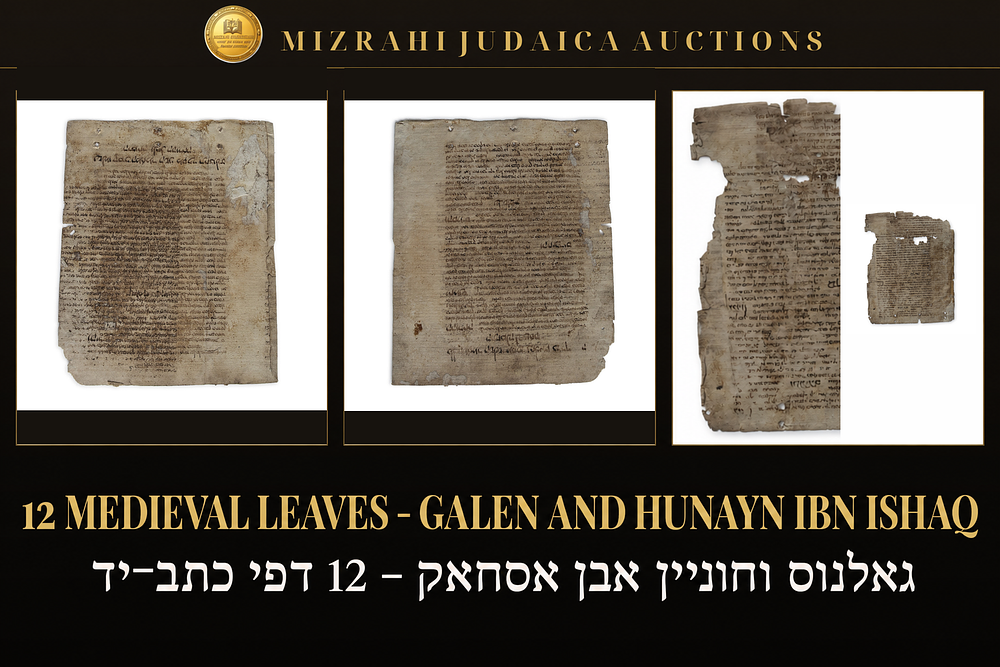
GALEN AND HUNAYN IBN ISHAQ - MEDIEVAL HEBREW MEDICAL 12 MANUSCRIPT LEAVES. Iberian semicursive script, 13th-14th century - Textual description for this lot was researched and written by noted scholar, editor and author Rabbi Ovadya Hofman Paleography, dating and expanded description by Dr Louis Chaim Meiselman , the Judaica Special Collections Cataloging Librarian at the University of Pennsylvania Libraries Iberian semicursive script, 13th-14th century. Contains captions in an Iberian square script A group of parchment leaves and fragments from a medieval Hebrew medical manuscript containing Galenic texts and summaries, including material attributed in the manuscript to the translation of Ḥunayn ibn Isḥāq, the great ninth-century translator of Greek medicine into Arabic. Hebrew manuscript in brown ink, in a distinctive semi-cursive hand, with unusually large and vigorous headings and catchwords. Heavily worn, stained and abraded from reuse as binding material. One section ends with the words נשלם המאמר השני..., followed shortly thereafter by the heading: קבוצי גאלינוס בבחראן העתקת חונין (”The Summaries of Galen on Crisis, translation of Ḥunayn.”) Another leaf bears the heading מאמר השלישי מספר גאלינוס בדרך התחבולה לרפואה, identifying material from the third book of the work known in Arabic as Ḥīlat al-Burʾ, Galen's Method of Medicine. Together the fragments preserve part of the Hebrew afterlife of the Galenic medical curriculum which passed from Greek into Arabic and, in the Middle Ages, from Arabic into Hebrew. One passage is particularly intriguing. It opens: מיני הבחראן ששה ”The kinds of crisis are six, ” and proceeds to describe six possible forms of medical crisis, beginning with a sudden change toward health, followed by a sudden change toward death, slower changes toward either outcome, and finally two compound forms. The wording is important. A modern edition of the Alexandrian summaries of Galen's On Critical Days has shown that two substantially different recensions of this material survive. The known medieval Hebrew version does not begin with this sixfold arrangement. The Arabic recension does. Its opening reads aṣnāf al-buḥrān sitta, ”the kinds of crisis are six, ” and proceeds through the same sequence found on the present leaf. The correspondence is close enough to make the present fragment a significant witness to the Hebrew transmission of this text . It appears to preserve a Hebrew rendering of the recension represented by the Arabic text , rather than simply another copy of the Hebrew recension presently known and published. Whether this represents an otherwise unknown Hebrew translation, or another stage in a more complicated transmission of the Alexandrian summaries, will require a full collation of the surviving leaves. The manuscript itself gives the attribution to Ḥunayn, and it would be premature to say more than the evidence presently allows. The Alexandrian summaries occupied an important place in medieval medical education. They distilled and reorganized the Galenic curriculum inherited from late antiquity, and it was often Galen in this summarized form which reached physicians working in Arabic and Hebrew. Modern study has shown that these summaries could substantially rearrange their source material and occasionally preserve interpretations distinct from Galen's original presentation. The script has strong Iberian characteristics, while the headings and sectional endings can expand into remarkably large, almost flamboyant letterforms. The condition tells part of the story. The medical codex was eventually dismantled and its leaves pressed into service as binding material, leaving folds, stains and areas where the writing has nearly disappeared. What survives is a fragmentary witness to a Hebrew Galenic tradition which, in the passage on crisis at least, appears to differ materially from the Hebrew text previously published. Aprox. 12 leaves, some partial and a few only quarter-sized page fragments, Noticeable traces of adhesion and separation. References : Bos-Langermann, The Alexandrian Summaries of Galen's On Critical Days (2015) pp. 1-10, 33-48; Steinschneider, Die hebräischen Übersetzungen des Mittelalters (1893) pp. 650-656; Emanuel, The European Genizah: Its Character and the History of Its Study (2019) pp. 587-624.