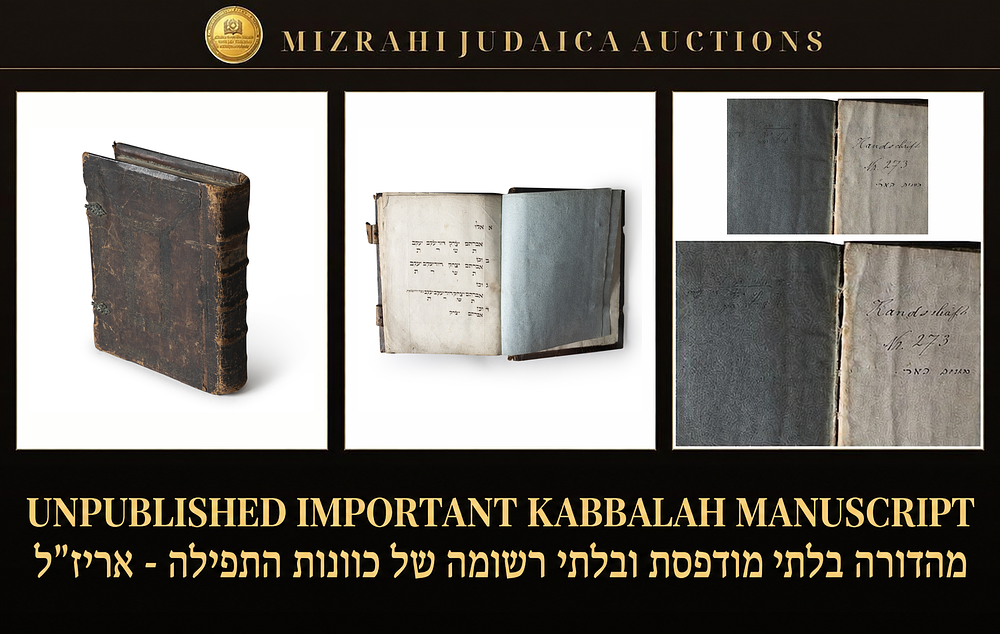
Bidspirit auction | UNRECORDED REVOLUTIONARY KABBALAH MANUSCRIPT. An
UNRECORDED REVOLUTIONARY KABBALAH MANUSCRIPT. An unprinted and unrecorded structural edition of the Lurianic prayer intentions (Kavvanot) for the Sabbath and festivals, written in 1717 by the elite Ashkenazic scribe Abraham ben R. Isaiah of Brody. SECOND HALF OF PRI ETS HAYYIM, EDITED BY R. MEIR POPPERS. - With important additional marginalia by R. Zerach of Pinsk and Rabbi Ovadya Aharon Chayun, author of Machaneh Aharon on the Zohar. Brody, 5477 [1717]. Research and description written with the assistance of Dr. Avinoam J. Stillman, whose doctoral dissertation is an intellectual biography of R. Meir Poppers. 231 paper folios. Octavo. Bound in contemporary leather over heavy boards, with functional metal clasps; marbled and blue endpapers. Structurally intact and in an extraordinary state of preservation. Written in a highly refined, elegant Ashkenazic cursive script, with ornamental Ashkenazic square script used for headings and other principal textual indicators. The exceptionally clean and spacious mise-en-page demonstrates master-level scribal planning. The margins contain numerous corrections, supplements, and hand-drawn manicules (pointing fingers) by Abraham ben R. Isaiah, marking significant passages and textual emendations. A later scholar added notes and longer textual passages in Ashkenazic cursive script. Minor contemporary ink staining and marginal finger-soiling are consistent with prolonged liturgical and scholarly use. The manuscript was completed in 1717, in Brody, then an important rabbinic and kabbalistic center in what is today western Ukraine. Abraham ben R. Isaiah identifies himself in his scribal colophon on f. 229v, which records the completion of his work. The colophon reads: תם ונשלם כל הכוונת שבח לאל בורא תהומות נכתב ע״י פועל העוסק במלאכת הקודש אברהם באל״א הוא אברהם הכה״ר ר׳ ישעי׳ יצ״ו מבראד יצ״ו בשנת ב״ע לפ״ק The principal text is an edition of the Lurianic Kavvanot for Shabbat and the festivals. It is based upon—but is not identical with—the known version of Pri Ets Hayyim edited by R. Meir Poppers. Its organization of “gates” (she'arim) and chapters closely resembles what has been identified as the “second edition” of Pri Ets Hayyim. See Moshe Hillel, “Yediot Hadashot Le-Toldot Rabi Meir Poppers, Hiburav VeKetavav…, ” Min ha-Genazim 14 (2020), pp. 55–56. The manuscript begins with “the first gate, the gate of Shabbat” on f. 9r. In Pri Ets Hayyim, the weekday Kavvanot would precede this material; Abraham ben Isaiah may have copied those sections in another volume. Consistent with the organization of Pri Ets Hayyim, the manuscript regularly identifies both the name of each gate and the number of chapters contained within it—for example, on f. 15r, “the second gate, the gate of Kabbalat Shabbat, which is divided into 13 chapters.” The codex therefore does not simply reproduce a standard printed recension. Rather, it preserves a distinctive and unprinted textual tradition of Poppers’ second, or final, edition. Poppers himself subsequently added explanatory hagahot to this recension, recently republished from manuscripts by Ahavat Shalom. Further research and systematic comparison with surviving manuscripts and Poppers’ autographs may clarify the precise genealogy of the present text. This precise edition has never been printed. The manuscript preserves numerous layers of Lurianic transmission. Like Poppers’ Pri Ets Hayyim, it incorporates extensive notes attributed to R. Jacob Tsemah (e.g. ff. 133v, 152v), as well as at least one note by R. Israel Benjamin (f. 223v), two of Poppers’ principal teachers of Lurianic Kabbalah in Jerusalem. ”Abraham ben Isaiah also copied several marginal notes bearing the name ”Aharon.” These are likely notes by R. Ovadya Aharon Chayun, the eighteenth-century Jerusalem kabbalist and rabbinic leader who sat on the Bet Din of the Pri Chadash and R. Moshe Galante and authored the Machaneh Aharon on the Zohar. In support of this attribution, R. Chayun is also known to have annotated other manuscripts of R. Meir Poppers in Jerusalem. in The codex also contains important later autograph marginalia by R. Zerach of Pinsk (d. ca. 1857–1858), whose autograph handwriting has been expert-verified. His extensive scholarly glosses engage directly with variants and readings in the manuscript, transforming what was already an important early witness into an active record of Eastern European kabbalistic study extending across nearly two centuries. A particularly interesting physical and textual anomaly occurs in the section devoted to the blowing of the shofar. Several folios have been bound incorrectly, and a first, unnumbered folio preserves an incomplete copy by Abraham ben Isaiah of the relevant Kavvanot. Abraham also made numerous corrections and supplements throughout the volume and added manicules to direct attention to important passages (e.g. f. 19r). The final folio copied by Abraham ben Isaiah, f. 230r,