Bidspirit auction | MANUSCRIPT. 18TH CENTURY. KARAITE. AFENDOPOLO,
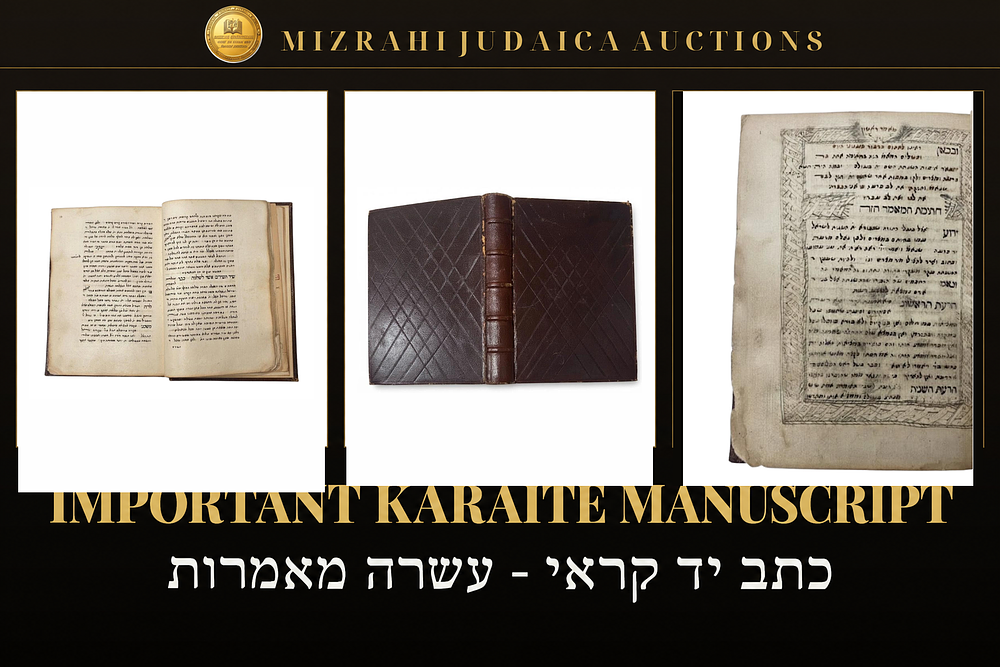
MANUSCRIPT. 18TH CENTURY. KARAITE. AFENDOPOLO, Caleb ben Elijah (1464?–1525). Asarah Ma'amarot [Ten Essays or Sermons]. [Ottoman Empire], 18th century. - An important late eighteenth-century manuscript copy of the foundational Karaite theological work Asarah Ma'amarot (”Ten Essays”), offering critical insight into early Karaite-Rabbanite polemics and an extraordinary, highly unusual early modern Jewish perspective on early Christianity. Caleb ben Elijah Afendopolo was one of the most prominent Hakhamim (scholars) of the Byzantine-Ottoman Karaite golden age, serving congregations in Constantinople and Adrianople. A polymath trained in both traditional scripture and secular sciences (including astronomy, mathematics, and philosophy), Afendopolo designed Asarah Ma'amarot as a series of ten sophisticated homiletic discourses. The text centers heavily around the Passover lesson (Exodus 12:14), navigating the complex laws of custom, the seven Sabbaths between Passover and Shavuot, and the Sinaitic revelation. Historically, the manuscript is highly significant for its extensive introductory material— frequently excerpted by later Karaite apologists such as Mordecai ben Nissim in his Dod Mordecai —which outlines the definitive theological schism between the Karaites (who adhere strictly to the written Torah given to Moses) and the Rabbanites (who maintain the validity of the Oral Law and Kabbalah). Most remarkably, the text contains a surprisingly empathetic commentary on the founder of Christianity. While Afendopolo textually misplaces the chronology by a century, he boldly celebrates his character, writing that he was ”according to the opinion of the lovers of truth, a wise man, pious, righteous, God-fearing, and shunning evil, ” arguing that the theological divergence of Christianity only arose when later disciples strayed from his original devotion to halakhah. Prefixed by three preliminary leaves written in a later hand in French and Hebrew (”Livre des dix sermons”). This manuscript serves as a monument to late-Enlightenment era Karaite scholarship and Jewish-Christian interreligious dialogue. Quarto (8¼ x 5¾ inches; 205 x 145 mm). [4 leaves of later modern notes], [2 original blank leaves], 173 manuscript leaves, written on recto and verso. Approximately 24 lines per page, with catch-words, wide margins. Stamped on high-quality, thick watermarked paper. Text rendered in an elegant, highly legible Rabbinic semi-cursive hand without vowel marks. Title page features an elaborate decorative surround finely executed in pen. Binding: Early twentieth-century full brown morocco, covers blindly stamped with an attractive cross-hatch design. Spines and edges with minor rubbing and mild shelf wear, but remaining tight and square. Condition: Very good overall. Occasional contemporary ink marginalia in Hebrew, alongside subsequent analytical pencil notes in French. Minor expected light soiling and finger-smudging to margins; intermittent minor professional repairs. The colophon leaf features historical marginal reinforcement repairing an old paper loss at the top corner, cleanly executed with absolutely no loss to the text. Provenance: The Krown & Spellman Collection. The Krown & Spellman Collection contained the private inventory and rare book stock amassed by Franklin Victor Spellman and his wife, Elizabeth Krown Spellman. For nearly four decades, the couple operated Krown & Spellman, Booksellers, a legendary antiquarian bookshop originally founded in 1977 and located on Westwood Boulevard in West Los Angeles For a later manuscript of this work, see The Russian State Library, Ms. Or F. 182 no. 166