Bidspirit auction | INCUNABULA. 1485. HIJAR. TURIM. Arba’ah
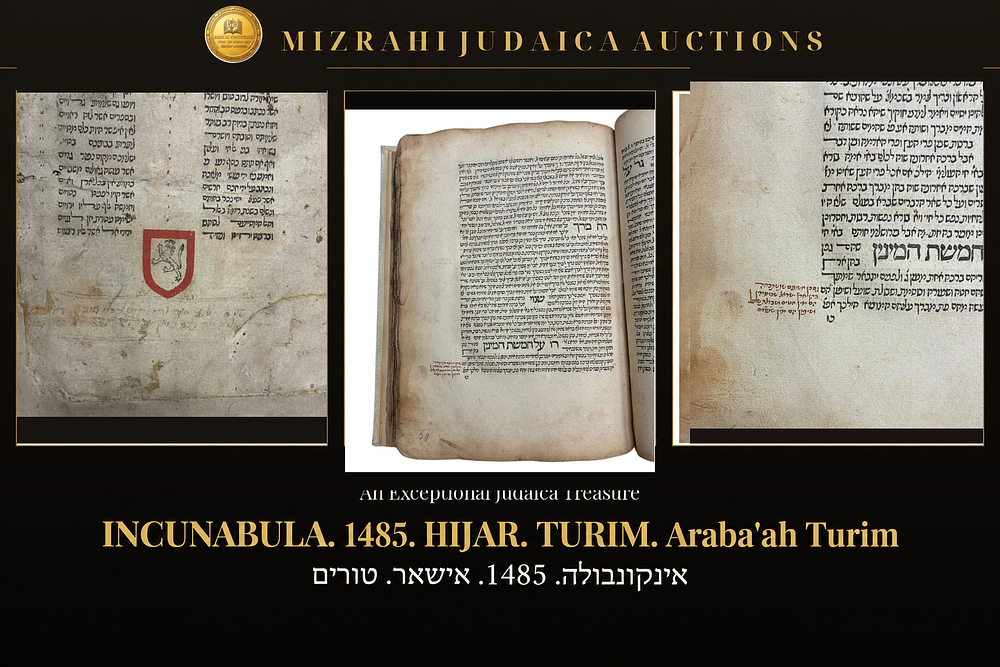
INCUNABULA. 1485. HIJAR. TURIM. Arba’ah Turim, Orach Chaim. Hijar (Ixar), Aragon, Spain: Eliezer Alantansi. 1485 - Spanish Hebrew Incunabula: The First Book Printed in Hijar THE VERY FIRST HEBREW BOOK WITH A PRINTERS’ MARK EXTREMELY RARE. NO COPY, OR FRAGMENT HAS APPEARED FOR SALE IN MANY YEARS The Delmonico Collection Copy An extraordinary, highly significant, and nearly complete copy of the very first book published in the Spanish town of Hijar . Printed in 1485, a mere seven years before the tragic expulsion of Jews from Spain, this volume is one of the ultimate achievements of early Hebrew typography. While most surviving copies of this famed edition exist only as sparse, highly incomplete fragments in global institutions, the present lot is remarkably complete, containing 165 original leaves (lacking only the first and eighth leaves of the index (the maftechot) and the two original blanks). All the text of the body of the work is complete and intact. It offers an unprecedented look into the golden age of Iberian printing before its abrupt destruction by the Inquisition. This specific edition is celebrated in the annals of bibliography for introducing a major milestone in the history of publishing: The First Hebrew Printers' Mark: This Tur marks the historic first appearance of a Hebrew printers' mark in any printed book . The iconic emblem features a magnificent lion rampant within a red shield (A. Yaari, Hebrew Printers' Marks, no. 1). The Master Type-Cutter: The funding for the press was provided by the wealthy Rabbinical scholar Solomon b. Maimon Zalmati. His capital allowed the printer, Eliezer Alantansi, to commission the legendary Christian master engraver Alfonso Fernández de Córdoba to cut the Hebrew letters. The Smallest 15th-Century Cursive: Córdoba's extraordinary skill resulted in a stunning combination of elegant square characters and an incredibly tiny, razor-sharp Sephardic cursive typeface—distinguished as the smallest typeface of its kind cut in the fifteenth century . Because Córdoba cut these typefaces for a Jewish press, he provoked the immediate ire of the Spanish Inquisition, was forced to flee the region, and was subsequently sentenced to death in absentia. The printer, Dr. Eliezer Alantansi , was a fascinating Renaissance figure: a fine scholar, an astute businessman, and a practicing physician. He worked in close scholarly and financial association with the towering statesman, philosopher, and financier Don Isaac Abrabanel (see She'eiloth R. Shaul Ha-Cohen, Venice, 1574, p. 1b). As noted by historian J. Bloch, this publication met the desperate, practical, everyday halakhic needs of Spanish Jewry during a time of immense political instability, quickly becoming the indispensable daily manual for Jewish life and practice in the Iberian Peninsula. Most known copies of this incunabula are heavily deficient. For context, the famous copy from the Elkan Nathan Adler-Wineman Family Collection, the last copy offered for sale publicly (in 2004), contained only 124 leaves (lacking 44). The copy held at the National Library of Israel (JNUL) consists only of incomplete fragments. The completeness of this 165-leaf copy places it among the finest and most intact specimens in private hands anywhere in the world. Total Count: 165 leaves present (out of 167 original leaves and the blanks). Lacking Only: Two pages of the index / maftechot (first page of text and folio 9) and the original blank leaves (folios 1, 108 and 170). Size: Chancery folio (12 x 8 5/8 in.; 304 x 220 mm). Bibliographic References: Mehlman, Ginzei Yisrael 5; Goff 51; Goldstein 86; Offenberg 65; Steinschneider p. 1186, no. 5500.21; Thes. B8; Wineman Cat. 53. Iakerson 93; BMC XIII 86 (C.50.d.4). Spanish incunabula are the ”holy grail” of Hebraica collecting. Because nearly the entire infrastructure of Spanish Jewish printing was burned, hidden, or carried away in fragments during the Expulsion of 1492, finding an almost completely intact Tur from Hijar is a once-in-a-generation event. Condition: Wide-margined copy. Minor holes on first 11 leaves, else clean. Several old Sephardic Marganalia. Margins size: top: 1.25-1.65”. Fore-edge: 2.25”. Lower margins: 2.25-2.75”. Total book height: 12”. collation: [1–1710]: 165 (of 170 leaves); lacking the three blank leaves 1, 108 (11/8) and 170, and fols. 2 and 9 (within index / maftechot), the sheets signed sequentially, 1–84, starting with the second sheet, first eight and final ten leaves remargined, marginal stains on most leaves and a few tears, some roughly repaired, but a very tall copy (British Library: 294 x 213 mm), with strong paper. Modern cream leatherette binding. Provenance : Property from the Delmonico Collection / Lot 43. Sothebys. 17 December 2008 • New York