Bidspirit auction | INCUNABULA.1489. 40 FRAGMENT LEAVES FROM
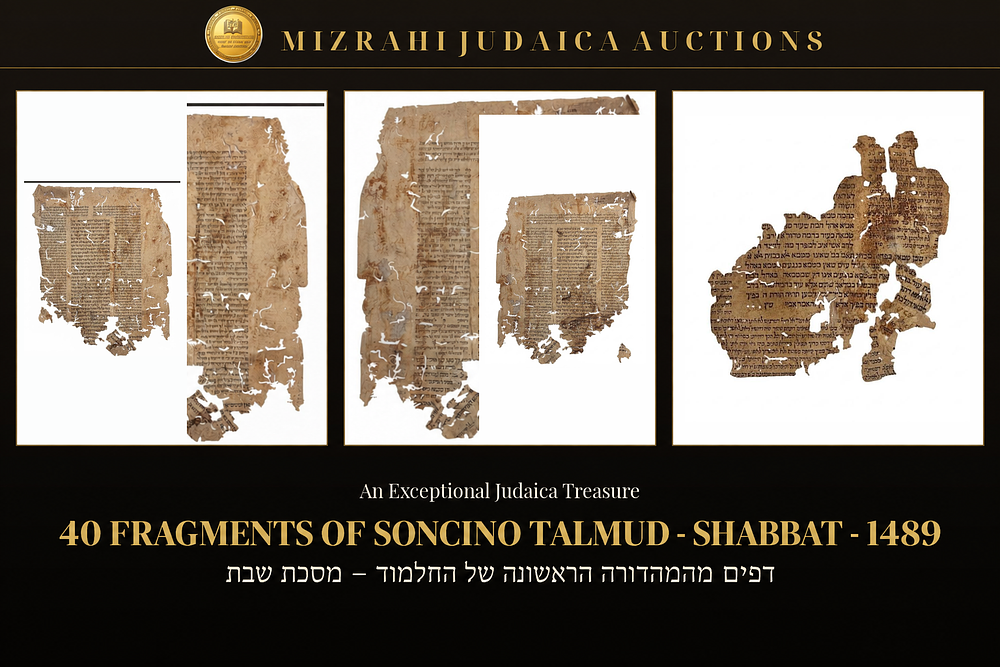
INCUNABULA.1489. 40 FRAGMENT LEAVES FROM FIRST TALMUD SHABBAT. Fragments of Tractate Shabbat (Babylonian Talmud) – Printed by Gershom Soncino, circa 1489 - An incredibly rare, collection of approximately 40 original leaf fragments of Tractate Shabbat from the Babylonian Talmud. This historical treasure was printed in Soncino, Italy, by the legendary master printer Gershom Soncino circa 1489. Coming from the first-ever printed edition of the Babylonian Talmud, these incunabula fragments represent a monumental milestone in Jewish history and the evolution of the printed word. Leaves from the first Talmud edition printed by the Soncino family are among the most elusive and sought-after treasures in the world of antique Hebraica. Their extreme scarcity on the market today is driven by four primary historical factors: Clandestine Printing & Incomplete Runs: Printing was conducted under a shroud of secrecy due to intense fear of Christian censorship and persecution. This caution followed the devastating 13th-century Papal decrees (in 1239 and 1264) that ordered the systematic burning of the Talmud. Because of these treacherous conditions, the Soncino family was never able to complete the printing of the entire Talmud (see: R. N.N. Rabinowitz, Maamar al Hadpasat HaTalmud, pp. 8–9). The Iberian Expulsions (1492–1497): A significant portion of the printed stock was sold to Jewish communities in Spain and Portugal. Tragically, the vast majority of these copies were lost, confiscated, or destroyed during the expulsions and forced conversions that ravaged the Iberian Peninsula just a few years later. The Counter-Reformation Burnings in Italy (1553–1554): The surviving copies that remained in Italy faced a second wave of destruction in the mid-16th century, when Papal authorities initiated widespread, public burnings of the Talmud across Italian cities (see: R. N.N. Rabinowitz, ibid., p. 15). Attrition From Constant Study: Because the Soncino press produced the only printed edition of the Talmud available for several decades, the volumes were subjected to relentless, daily use by scholars and students, causing the vast majority of copies to literally wear out over time. While minor fragments of this 1489 tractate are preserved across a few global institutions, this specific lot contains an unparalleled academic treasure. To the absolute best of our bibliographic knowledge, the fragment in this lot parallel to Folio (Daf) 4 (Chapter I, equivalent to folio 4a-b) is the only surviving copy of this page in existence and is entirely unrecorded elsewhere globally The fragments in this lot have been salvaged from a historic ”bindings genizah”—where early printed leaves were recycled by bookbinders to stiffen the covers of later volumes. The collection offers a wide textual spread across Tractate Shabbat, including Chapter I: (The uniquely surviving fragment corresponding to folio 4a-b). Chapters V & VI: A structural fragment showcasing the transition and end of Chapter V into the beginning of Chapter VI. Chapters III, IV, and VII: Multiple text segments. Chapters XV, XVI, XVII, XVIII, and XIX: A substantial cluster of consecutive structural fragments. Gershom Soncino (The Soncino Family Press). Soncino, Italy, [ca. 1489]. Approximately 40 loose, salvaged leaf fragments of varying sizes. Approx. forty fragments (including more than ten large fragments, almost the size of the original leaf, or most of it). Size varies. Various degrees of damage due to use in binding.