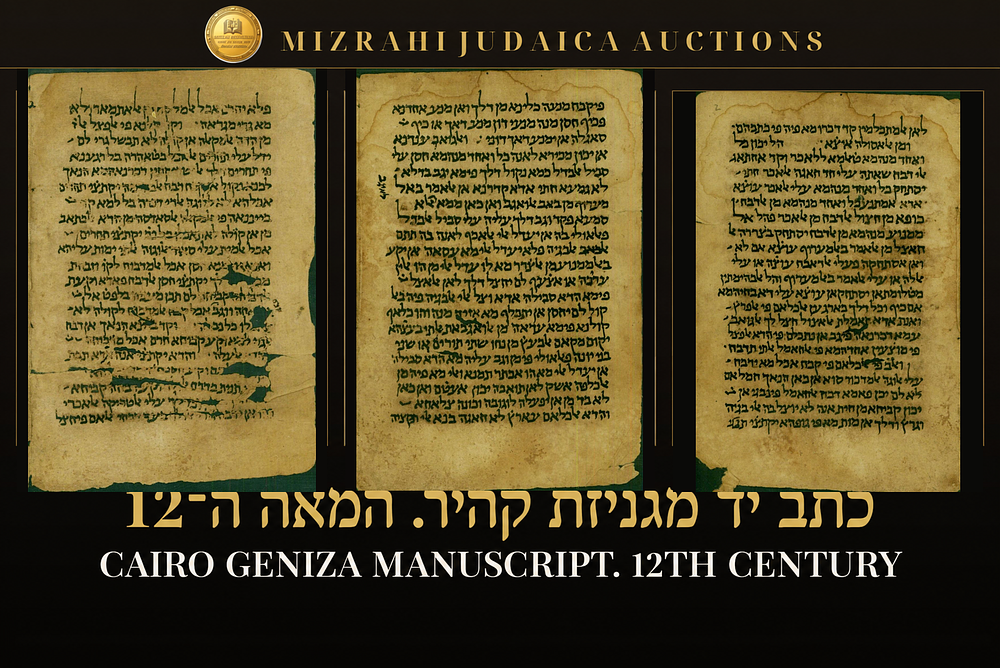
Bidspirit auction | CAIRO GENIZA MANUSCRIPT. 12TH CENTURY.
CAIRO GENIZA MANUSCRIPT. 12TH CENTURY. 12 PAGES. A Foundational Karaite Polemic by Yusuf al-Basir (Kitab al-Istibsar) - An extraordinary discovery from the Cairo Genizah . This lot comprises six original leaves (12 pages) of an early 11th-century Karaite theological manuscript written in an elegant, ancient Judeo-Arabic script. The text is identified as a critical section from Kitab al-Istibsar (The Book of Discernment), the magnum opus of Yusuf al-Basir (Yosef ben Avraham al-Basir) , one of the paramount philosophical leaders and legal authorities of the Golden Age of Karaism. The opening page of this fragment begins with the Judeo-Arabic phrase “atkal min amalah” (اتكل من عمله / trust in his work). This exact passage aligns seamlessly with the famous St. Petersburg Manuscript housed in the First Firkovich Collection (Shelfmark: 513 Yevr-Arab I, page 17a, line 7 onwards) . Within these six leaves, Yusuf al-Basir engages in a direct, rigorous philosophical and halakhic debate targeting the text of Kitab al-Anwar wal-Maraqib (The Book of Lights and Watchtowers), written by his illustrious 10th-century predecessor, Ya'qub al-Qirqisani . Accompanied by a formal, expert authentication certificate issued on October 1, 2021, by the renowned Genizah researcher and manuscript editor, Yehuda Zeivald (Bnei Brak, Israel). The identification of this manuscript has been endorsed by Dr. David Sklare of the Hebrew University of Jerusalem. Dr. Sklare is globally recognized as a foremost authority on Karaite manuscripts and the author of the definitive catalogue Judaeo-Arabic Manuscripts in the Firkovitch Collections: The Works of Yusuf al-Basir (Ben-Zvi Institute, 1997). Composition Date of Text: Circa 1036–1037 CE. Scribal Date & Typography: Circa 12th century; penned in a distinct, highly professional Eastern Hebrew square script common to Karaite scribes of the era. Quantity: 6 loose leaves (12 pages), formed by 3 Bifolium, each bifolium being a single sheet of paper folded in half to create two leaves / four pages. Provenance: T his specific manuscript was formerly part of the prestigious private Hava Solomon Collection in Jerusalem, before which its pedigree traces directly back to the historic repositories of the Cairo Genizah .