Bidspirit auction | AMSTERDAM 1762. THE FIRST SPANISH-HEBREW
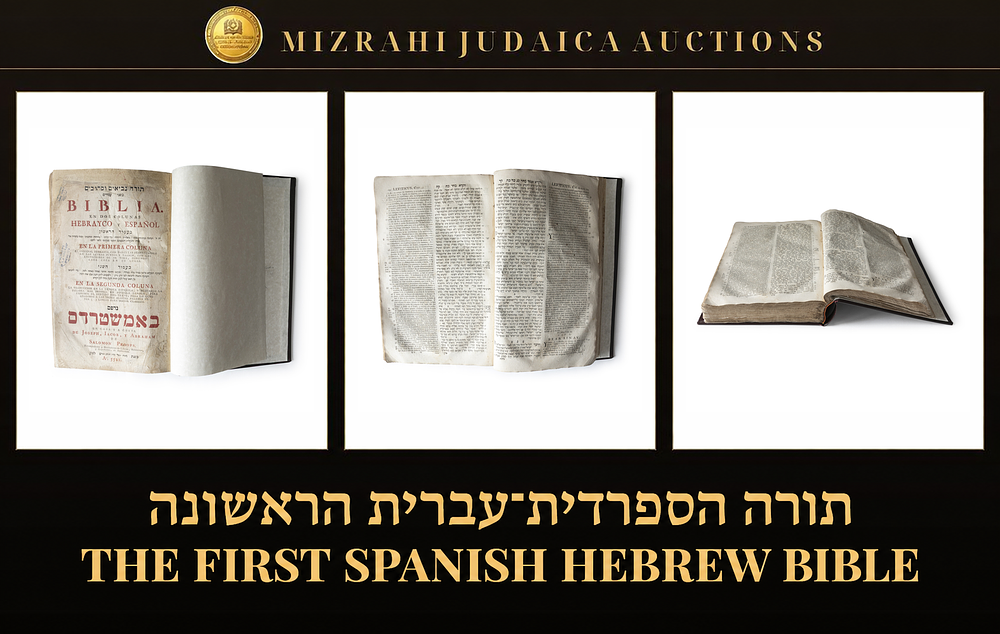
AMSTERDAM 1762. THE FIRST SPANISH-HEBREW TANACH. Amsterdam: Joseph, Jacob, and Abraham Proops, 5522 [1762]. Folio - An exceptional landmark of Jewish printing in the Americas and the first Bible to present the Hebrew and Spanish texts in parallel columns. This handsome Amsterdam folio occupies a singular place in the history of Hebrew printing and Sephardic Jewish culture. Printed in 5522 [1762] by the brothers Joseph, Jacob, and Abraham Proops, sons of the distinguished Amsterdam printer Salomon Proops, it is apparently the first edition of the Bible in which the original Hebrew text and its Spanish translation are presented together , in facing parallel columns within a single volume. Spanish translations of the Bible had a venerable history among Sephardic Jews, most famously represented by the celebrated Ferrara Bible of 1553. The present edition, however, represents a significant further development: rather than presenting the Spanish Scriptures independently, it places the vernacular translation directly alongside the Hebrew, allowing the reader to pass readily between the sacred Hebrew text and the Spanish language that remained central to the religious and cultural life of many Sephardic communities. The conception and financing of this ambitious undertaking are themselves of extraordinary interest. In their introduction, the Proops brothers credit Abraham Mendes de Castro, a prominent member of the Jewish community of Curaçao in the Dutch West Indies, with proposing and financing the project . Castro had observed a practical deficiency in the Jewish community of the Caribbean: the young students engaged in Torah study lacked sufficient copies of the Pentateuch in both Hebrew and Spanish. In 1760 he therefore transmitted funds across the Atlantic to the Proops press to commission the bilingual edition. Castro's initiative was motivated by more than pedagogical necessity. His support reflects the remarkable intellectual and religious connections maintained between the Jewish communities of the Caribbean and the great centers of Hebrew scholarship and printing in Europe. Deeply devoted to Eretz Yisrael, Castro further stipulated that the profits from the edition be directed to the Jewish communities of Jerusalem and Hebron. The volume thus embodies a remarkable chain of Jewish communal solidarity extending from Curaçao, through Amsterdam, to the holy communities of the Land of Israel. The Proops brothers' own account adds another significant bibliographical dimension. They note that they had recently acquired the type matrices of the celebrated Amsterdam printers Joseph Immanuel Athias and Abraham Athias, thereby connecting the present production with one of the great traditions of Hebrew typography in Amsterdam. The city had long served as a major center for the production and dissemination of Jewish books, and the inheritance of earlier printing materials further situates this Bible within the continuity of Amsterdam's distinguished Hebrew press. The resulting volume was recognized for its physical beauty as well as its historical importance. The bibliographer Cardozo de Bethencourt subsequently characterized it as “ one of the most beautiful of Spanish Bibles , ” an assessment readily appreciated in the presence of a well-preserved copy. Of perhaps even greater significance is its place in the history of Jewish life in the Western Hemisphere. The edition has been described as the first Hebrew book whose publication was financed by, and specifically intended for, Jews of the American hemisphere. Its story therefore extends well beyond the history of biblical translation or Amsterdam typography. It is a tangible testament to the vitality of Jewish learning in the Caribbean, to the mobility and interconnectedness of Sephardic communities, and to the determination of Jewish patrons to strengthen Torah study across geographic boundaries. For the bibliophile, the volume is particularly evocative: the sacred text of Tanakh stands here together with the language of the Sephardic exile; a Caribbean Jewish patron provides the means for its publication; Amsterdam's premier Hebrew printers execute the undertaking; and the proceeds are directed toward the yishuv of Jerusalem and Hebron. Few eighteenth-century Hebrew books so vividly unite Torah, the diaspora, Eretz Yisrael, tzedakah, and the history of the Jewish book. A book of exceptional historical, bibliographical, and religious significance , this 1762 Proops Bible stands as a landmark of Sephardic Jewish printing and as a rare physical witness to the transatlantic network of Torah, commerce, philanthropy, and communal responsibility that linked Jewish communities from the Caribbean to Amsterdam and the Land of Israel. Condition : complete copy, folio, in later cloth covers. Occasional old repairs. Overall, attractive copy. Each part separately titled (title-leaves for 2nd-4th parts not included in the pagination),