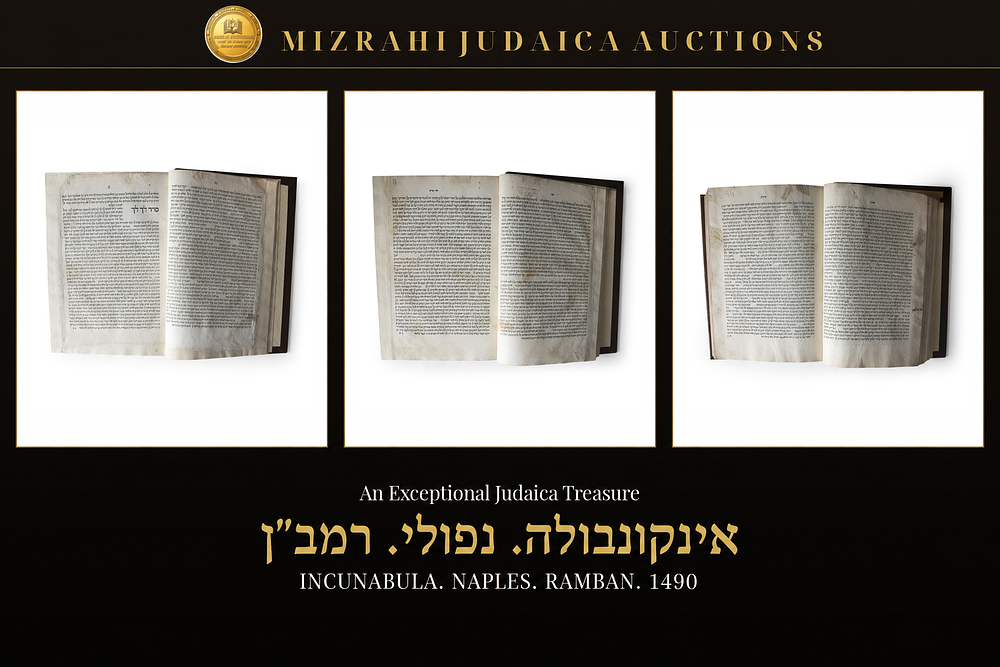
Bidspirit auction | INCUNABULA. NAPLES. RAMBAN. 1490. RAMBAN
INCUNABULA. NAPLES. RAMBAN. 1490. RAMBAN (R. Moshe ben Nachman). Commentary on the Torah. Nachmanides - Naples: Joseph ben Jacob Ashkenazi Gunzenhauser, 13 Tammuz 5250 [July 1, 1490]. Incomplete copy One of the great monuments of Hebrew printing and among the earliest printed witnesses to one of Judaism's most enduring biblical commentaries. Issued scarcely two decades after the advent of Hebrew typography, the Naples Ramban is the third printed edition of the commentary (following Rome and Lisbon), produced at a moment when the text was still emerging from a fluid manuscript tradition into the permanence of print. The lengthy colophon proudly proclaims the exceptional care devoted to the edition, noting that it was corrected against manuscripts examined by the scholars of Spain and Messina, a remarkable statement of editorial ambition from the infancy of Hebrew printing. No medieval Torah commentary has exercised a broader or more enduring influence than that of Ramban. At once an exegete, halakhist, philosopher, and kabbalist, Ramban fashioned a commentary that moves effortlessly between the plain meaning of Scripture, rabbinic interpretation, legal analysis, philosophical reflection, and mystical allusion. Modern scholarship has demonstrated that the work itself remained a living composition: after settling in Eretz Yisrael, Ramban continued revising and expanding his commentary, adding hundreds of passages preserved through the early manuscript tradition before the text ultimately reached the press. This Naples edition thus represents one of the earliest attempts to stabilize a work that had continued to evolve even during its author's lifetime and beyond. Printed in Naples only two years before the Expulsion from Spain , the edition stands at the threshold between two worlds. It preserves, in typographic form, the intellectual legacy of medieval Spanish Jewry just as that civilization approached its final chapter. The Gunzenhauser press itself was active for only a few years, producing a remarkably small corpus of Hebrew books, making each of its editions an important witness to the earliest generation of Hebrew printing. Surviving copies of the Naples Ramban are accordingly among the most coveted of Hebrew incunabula, and even imperfect examples are seldom encountered on the market. The present copy preserves an early manuscript marginal excerpt from Rabbi Isaac Aboab's supercommentary to the Ramban, accompanying the opening verses of Bereishit. Apparently confined to this celebrated passage, the annotation is nevertheless a noteworthy bibliographical curiosity, illustrating the practice of enriching early printed books with material drawn from manuscript sources decades before Aboab's commentary reached print in the Constantinople edition of 1525. Condition: Opening leaves supplied in facsimile; additional leaves supplied or restored in places, with occasional repairs, reinforcement, and worming. Specific collation and detailed condition report available upon request. Later richly blind-tooled brown morocco, spine gilt-lettered. Condition: Title-page and opening leaves supplied in facsimile; additional leaves supplied or restored in places, with occasional repairs, reinforcement, and worming. Later richly blind-tooled brown morocco, spine gilt-lettered. Collation: ff. 1–3 supplied in fine facsimile. Present are 201 original leaves. Lacking ff. 4–10, 14–18, 24–25, 27–31, 57, 66 (blank), 131, 207–209, 226–240, and 242–243, 42 original leaves missing in all. Multiple expert repairs, occasionally affecting text; several leaves with expertly reinforced margins and corners. Multiple manuscript annotations in several hands. Handsome later blind-tooled calf over boards. Reference: Offenberg, Hebrew Incunabula in Public Collections, no. 98; Iakerson, Catalogue of Hebrew Incunabula, I 249–254; Goff, Incunabula in American Libraries, Heb-88; Ofer & Jacobs, Nahmanides’ Torah Commentary Addenda (Heb.) Intro. 42ff.