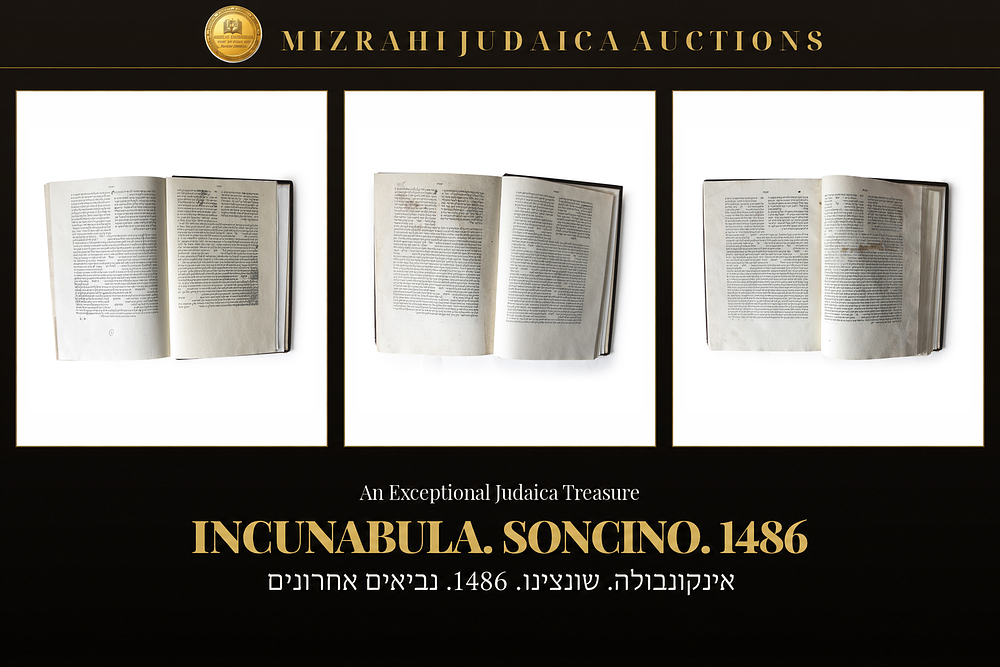
Bidspirit auction | INCUNABULA. SONCINO. 1486. Nevi’im Acharonim
INCUNABULA. SONCINO. 1486. Nevi’im Acharonim (Later Prophets): Isaiah, Jeremiah & Ezekiel with the commentary of R. David Kimchi (RaDa”K). Soncino 1486 - FIRST PRINTED EDITION OF THE LATER PROPHETS; FIRST EDITION OF RADAK’S COMMENTARY. Incomplete copy, 222 leaves present One of the formative monuments of Hebrew printing. Issued only a few years after the establishment of the Soncino press, and two years before that house produced the first complete Hebrew Bible, this volume brought the Nevi’im Acharonim, together with Radak’s great commentary, into print for the first time. Together with the Soncino Nevi’im Rishonim of 1485, it constituted the earliest printed presentation of the Prophets accompanied by one of the central works of medieval Jewish exegesis. R. David Kimchi of Narbonne inherited the grammatical and exegetical tradition of his Spanish-born family, yet transformed it into a commentary of unusual breadth and accessibility. His explanations rest upon close attention to vocabulary, syntax and context, but Radak never treated peshat as requiring the abandonment of Chazal. Recent scholarship has shown how deliberately he places contextual interpretation beside derash: at times rabbinic tradition solves a textual difficulty; elsewhere it supplies a theological or homiletical dimension; and on occasion Radak, with striking independence, declines an interpretation that he believes cannot be reconciled with the language of Scripture. The prophetic books provided an especially rich field for this method. Historical narrative, difficult Hebrew, Messianic prophecy and visions of the supernatural allowed Radak to move between philology, rabbinic tradition and the rationalism of the Maimonidean world. His celebrated treatment of Ezekiel’s vision of the Divine Chariot is not merely a gloss upon obscure verses, but an extended philosophical inquiry into prophecy and theophany. The result is a commentary that became indispensable to later Jewish study and, through its use by Christian Hebraists, one of the principal conduits through which medieval Jewish grammar and exegesis entered the wider European biblical tradition. The physical scale of the undertaking is itself impressive: nearly three hundred folios of biblical text and commentary, set by hand during the earliest generation of Hebrew typography. The Soncinos had opened their press only in 1483-84; within a remarkably brief period they moved from individual tractates to ambitious editions of the Hebrew Bible, laying foundations upon which Hebrew printing would develop for centuries. Complete copies of this edition are exceptionally rare, and even substantial imperfect copies seldom appear. Condition : Substantial though incomplete copy, containing 222 leaves in original, with replacement leaves and extensive skilled restoration and reinforcement throughout. Occasional worming and staining, in places affecting text. Bound in an imposing modern dark-brown morocco binding, richly blind-tooled with multiple geometric and foliate borders, central arabesque ornament, raised bands and gilt-lettered spine labels. Small folio. Collation and Condition: 222 leaves, comprising Isaiah, Jeremiah, and Ezekiel only; lacking Trei Asar. Numerous leaves with professionally refurbished margins and borders, generally not affecting text. Isaiah: Leaves 4–5, 9–10, 12–13, 15–16, 20–22, 26–31, 33–74, 76–77, 79–80, 82–88 present; lacking leaves 1–3, 6–8, 11, 14, 17–19, 23–25, 32, 75, 78 and 81. Borders of leaves 76–77 substantially refurbished, with slight loss or involvement of letters at the top of 76a and bottom of 76b and 77a. Leaf 88 supplied in facsimile, with recto and verso inadvertently reversed. The original blank spanning 88b–89a is absent. Censor markings on leaves 12, 29, 47b, 65b, 69b, 70a, 84a and 87a; that on leaf 12 concerns the Virgin Mary. Jeremiah: Begins on leaf 90. Leaves 90–96, 98–103, 105–127 and 129–153 present; lacking leaves 97, 104 and 128. Minor marginal losses and repairs, including small losses to the outer borders of leaves 91–92; small puncture at the upper corner of leaf 112; inner border of leaf 129 refurbished with slight involvement of text; upper corners of leaves 143 and 146–151 torn away. Ezekiel: Leaves 156–159, 162–163, 168–184 and 186–222 present; lacking leaves 154–155, 160–161, 164–167 and 185. Smudged ink staining in the lower margins of 157b–158a, with possible traces of a censor’s signature; small puncture to the inner margin of leaf 158. Censor marking on 215b. Early manuscript indications of haftarah readings on 196 (“הפט׳ וא[רא]”) and 206a (“הפט׳ ו[יגש]”). Reference : Grunhaus, Challenge 55-71 Provenance: The collection of Abraham Lieberman