Bidspirit auction | 18th-Century Torah Scroll from Eastern
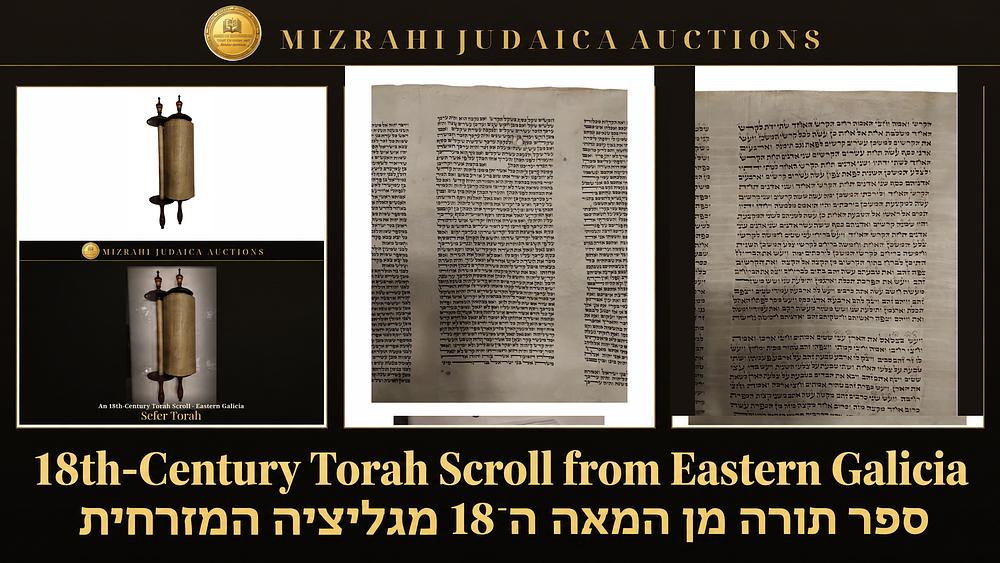
18th-Century Torah Scroll from Eastern Galicia - Not Kosher - 300 Years Old | Original and Complete | Unique Halachic Antiquity and Scribal Anomalies Height: 40 cm | 45 Lines | Ksav Ari Interwoven with Vellish Script Provenance & Scribal Mastery Offered here is an extraordinary, museum-grade Sefer Torah originating from Eastern Galicia, dating back approximately three centuries (circa early 18th century). This masterwork is a rare survivor of its era: a completely intact scroll where every single yeriah (parchment sheet) is original to the initial writing. The entire text from Bereshis to L’eynei kol Yisrael was executed by a single master scribe (sofer). His supreme craftsmanship, absolute composure, and profound Yiras Shamayim (fear of Heaven) are reflected in the remarkable uniformity of the calligraphy. The script maintains a flawless consistency from the opening lines of Genesis through the closing verses of Deuteronomy, showing no signs of fatigue or variance. Exquisite Material & Structural Condition Unlike contemporary scrolls prepared from calfskin, this historical scroll utilized the hides of mature cattle, a material notoriously difficult to process, particularly during the 18th century before the advent of modern chemical agents. Despite these limitations, the sofer succeeded in producing exceptionally refined, thin, and lightweight sheets, drastically minimizing the scroll’s overall weight. Original Mounting: The scroll remains affixed to its original wooden rollers (Atzei Chaim). Structural Integrity: The tefiyah (sinew stitching) is entirely original and complete. Notably, the backs of the sheets are pristine, featuring no backing patches or structural reinforcements , attesting to its pristine preservation. Precision Ruling: The sirtut (imprinted lines) and column margins are perfectly uniform and strictly aligned, reflecting master-level mathematical and physical preparation. Scribal Calligraphy ( Ksav ) and Advanced Ornamentation The script presents a magnificent fusion of Ashkenazic Ksav Ha-Ari with elements of ancient Vellish calligraphy. The visual layout is a testament to the hiddur mitzvah of yesteryear, characterized by expansive, breath-giving spacing between individual letters and words. The script is devoid of the compressed columns or overly elongated letters common in antique scrolls. Of significant note is the magnificent execution of the tagin (crowns). The scribe went to tremendous lengths to apply advanced, multi-layered crowns (”תגין על גבי תגין”) in a highly sophisticated and regal manner. Rare Mesoros, Scribal Paradoxes, and Halachic Anomalies This Sefer Torah serves as an invaluable historical repository of ancient scribal traditions (mesoros), many of which date back to the medieval Machzor Vitry, and some of which have since fallen out of common practice over the last two centuries. Scribal Punctuation: A deliberate space, equivalent to the width of two letters, is maintained between every single verse (פסוק). The BYH ShMV Columns: In the six traditional columns designated by halacha to begin with the letters Bet, Yud, Hey, Shin, Mem, Vav (ב י ה ש מ ו), the scribe wrote these opening characters as Otiyos Gedolos (enlarged letters). The Horned Ches : Hundreds of instances of the letter Ches (ח) were written with their left legs bent sharply outward, topped with thorn-like projections resembling horns slanting in both directions, following an ancient esoteric tradition cited by the Rishonim. While a later scribe attempting to ”modernize” the scroll erased many of these specific features, numerous curved Chas-in remain fully intact, and the physical traces of the erased horns remain visible under inspection. The Rashi Ches : Multiple instances of the Ches appear without the standard roof-hump, conforming strictly to the opinion of Rashi. The Inverted Tzadi : The letter Tzadi (צ) throughout the entirety of the scroll is meticulously written according to the ancient Tzadik Hafuch (inverted Yud) tradition. Orthographic Variance: In Parashat Ki Tetze, the word Decha is spelled with an Aleph (דכא), a highly significant textual variant matching historical North German and Eastern European mesoros, contrasting with the modern custom of spelling it with a Hey (דכה). Enlarged Ayin : The letter Ayin (ע) in the phrase ”Shema Yisrael... Atah over hayom” (Parashat Ekev) is beautifully extended upward. The Broken Vav: In the word Shalom (Parashat Pinchas, ”Hineni nosein lo es brisi shalom”), the Vav Ha-Ketuah (broken Vav) is rendered in a unique and captivating kabbalistic form. Section Breaks: The layout of the Parashiyos Pesuchos and Sestumos aligns precisely with the stringent rulings of the Rambam. The Spiral Pei : Several instances of Pehin Lefuphos (spiraled or wrapped letters Pei) are present. Line-Filling Calligraphy: In Parashat Tzav, within the verse ”Kol Chelev,