Bidspirit auction | Decorated Ketubah – Sephardic Community
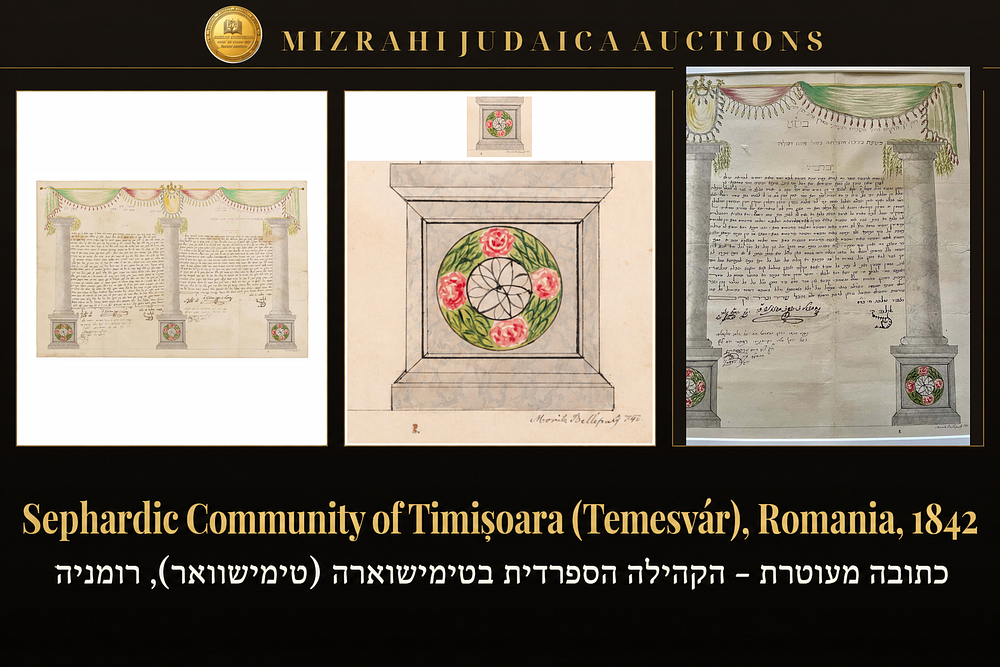
Decorated Ketubah – Sephardic Community of Timișoara (Temesvár), Romania, 1842 - A rare and elegant decorated Sephardic ketubah , executed in ink and paint on paper, documenting the marriage of Shmuel son of Yaakov son of Rafael Yaakov son of Yehuda Magyar and Beya daughter of Yosef son of Yitzchak Navon , celebrated in Timișoara (Temesvár), Kingdom of Hungary, present-day Romania, on 14 Tammuz 5602 (June 22, 1842) . This exceptional marriage contract provides a remarkable testimony to the artistic traditions and communal identity of the historic Sephardic community of Timișoara during the nineteenth century. The ketubah is composed on a rectangular sheet of paper and features an impressive architectural decorative scheme. Three monumental pillars rise across the composition, crowned by colorful draped curtains and complemented at their bases by matching floral arrangements. The theatrical architectural framing transforms the legal document into a ceremonial work of art, reflecting the influence of European decorative aesthetics combined with the enduring traditions of Sephardic Jewish manuscript culture. Following the custom of Sephardic communities, the text is divided into two distinct sections: the ketubah text appears on the right side, while the Tenaim (marriage conditions) are recorded on the left. Beneath the two columns appear the signatures of the groom and witnesses, including Rabbi Tzvi Hirsch Oppenheim , rabbi and head of the rabbinical court (Av Beit Din) of Timișoara, providing significant historical and communal importance to the document. The lower right corner preserves the signature of the artist responsible for the decoration: “Moritz Bellenfanti, [1]842” . This rare artist’s signature adds exceptional value, identifying the creator of the ketubah’s elaborate ornamental program and offering a direct connection between the manuscript and the artistic world of nineteenth-century Timișoara. The Jewish community of Timișoara was one of the important Sephardic communities of the Habsburg and Hungarian realms, maintaining distinctive Iberian traditions while adapting to the cultural environment of Central Europe. Decorated ketubot from this community are scarce, and surviving examples such as the present work provide important insight into the religious life, artistic expression, and communal heritage of Sephardic Jews in the region. Measuring approximately 33.5 × 50 cm , the ketubah remains in overall good condition. It displays numerous old folds and tears along the folds and margins, all professionally restored, with additional handwritten inscriptions preserved on the verso. Despite these signs of age, the manuscript retains its impressive decorative character and historical significance. Provenance: The Melikian Collection.