Bidspirit auction | Decorated Ketubah – Rodosçuk (Tekirdağ),
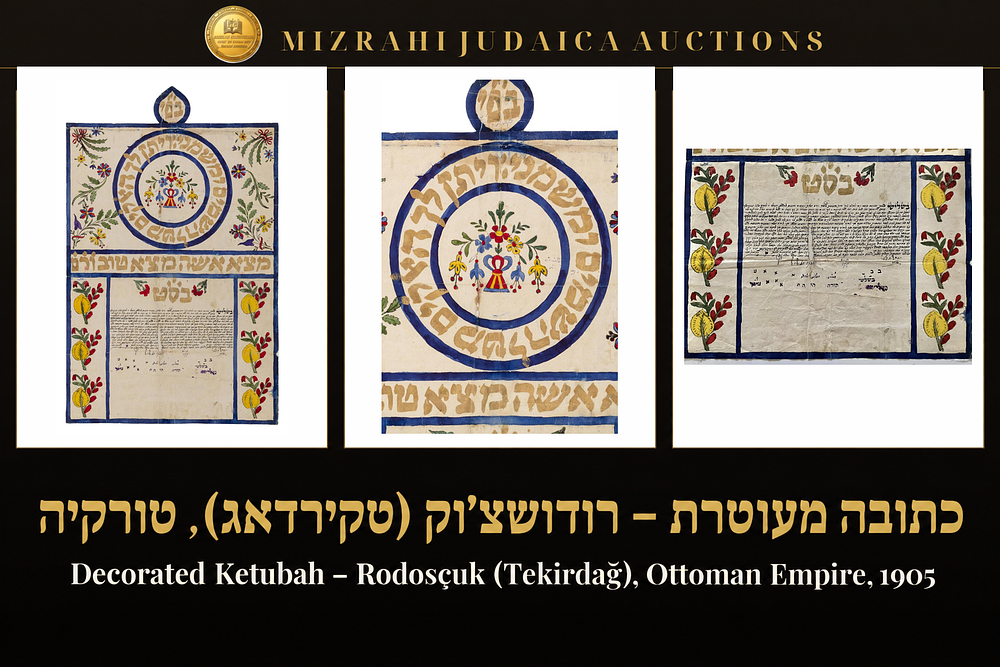
Decorated Ketubah – Rodosçuk (Tekirdağ), Ottoman Empire, 1905 - A rare and striking Ottoman Sephardic decorated ketubah , executed in ink, paint, and woodblock printing on paper, documenting the marriage of Yaakov son of Rafael Yehoshua Balul and Esther daughter of Yehuda ben Ezra , celebrated in Rodosçuk (Tekirdağ), Ottoman Empire, present-day Turkey, on 18 Iyar 5665 (May 23, 1905) . This exceptional marriage contract represents the distinctive artistic traditions of the Sephardic communities of the Ottoman Empire and offers a remarkable example of the fusion between Jewish ceremonial art and Ottoman decorative aesthetics. The ketubah is composed on a thick rectangular sheet of paper with an elegant pointed projection at the upper section. Its surface is dominated by an elaborate decorative program incorporating blessings and ornamental motifs. The central area features verses of blessing written in gold, arranged within a circular composition and surrounded by a rectangular ornamental band, creating a harmonious interplay between sacred text and visual design. The margins, as well as the decoration surrounding the central circle, are adorned with colorful repeating vegetal patterns created through woodblock printing. This technique, widely used in Ottoman decorative arts, was skillfully adapted here to the Jewish ceremonial context, resulting in a richly patterned composition that combines printed ornament with handwritten Hebrew text. The actual ketubah text appears in the lower third of the sheet, followed by the signatures of the groom and witnesses: Yisrael H. Halevi and Chaim Gaon . The arrangement of blessings, ornament, and legal text reflects the importance placed upon the ketubah not merely as a legal document, but also as a treasured ceremonial object celebrating marriage and communal identity. The Jewish community of Rodosçuk (Tekirdağ) was one of the historic Sephardic communities of the Ottoman Empire, established in the aftermath of the expulsion from Spain and maintaining distinctive Sephardic traditions for centuries. Surviving decorated ketubot from Tekirdağ are exceptionally rare; the ketubah database of the National Library of Israel records only five examples from this community. One of these, preserved in the collection of Yale University Library (Hebrew MSS suppl. 174), bears a striking similarity in its decorative vocabulary to the present example, emphasizing its importance and rarity. Measuring approximately 40.5 × 63.5 cm , the ketubah remains in overall good condition. It displays light moisture damage with minor effects to the painted decoration, creases, minor tears, and old folding marks, all professionally restored. A repaired tear of approximately 5 cm affects the ketubah text, and pen trials appear in the margins and on the verso. Despite these signs of age and use, the work retains its remarkable decorative impact and historical significance as a rare surviving example of Ottoman Sephardic ceremonial art. Provenance: The Melikian Collection.