Bidspirit auction | Decorated Persian Ketubah – Isfahan,
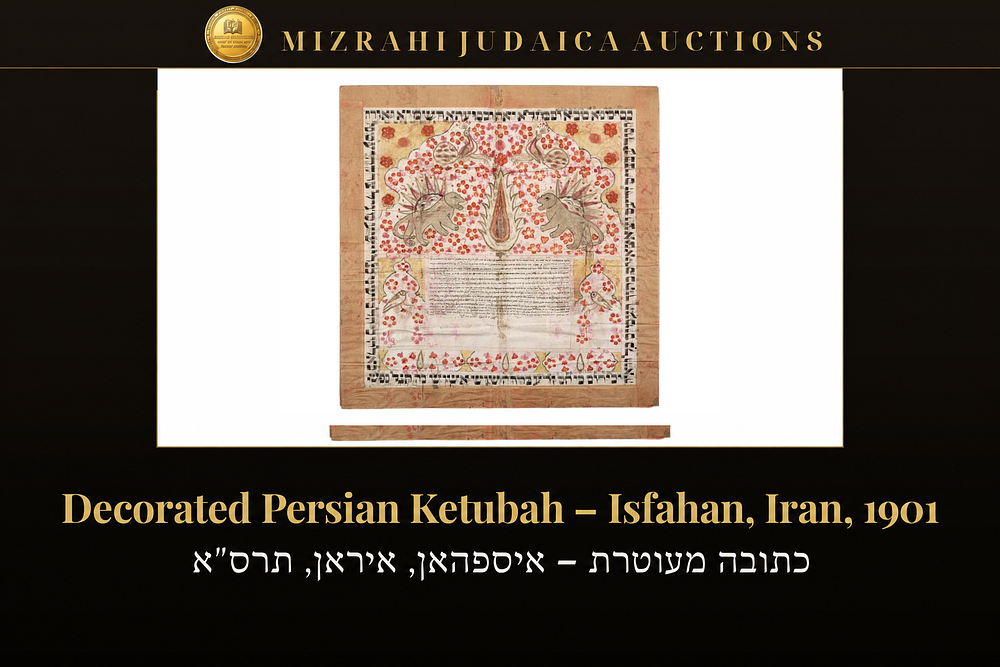
Decorated Persian Ketubah – Isfahan, Iran, 1901 - A large and beautifully illustrated Persian ketubah , executed in ink and vibrant colors on paper, documenting the marriage of Akajan son of Yosef and Zuleikha daughter of Benjamin , celebrated in Isfahan, Iran, on 9 Nisan 5661 (March 29, 1901) . This impressive marriage contract offers a rare and evocative glimpse into the artistic traditions and ceremonial culture of the Jewish community of Isfahan, one of the oldest and most significant Jewish communities of Iran. The ketubah is adorned with a rich array of colorful motifs characteristic of Persian Jewish marriage contracts from Isfahan. Its decorative program includes majestic lions , a radiant sun with a human face , a graceful cypress tree , flowers, and birds. Particularly striking is the traditional Persian motif of the lion accompanied by a half-sun bearing human features—a powerful emblem deeply rooted in Persian visual culture and historically associated with the identity and symbolism of Iran. Adapted here into a Jewish ceremonial document, these images reflect the unique fusion of Persian artistic heritage and Jewish religious tradition. The text is written in elegant Hebrew script, following the customs of Persian Jewry. The document is signed by the witnesses Ezra son of Abraham , Abraham son of Jacob , and the scribe Shmuel son of Moshe , preserving a valuable record of the individuals responsible for validating and producing this marriage contract. The edges of the ketubah are enhanced with delicate strips of pink-colored paper, adding further refinement to the overall composition. Measuring approximately 70 × 75 cm , this monumental ketubah represents an important example of the illustrated marriage contracts created by the Jewish community of Isfahan at the turn of the twentieth century. Beyond its aesthetic qualities, it serves as a historical document reflecting the customs, artistic vocabulary, and communal identity of Iranian Jewry during the final years of the Qajar period. Despite its age and evidence of use—including stains, extensive water damage, numerous folds, and tears along the margins and folding lines—its surviving decorative elements and inscriptions preserve the exceptional character of this remarkable work of Persian Jewish ceremonial art Measuring 70x75 cm, this item exhibits characteristic signs of aging, including creasing, minor water staining, and fold lines. The Ketubah has undergone conservation and repair, during which tears along the margins and folds were reinforced with archival tape on the reverse. This ensures its stability, allowing for its continued display and preservation.. Provenance: The Melikian Collection