Bidspirit auction | Large Decorated Ketubah – Tehran,
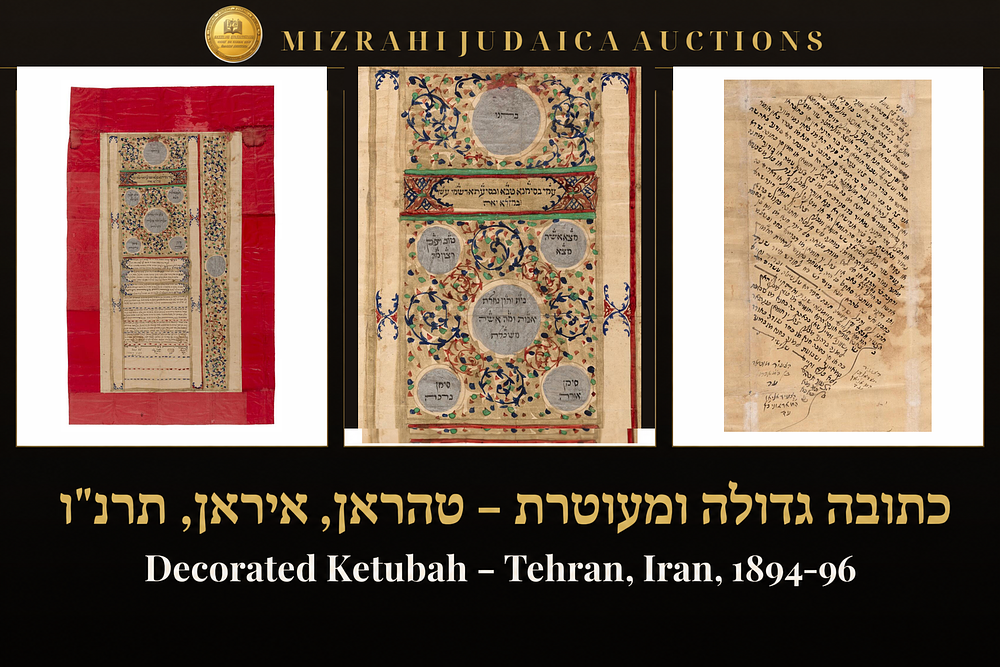
Large Decorated Ketubah – Tehran, Iran, 1894-96 - A magnificent and monumental Persian Jewish ketubah , executed in ink and paint on paper, documenting the marriage of Shmuel son of Chaim (Esfahoni) and Chanah daughter of Nisan , celebrated in Tehran, Iran, on 27 Tevet 5654 (January 5, 1894) . Richly decorated with elaborate floral ornament, gold and silver highlights, and elegant calligraphic framing, this impressive marriage contract represents the refined artistic tradition of the Jewish community of Tehran during the late Qajar period. The ketubah is composed on a large rectangular sheet and features a sophisticated decorative program inspired by Persian manuscript illumination. The text is enclosed within multiple ornamental frames, some with pointed edges, surrounded by vibrant vegetal motifs and arabesque patterns. The extensive use of gold and silver creates a luxurious visual effect, transforming the legal marriage document into a ceremonial work of Jewish art. Persian Jewish ketubot are particularly renowned for their fusion of Jewish textual tradition with the aesthetics of Islamic manuscript decoration, and Tehran emerged as one of the most important centers for this distinctive artistic style. The lower portion of the ketubah concludes with the signatures of the groom and the witnesses, while the verso preserves an additional contractual addition dated Iyar 5656 (1896), accompanied by further witness signatures. This later inscription provides additional historical interest, recording the continued legal use and preservation of the document beyond the original wedding ceremony. The decorative language of this ketubah reflects the remarkable creativity of Iranian Jewish scribes and artists, who adapted the ornamental vocabulary of Persian art— floral arabesques, geometric framing, and metallic embellishment —into the Jewish ceremonial sphere. Examples of Tehran ketubot from this period are distinguished by their monumental scale, elaborate illumination, and the harmonious integration of text and ornament. Measuring approximately 60 × 70 cm , this ketubah remains an outstanding example of Persian Jewish manuscript art. Despite some creases, stains, and minor damage to the painted decoration, it retains its impressive decorative character and offers a rare glimpse into the religious life, artistic achievement, and cultural identity of the Jewish community of Tehran at the turn of the twentieth century. Provenance: The Melikian Collection; Kedem Auction House.