Bidspirit auction | Huge Illustrated Ketubah – Kyustendil,
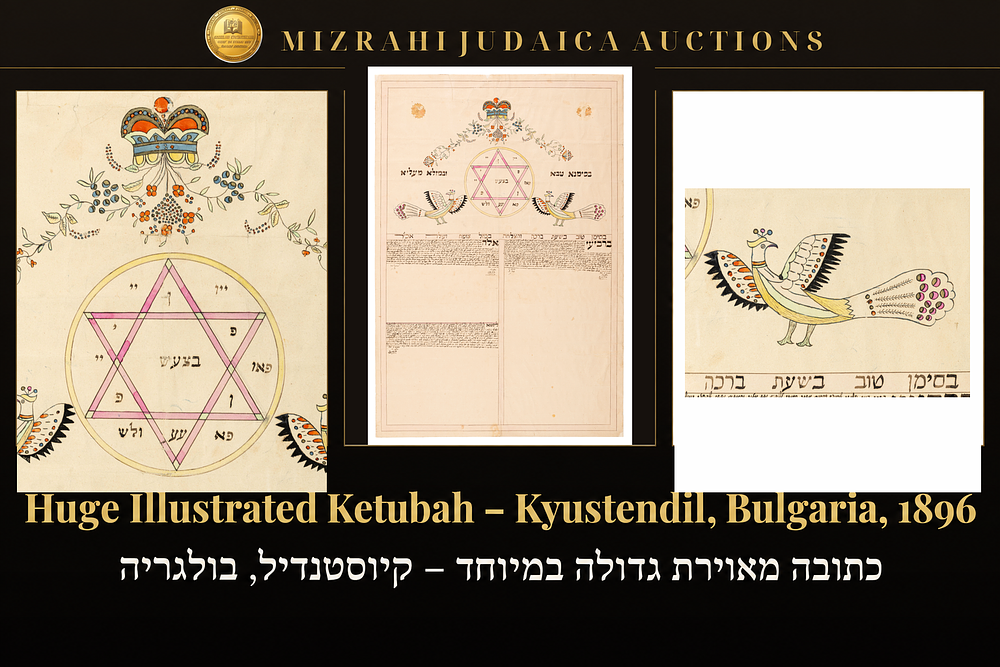
Huge Illustrated Ketubah – Kyustendil, Bulgaria, 1896 - An exceptionally large and magnificently illustrated Sephardic ketubah , executed in ink and watercolor on paper for the marriage of Avraham ben Moshe Ha-Levi and Rosa bat Yosef Shabtai Tajir of Sofia , celebrated in Kyustendil, Bulgaria , on 3 Elul 5656 (August 12, 1896) . Monumental in both scale and artistic ambition, this remarkable marriage contract is among the finest surviving examples of the richly illuminated ketubot produced by the Sephardic communities of the Balkans during the late Ottoman period. Executed on an unusually large sheet, the ketubah combines legal text with an elaborate decorative program of exceptional refinement. The upper portion is dominated by two richly gilded ornamental panels framing an imposing royal crown surrounded by lush floral arrangements. At the center appears a large Star of David enclosed within a circular medallion containing Kabbalistic letter permutations, flanked by a graceful pair of birds—a traditional symbol of harmony, fidelity, and blessing. The extensive use of gold, together with the vibrant floral ornamentation, creates an impressive ceremonial document intended to celebrate the importance of the marriage and the distinguished status of the families involved. The ketubah is written in elegant Sephardic cursive script and follows the traditional Sephardic rite. The principal marriage contract occupies the right side of the sheet, while the left contains the text of the Tena'im (engagement agreement), beneath which appears a detailed record of the bride's dowry. Both the ketubah and the Tena'im are signed by the same distinguished witnesses, Rabbi Rachamim Yisrael Berechiah and Rabbi Menachem ben Yehudah Ha-Levi, while the dowry section bears the signature of Rabbi Rachamim Yisrael Berechiah alone. This carefully organized layout reflects the legal traditions of the Sephardic communities of the Ottoman Balkans at the close of the nineteenth century. The Jewish community of Kyustendil traces its origins to the sixteenth century and was one of the important Sephardic centers in western Bulgaria. By the beginning of the twentieth century the town was home to approximately 1,200 Jews, maintaining a vibrant communal and religious life. Illuminated ketubot from Kyustendil are extraordinarily rare: only a single additional example is documented in the collections of the National Library of Israel (from the Jewish Theological Seminary collection), making the present manuscript an exceptionally scarce witness to the artistic and ceremonial traditions of this historic community. Combining monumental dimensions, masterful calligraphy, lavish gilding, and refined symbolic decoration, this ketubah stands among the most impressive examples of Balkan Jewish manuscript art. Beyond its aesthetic beauty, it offers a rare window into the religious life, legal customs, and visual culture of Bulgarian Sephardic Jewry at the end of the nineteenth century. Provenance: The Melikian Collection; Kedem Auction House, Auction 103, Lot 200 Opening price: $1,200