Bidspirit auction | Megillat Haftarat Yehezkel – Read
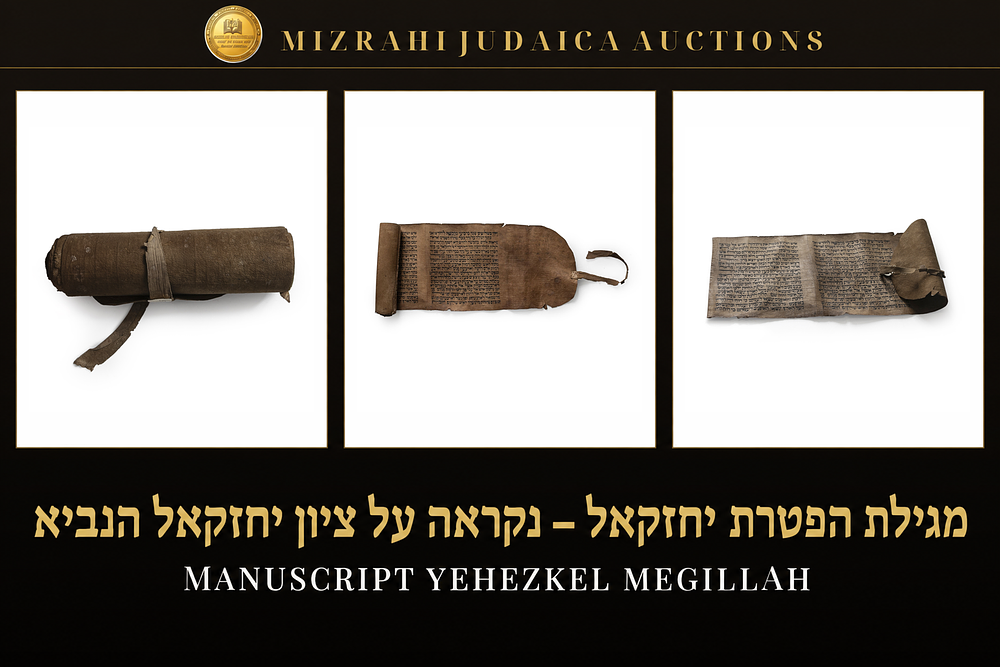
Megillat Haftarat Yehezkel – Read at the Kever of Yechezkel Hanavi, [Al-Kifl (Iraq), ca. 5629 / 1869] – From the Renowned Sassoon Collection - This extraordinary manuscript , hand-written on authentic gevil, is a rare and completely intact treasure reflecting the deep, centuries-old devotion of Iraqi Jewry and their sacred tradition of Aliyah l'Kever to the resting place of Yechezkel Hanavi . For over a thousand years, the holy shul and complex housing the tziyun of the Navi in the town of Al-Kifl served as a powerful spiritual epicenter for Near Eastern Jewry, drawing masses of mitpallelim from Baghdad, Basra, and Persia, particularly around the High Holidays and Shavuot. This specific megillah was meticulously prepared to be used directly at this holy site; custom dictated that pilgrims remove their shoes in awe before approaching the kever, where they would prostrate themselves, pour out their hearts in tefillah, and unroll these custom-commissioned scrolls containing the exact haftarah portions of Yehezkel . These sacred texts were deployed to evoke immediate heavenly mercy, refuot, yeshuot, and the ultimate Geulah and Techiyat Hametim. Complete with a beautifully preserved colophon dedication by the donor, Aga Hillel ben Rahamim ben Shemaiah ben Aaron, in the year 5629, this scroll stands as a remarkable testament to the meticulous care of the Baghdadi sofrim. The prestigious provenance of this artifact connects it directly to one of the most famous episodes in modern Jewish bibliography. On Sunday, 3 Kislev 5671 (December 4, 1910), during a historical heritage journey through Iraq, the legendary collector and scholar David Solomon Sassoon visited the Al-Kifl sanctuary , a holy site that had been magnificently refurbished and restored by his own grandfather, the great philanthropist David Sassoon, in 1859. Spending that evening searching for holy manuscripts, Sassoon succeeded in locating and acquiring a select group of these rare scrolls, which he designated as megillot haftarat yehezkel, of which the present scroll was a prized find. Formally recorded and cataloged as MS 195 in Sassoon's landmark Ohel Dawid, this manuscript serves as a rare surviving eyewitness to a beautiful, localized minhag that vanished entirely with the mid-20th-century mass exodus of the historic Iraqi Kehillah. From the perspective of safrut, the scroll is a magnificent example of seasoned Near Eastern scribal craftsmanship , flawlessly executed in a sharp, authentic Baghdadi square ktav using rich black ink across five stitched yeriot (membranes) of prepared gevil. Measuring approximately 7 ¼ by 81 ⅞ inches, the sacred text is arranged across 11 columns with 17–18 lines per column. It features traditional Tiberian nekudot (vocalization elements) in the initial columns, alongside distinct scribal features characteristic of the region, such as the Shem Hashem variably written out or abbreviated via a double yud. The state of preservation is outstanding for a sacred artifact with such an active history of ritual use, showing scattered holy usage stains, minor edge tears, and a partially softened final line on the third column, while retaining its original, worn gevil wrapping strip at the outer edge used to bind the scroll. Literature Abraham Ben-Yaacob, “Eid al-ziyara be-bagdad, ” Edot 1 (1946): 37-40, at pp. 37-39. Abraham Ben-Yaacob, Kevarim kedoshim be-bavel: tei’urim shel kivrei ishim mi-tekufat ha-tanakh, ha-talmud ve-ha-ge’onim (Jerusalem: Mossad Harav Kook, 1973), 38-98, esp. pp. 80-81. David Solomon Sassoon, Ohel Dawid: Descriptive Catalogue of the Hebrew and Samaritan Manuscripts in the Sassoon Library, London, vol. 1 ([Oxford]: Oxford University Press; London: Humphrey Milford, 1932), 559 (no. 195). David Solomon Sassoon, A History of the Jews in Baghdad (Letchworth: Solomon D. Sassoon, 1949), 98, 140, 150, 155-156, 181, 184. David Solomon Sassoon, Massa bavel be-tseiruf inyanim le-toledot ha-kehillah he-yehudit be-bagdad, ed. Meir Benayahu (Jerusalem: Azrieli, 1955), 158-167, 272, esp. pp. 161-162, 272. Provenance: David Sassoon Collection, The Melikian Collection