Bidspirit auction | IMPORTANT AUTOGRAPH UNPUBLISHED MANUSCRIPT OF
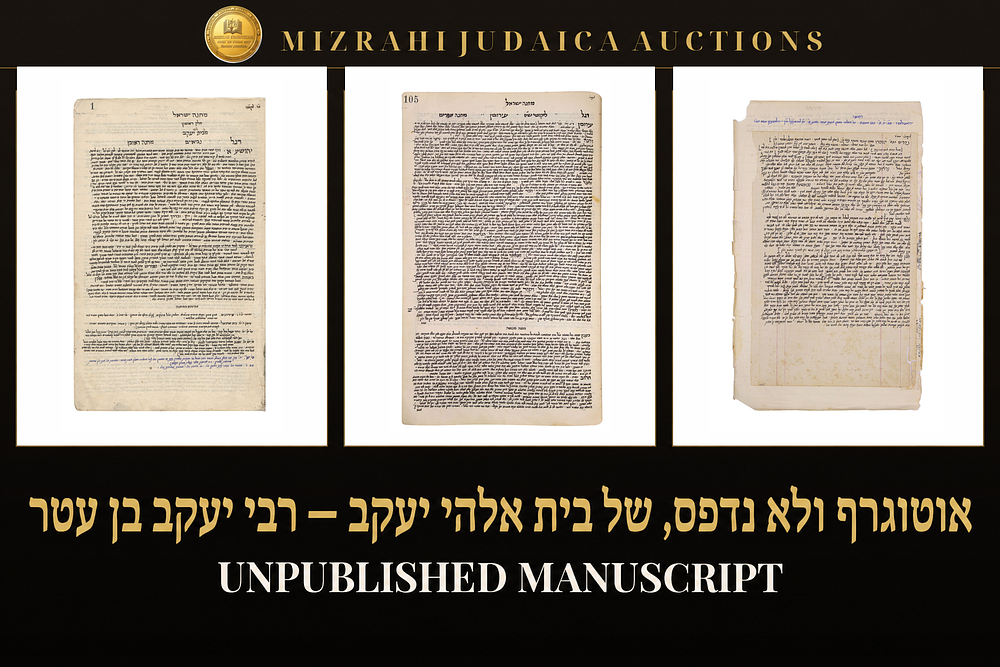
IMPORTANT AUTOGRAPH UNPUBLISHED MANUSCRIPT OF BET ELOHAI YAAKOV — R. YAAKOV BEN ATTAR. JERUSALEM. - Autograph manuscript of R. Yaakov ben Yehudah Ben Attar (c. 1845–1924), Jerusalem dayan, kabbalist and celebrated Shadar of the Moroccan community. Substantial unpublished portions of his great literary project, Mahaneh Yisrael . An extraordinary working manuscript of Beit Elohai Yaakov, the sprawling work to which R. Yaakov Ben Attar devoted his later years. He conceived the work almost architecturally, as three great “camps”: Mahaneh Yisrael, encompassing Tanakh and Torah she-be’al peh; Mahaneh Leviyah, derashot; and Mahaneh Shekhinah, tefillah. Each camp was divided into degalim (“banners”), and these again into matot (“tribes”), the Biblical encampment becoming the organizing framework for an enormous Torah library. Only the beginning of Mahaneh Yisrael ever reached print. Publication commenced in Jerusalem in 1924, accompanied by unusually warm approbations from the two Chief Rabbis, R. Yaakov Meir and R. Avraham Yitzhak Kook. Ben Attar died that same year, with the press having advanced only as far as Parashat Lekh Lekha, leaving the far larger architecture of Beit Elohai Yaakov in manuscript. The present manuscript preserves extensive portions of the work that remained in manuscript: Degel Mahaneh Reuven, on Nevi’im, divided between Mateh Shimon (derush) and Mateh Gad (sod); Degel Mahaneh Dan, on Ketuvim, with Mateh Asher and Mateh Naftali; and Degel Mahaneh Ephraim, on Torah she-be’al peh, with Mateh Menasseh and Mateh Binyamin. The Tanakh sections are accompanied by Sevivot ha-Mahaneh, an additional apparatus containing reference material and, among other things, identifications of Biblical places. Fol. 91 contains additions to his Torah commentary, corresponding in his scheme to Degel Mahaneh Yehudah. The manuscript reveals something of the remarkable library -printed and manuscript- that stood behind the project. Alongside an abundance of classical and later rabbinic literature, Ben Attar reaches for medieval accounts of Eretz Israel, an Arabic translation of Scripture, and even “Hiranimus”, Jerome and the Vulgate. Material encountered in rabbinic manuscripts was copied into the work as well; in one revealing passage he announces, “And now there has come into my possession a precious explanation…”, copied from the sermons of the recently deceased R. Yosef Hayyim of Baghdad. Elsewhere are substantial omissions to vol. III of R. Yosef Berdogo’s Ketonet Yosef (ff. 37b–40a, 41b–45a and 46b–50a). The manuscript itself bears witness to this continuing process of collection: smaller leaves and slips have been carefully mounted or bound into their proper places, with the surrounding text adjusted to accommodate them. Occasionally Ben Attar turns from books to the world outside his study. In one place, he launches into a wonderfully sharp attack on the fashion-conscious travelers of his day: Jews who journey to Europe and return having adopted European modes of dress, with the fashion spreading so far that, he complains, even women without sufficient means for their livelihood somehow find money for the newest styles. The life behind the manuscript was nearly as far-ranging as its sources. Born in Azemmour, Morocco, c. 1845, Ben Attar settled in Jerusalem in 1884–85; family tradition, later recorded by his grandson, Israeli President Yitzhak Navon, related that the move followed a dream in which Eliyahu HaNavi demanded, “עד מתי תשב כאן בנחת וירושלים בצער?” He became a dayan and important communal figure of the Ma’aravi community, and his standing in the Jerusalem rabbinate is already evident decades before the present work reached print. R. Yosef Nissim Burla (1828–1903), the veteran Jerusalem Rosh Av Beit Din, engages at length with a carefully organized halakhic exposition of Ben Attar’s, repeatedly referring to him with marked respect as הרב הפוסק. Ben Attar also spent many years abroad as a shadar. During one such mission in Lisbon, an encounter with Mas‘ud Cohen of Bahia, Brazil, resulted in the establishment of Mishmeret Kehunah, its name honoring the new benefactor, who undertook the support of ten Jerusalem scholars, an endowment whose later disposition generated a substantial halakhic responsum. During the young Baba Sali’s Jerusalem sojourn in 1922, Ben Attar was among the Ma’aravi sages with whom he studied and whom he remembered with particular affection. There is a fitting physical connection between these two halves of Ben Attar’s life. His great Torah project was written in a repurposed fundraising ledger from his own work as a shadar. The faded legend still visible on its green cover reads Pinkas Nedavot la-Aniyei Kollelot Benei Morocco ve-Afrika and names R. Yaakov Attar, the Shadar. Inside the front board, Ben Attar carefully mapped and indexed his elaborate arrangement. The volume comprises 165 numbered leaves, written on both sides, followed by a partially written leaf 166,