Bidspirit auction | VENICE. 1600. MACHZOR. Monumental Ashkenazic
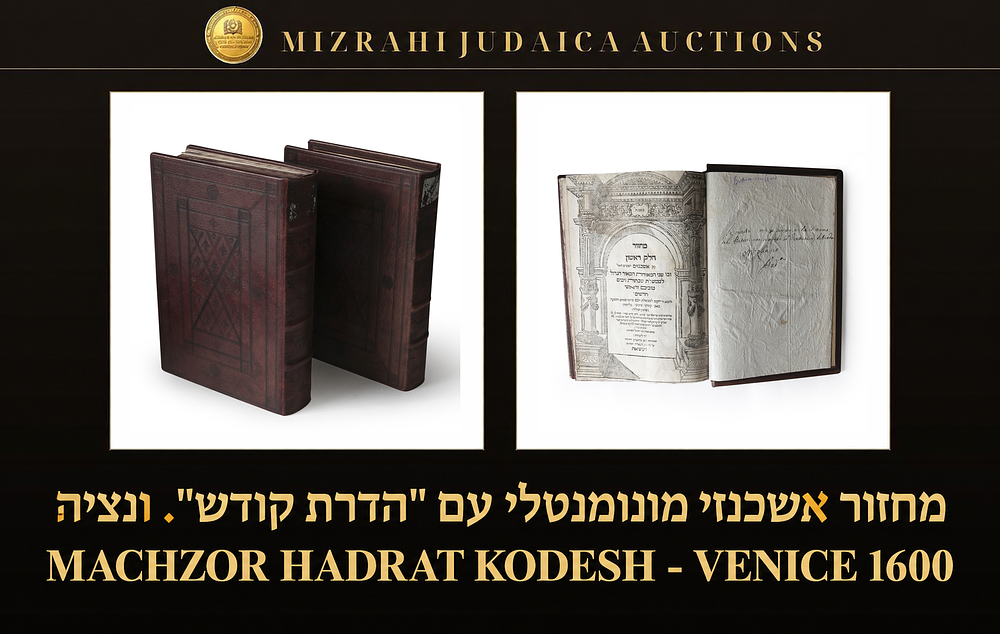
VENICE. 1600. MACHZOR. Monumental Ashkenazic Mahzor with Hadrat Kodesh. Venice, 1600. Two Volumes - A monumental two-volume Ashkenazic Mahzor from the great age of Hebrew printing in Venice, edited by R. Yitzhak b. R. Yaakov Yuzbel Segal of Herlisheim, an Ashkenazic shaliaḥ tzibbur who set out to create something considerably richer than a prayer book. Printed in Venice in ש״ס [1600], the Mahzor gathers the liturgy of the entire Ashkenazic year together with an unusually extensive treasury of commentary, halakhah, minhag and mussar. Its editor drew upon earlier Ashkenazic liturgical authorities and commentators, including Maharil, R. Yitzhak Tirna and R. Avraham Klausner, alongside R. Yosef Karo and Rema. His own collected apparatus of מנהגים ודינים ומוסרים appears under the distinctive title הדרת קדש. The result is almost an encyclopedia of Ashkenazic prayer as it had developed by the close of the sixteenth century, preserving not merely what was recited, but the learning and custom that surrounded it. There is something particularly evocative about such a work appearing in Venice. An Ashkenazic ba'al tefillah, rooted in the synagogue traditions of Germany, assembled generations of Ashkenazic prayer and custom into an imposing Hebrew book produced by the sophisticated Venetian press. The Mahzor subsequently enjoyed a significant afterlife, with Hadrat Kodesh becoming an important component of later Venetian Ashkenazic mahzorim. Among the literary additions is a particularly attractive Venetian connection: a Hebrew poem by the young R. Yehudah Aryeh (Leone) Modena (1571–1648), his name embedded acrostically in the verse. Modena was then only in his late twenties, decades before becoming one of the most colorful and celebrated Jewish figures of seventeenth-century Venice. The poem belongs to an early period in which he was already moving through the city's Hebrew printing world, contributing Hebrew verse to books emerging from its presses. The Mahzor also includes מוסר השכל במליצה לרב האי גאון, the celebrated ethical poem traditionally attributed to Rav Hai Gaon. This particular set bears the marks of a Mahzor that continued to live long after leaving the Venetian press. An early owner records on a blank page: חנני אלקי׳ ונתן לי את המחזור הזה נאום משה בר יצחק הלוי ז״ל המכונה משה שריטעלד(?) Later readers continued the process, supplying texts for insertion and glosses in the margins. A blank leaf following the printed text contains several manuscript רבונו של עולם prayers, while its verso bears an inscription addressed to R. Anshil Segal, then in Ansbach, dated תקל״ט [1778/79]. Family records on an endleaf preserve dates of deaths and burials. Across nearly two centuries, the imposing Venetian Mahzor had thus become something more intimate: a working prayer book, annotated devotional collection, and family record. Two volumes. Venice, ש״ס 1600. Large architectural title page. Bound in later full brown morocco, elaborately blind-tooled with geometric latticework and floral devices, raised bands and Hebrew spine lettering. Vol. I: narrow vertical tear to outer margin of f. 60; small tear to f. 277 with loss of some text, subsequently repaired and filled with blank paper. Vol. II: title page expertly repaired and reinforced; scattered leaves with reinforcement and minor repairs to margins. Occasional manuscript additions and glosses. Overall an imposing and richly layered copy of one of the great early printed Ashkenazic Mahzorim. References : Simon Bernstein, “שלשה פיוטים חדשים לר׳ יהודה אריה ממודינה, ” Alim 4 (1935), pp. 107–108. Dan, “Musar Haskel” EJ Provenance : The collection of Abraham Lieberman, Flatbush, Brooklyn NY