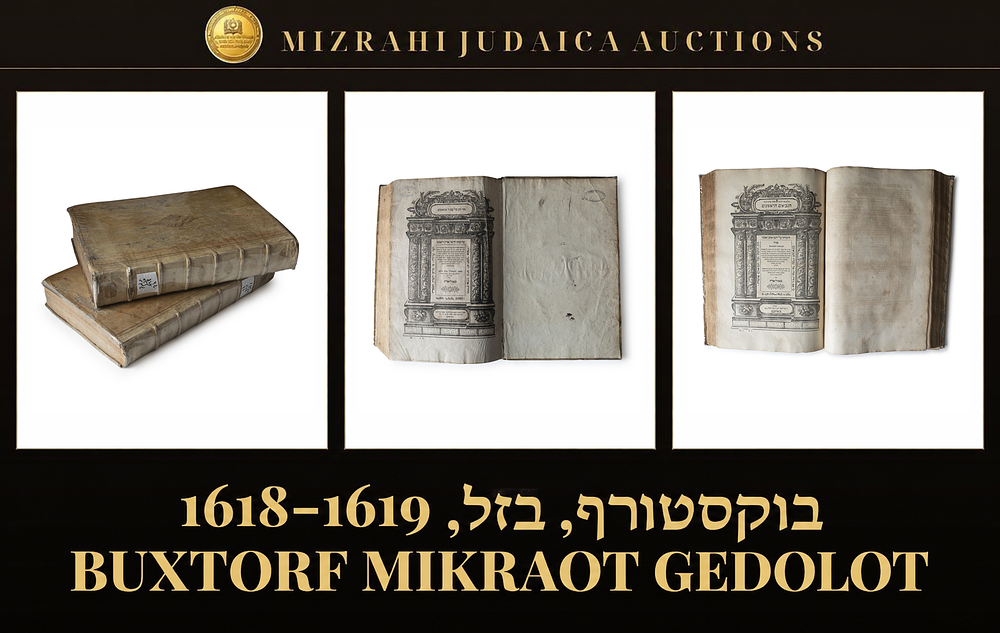
Bidspirit auction | MIKRA’OT GEDOLOT - BUXTORF’S MONUMENTAL
MIKRA’OT GEDOLOT - BUXTORF’S MONUMENTAL RABBINICAL BIBLE BASEL, 1618–1619 - COMPLETE IN TWO MASSIVE FOLIO VOLUMES, WITH TIBERIAS - THE JEWISH CORRECTORS OF THE BASEL PRESS The great Basel Rabbinical Bible of Johannes Buxtorf the Elder (1564–1629), printed by Ludwig König, 1618–1619. Complete in two monumental folio volumes, with Buxtorf’s Tiberias bound from the opposite end of the first volume. One of the great scholarly Bibles of the seventeenth century, and the culmination of decades of Christian Hebraist engagement with the Jewish biblical tradition. Buxtorf did not intend merely to reproduce an earlier Mikra’ot Gedolot. Taking the 1546–48 Venetian Rabbinical Bible as his principal model, he deliberately drew upon the other great Venetian editions as well, incorporating, among other material, Ibn Ezra from the 1524–25 edition and portions of the Masorah Gedolah from the 1568 printing, in an attempt to gather the best of the Venetian tradition into a single edition. The result is formidable even before the book is opened. These were not volumes meant to be carried to shul, but to remain open in the scholar’s study, where the broad folio page could accommodate an entire world around the biblical text: Targum, the classical commentators, and the Masorah. The work became a standard tool of biblical scholarship and was sufficiently expensive in its own day that Burnett places Rabbinical Bibles of this sort well beyond the reach of most individual scholars. Yet behind this imposing Christian-Hebraist production stood a remarkable group of Jewish editors and correctors, some of whose names and voices remain printed in the present volumes. Chief among them was R. Abraham b. Eliezer Braunschweig, whose Hebrew preface appears immediately following the title page and whose poem appears among the concluding leaves. The realities of producing such an enormous Hebrew work were considerable. König’s shop was expected to set and print three folio pages on a working day, although most of its Christian typesetters could not themselves read Hebrew. The Jewish correctors consequently worked under intense pressure, and when the Christian printers continued setting Hebrew type on Shabbos, without their Jewish correctors beside them, mistakes inevitably crept into the sheets. The problem was sufficiently memorable to enter later Jewish bibliographical literature, with Braunschweig noted among the Hebrew proofreaders who complained of precisely this predicament. The very presence of these Jewish workers in Basel was exceptional. Jews were ordinarily forbidden to reside in the city, with limited concessions made for those whose expertise was required by its Hebrew presses. And in the summer of 1619, while this Bible was approaching completion, the precarious arrangement nearly collapsed altogether. Braunschweig’s wife had given birth to a son, and a bris was held in Basel on June 2, attended by Buxtorf, members of the König printing circle and Jewish guests. The affair brought the participants into conflict with the municipal authorities. Braunschweig was heavily fined, as were Buxtorf and König, and the Jewish correctors faced expulsion. Buxtorf feared that their removal would make it impossible to finish the Rabbinical Bible. König ultimately persuaded the authorities to allow the Jewish workers to remain just long enough to complete the edition for the approaching Frankfurt book fair, after which they were required to leave Basel. Thus the Hebrew poems and colophons at the end of these volumes are more than ornamental preliminaries and finales. They preserve something of the Jewish personnel who actually stood behind the type as this monumental edition made its way through the press. The Hebrew Bible occupies 946 folios, followed by an extensive separately paginated apparatus: Targum Yerushalmi, Masorah Gedolah, Pesikta, Chillufei Keri’ah, Chilluf Ha-Torah and Sha’ar Ha-Neginot, concluding with Hebrew poems and colophons by members of the printing circle, including Braunschweig and Elijah b. Judah Ulma. Bound from the opposite direction at the rear of the first volume is Buxtorf’s separately titled Tiberias, sive Commentarius Masorethicus, 114 pages. Its presence here is not incidental: Buxtorf conceived Tiberias specifically as a guide to the four principal elements of his Basel Bible -the Hebrew text, Targum, commentaries and Masorah- and the folio edition was expressly produced to be bound together with the Rabbinical Bible. The physical arrangement is particularly apt: the Jewish biblical and exegetical tradition opens from one direction, while Buxtorf’s Latin exposition of its Masoretic apparatus opens from the other. This copy bears the stamp of the Bibliothèque du Grand Séminaire Saint-Charles d’Avignon , an especially fitting later provenance for a work created at the intersection of traditional Jewish learning and Christian biblical scholarship. Copy description : Two massive folio volumes.