Bidspirit auction | BEN ISH CHAI MANUSCRIPT Autograph
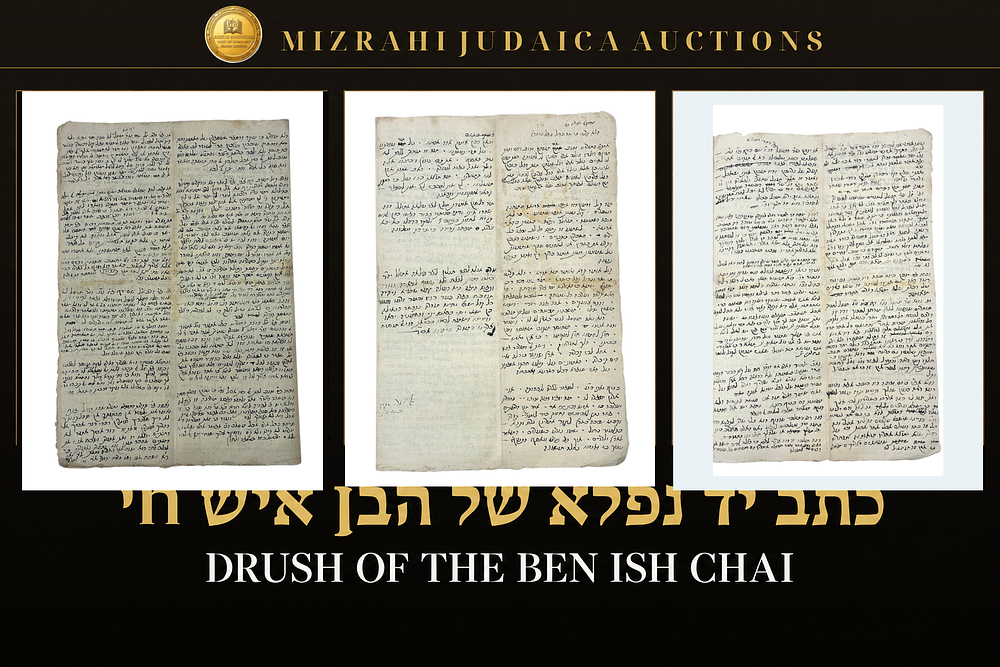
BEN ISH CHAI MANUSCRIPT Autograph Drush Manuscript by Rabbi Yosef Chaim of Baghdad (1832–1909), the ”Ben Ish Chai.” - BEN ISH CHAI MANUSCRIPT Autograph Drush Manuscript by Rabbi Yosef Chaim of Baghdad (1832–1909), the ”Ben Ish Chai.” Few figures embodied the remarkable renaissance of nineteenth-century Baghdadi Jewry more fully than Ezekiel Judah (1800–1860). Born into the distinguished Ma'tuk (Judah) family of Baghdad, he combined extraordinary success as a merchant with profound Torah scholarship, communal leadership, and philanthropy. After settling in Calcutta, he became the acknowledged leader of its rapidly growing Baghdadi Jewish community, founded the city's first synagogue (Neveh Shalom), helped establish Beth El, maintained a yeshivah, educated impoverished students, and emerged as one of the principal architects of the Baghdadi Jewish diaspora in India. His marriage to Rachel, daughter of Rabbi Moshe Chaim, forged a family bond with the household from which the Ben Ish Chai would later emerge, making him the brother-in-law of the Ben Ish Chai's father. The present manuscript preserves Rabbi Yosef Chaim's autograph preparation for the eulogy he delivered upon Ezekiel Judah's passing. Significantly, the manuscript bears the evocative heading ”...כי שר וגדול נפל בישראל” (”...for a prince and a great man has fallen in Israel”), consciously echoing King David's lament for Avner (II Samuel 3:38). The choice of title is itself a powerful tribute, reflecting the extraordinary esteem in which Ezekiel Judah was held by both family and community, and underscoring that his death was regarded as a loss extending far beyond his immediate circle. Particularly revealing is the young Ben Ish Chai's citation of Kol Yaakov, the celebrated collection of derashot by Rabbi Yaakov Kranz (1741–1804), the Dubno Maggid. The reference demonstrates that, while still in his twenties, the future Ben Ish Chai was already drawing naturally upon one of the classic masterpieces of the Ashkenazic homiletic tradition. Thousands of miles from the great centers of Eastern European Jewish learning, the rising Baghdadi preacher had already incorporated its most celebrated sermonic literature into his own intellectual world, a striking testament to the remarkable circulation of books and ideas across the nineteenth-century Jewish diaspora. The manuscript itself consists of the Ben Ish Chai's working notes for the funeral oration, accompanied by what appear to be related homiletic excursuses on the themes of mourning and eulogy. Rather than a fair copy prepared for delivery, these pages preserve the sermon in the midst of composition, with numerous cancellations, interlinear insertions, and marginal additions recording the author's ongoing refinement of the text. Such working manuscripts are exceptionally uncommon, affording a rare glimpse into the creative workshop of one of the most influential Sephardic rabbis of the modern era. Autograph manuscript on paper. Baghdad, circa 1860. Eight pages on four tall, narrow conjugate bifolia, folded vertically. Minor worming at the upper margins and along one central fold, expertly repaired. Opening price: $6,500