Bidspirit auction | AUTOGRAPH LETTER. R. Avraham Binyamin
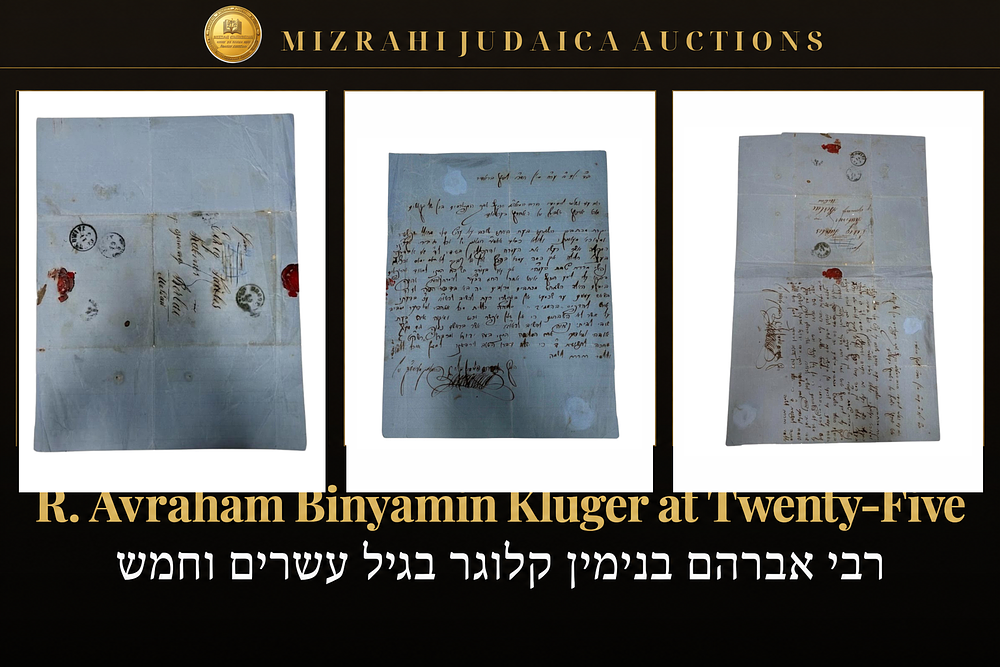
AUTOGRAPH LETTER. R. Avraham Binyamin Kluger at Twenty-Five: “I Would Have Perished in My Affliction.” Dramatic Letter Following a Near-Fatal Illness, to R. Yitzchak Aizik Taubes of Bârlad. Brody, 1866 - An unusually personal autograph letter from R. Avraham Binyamin Kluger (1841–1915), son of the celebrated R. Shlomo Kluger (1785–1869), written while still recovering from a grave illness. Addressed to R. Yitzchak Aizik Taubes (c. 1834/37–1920), Rabbi of Bârlad, it provides a remarkable private prelude to a public announcement Kluger would publish only weeks later in HaMaggid. Brody, Monday, Erev Rosh Chodesh Sivan 5626 [May 14, 1866]: Kluger opens warmly to Taubes as “ידידי הרב המאה״ג חריף ובקי... בנן של קדושים מוה׳ אייזיק טוביש... האבד״ק בערלאד”. Taubes was indeed a distinguished rabbinic scion, grandson of R. Aharon Moshe Taubes (1787–1852), the famed Rabbi of Iași and author of To’afot Re’em and Karnei Re’em. By 1862, Yitzchak Aizik had received official recognition as rabbi of Bârlad; he would become an important figure in Romanian Jewish public life. The substance of the letter, however, is startlingly personal. Kluger tells Taubes that his letter had arrived when he was already “שוכב על ערש דוי”, lying on a bed of severe illness. He believed his condition had become genuinely perilous. Were it not for his father, R. Shlomo Kluger, and the other great and distinguished men who rallied to pray for him, he writes, “אז אבדתי בעניי חלילה”, “then, Heaven forbid, I would have perished in my affliction.” His doctors had now instructed him to travel after the approaching festival of Shavuot “להמרחצאות”, to the baths for recuperation. In the meantime, letters had accumulated from every direction, concerning a multitude of subjects, and he was physically unable to answer them all. Kluger therefore tells Taubes of his intention to publish a public apology in HaMaggid explaining to his many correspondents why their letters had gone unanswered. He closes with the prayer that his strength return, enabling him to respond as necessary and, above all, “אוכל ללמוד וללמד תורתו לשמה”, that he might once again study and teach God's Torah for its own sake. Remarkably, Kluger was only about twenty-five years old . Already at that age, his Torah correspondence was sufficiently extensive that a serious illness created a backlog requiring a public explanation in one of European Jewry's principal Hebrew newspapers. Born in Brody in 1841, he had studied principally under his father, who cited his Torah observations from an early age. He would later become an author and editor in his own right and an important custodian of his father's enormous literary legacy. On 18 Sivan 5626 [June 1, 1866], barely three weeks after the present letter, HaMaggid printed a lengthy communication by Kluger under the striking heading “התנצלות”. It provides an extraordinary public counterpart to this private letter. Kluger explains himself to the numerous Torah scholars and correspondents who had sent him letters, questions, manuscripts and books, and then turns to the illness which had rendered him incapable of dealing with them. The published account also reveals the scale of what had happened in Brody. Kluger describes a communal response extending “למקטן ועד גדול”, from the small to the great, involving the city's rabbinic and communal leadership, wealthy householders and scholars, who exerted themselves in prayer on his behalf. Now recovered, he publicly blesses those whose prayers he credited with his restoration to health. The letter also brings together two notable rabbinic dynasties. Its author was the son of R. Shlomo Kluger, the extraordinarily prolific Brody posek whose responsa circulated throughout Europe; its recipient was the grandson of R. Aharon Moshe Taubes of Iași. R. Shlomo Kluger himself remained active in Brody until his death three years later, on June 9, 1869. One autograph letter on dark blue paper, the paper appearing substantially lighter in the accompanying photographs. Written and signed הק׳ אברהם בנימין קליגר בהגאון מוהרש״ק ש׳. The integral address panel is inscribed in Latin script to “Isaac Taubes, Rabbiner in Berlad, Moldau, ” with contemporary postal cancellations. The sheet was folded horizontally and vertically into a compact self-mailing letter and sealed for transmission; substantial remnants of the original red wax seals survive. Fold wear, small tears and occasional stains, with minor wear along folds and edges. References: HaMaggid, 18 Sivan 5626 Opening price: $1,500