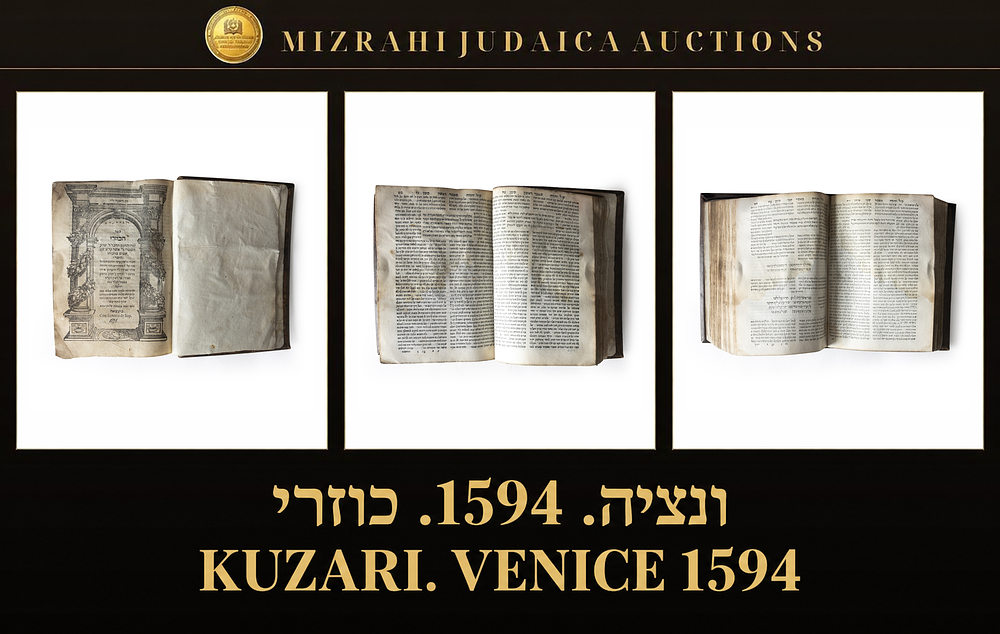
Bidspirit auction | VENICE. 1594. KUZARI. SEFER HA-KUZARI,
VENICE. 1594. KUZARI. SEFER HA-KUZARI, WITH KOL YEHUDAH. VENICE, 1594. FIRST EDITION OF KOL YEHUDAH. - R. Yehudah ha-Levi, Sefer ha-Kuzari, with Kol Yehudah by R. Yehudah Moscato. The Kuzari of R. Yehudah ha-Levi (c. 1075–1141), cast as the celebrated dialogue between the king of the Khazars and the Jewish sage, here accompanied for the first time by the Kol Yehudah of R. Yehudah Moscato (c. 1530–1593). Written in Renaissance Italy by one of its most learned Jewish preachers and thinkers, Moscato’s expansive commentary brought the medieval philosophical dialogue into the intellectual world of Italian Jewry and became one of the principal commentaries through which the Kuzari was studied. The circumstances surrounding the printing of this edition are unusually well documented. Its editor, R. Shlomo Shemayah Sforno, closes with a candid plea that the reader judge charitably the errors which escaped his efforts to produce a corrected text. His account offers a rare glimpse into the hurried workings of a sixteenth-century Venetian Hebrew press. Sforno describes himself as having approached the sacred task כמזקק ומטהר הכתב מכתב הדפוס, refining and purifying the text for print as far as his abilities allowed. But the realities of the printing house were less accommodating. He complains that the proprietors would pressure him, hurrying the Jewish correctors with the words of Pharaoh’s taskmasters, כלו מעשיכם דבר יום ביומו, “finish your work, each day’s work on its day.” Friday presented its own difficulty. Playing upon the Biblical description of the double portion of manna prepared before Shabbos, Sforno writes: והיה ביום הששי והכינו את אשר יביאו לחם משגה On the sixth day they prepared, as it were, a לחם משגה, a “portion of errors.” The joke concealed a very practical problem. Work had to be prepared as Shabbos approached, while the Christian personnel of the press were not bound by the Jewish working week. Sforno goes on to complain of errors arising בשעת ההדפסה, during the printing itself, when type broke or one letter was substituted for another by המדפיסים אשר לא מבני ישראל המה, “the printers, who were not of the Children of Israel.” Contemporary discussion of the passage has understood his complaint to include errors introduced while the press continued operating beyond the Jewish corrector’s ability to supervise it. There was another, quite deliberate, kind of textual intervention in this edition. Printing the Kuzari in Counter-Reformation Venice required sensitivity to the Christian censor, and comparison with earlier texts reveals passages which were softened or altered where R. Yehudah ha-Levi’s original language could give offense . Some of these changes have been attributed specifically to the di Gara printing house. The result is an edition which preserves within its pages traces of both sides of Venetian Hebrew printing: the ordinary hazards of producing a complicated Hebrew text with non-Jewish pressmen, and the calculated accommodations sometimes required to get such a text through the press at all. The physical construction of the volume has its own bibliographical peculiarity. Blank leaves were deliberately left following the first four ma’amarim, without interrupting the foliation. These are original to the edition and are sometimes absent from surviving copies. Their presence should therefore not be mistaken for later blanks or missing text. Title page followed by three-leaf foreword; text begins f. 5 and continues through f. 299b. Blank unnumbered leaves following each of the first four ma’amarim, without interruption of the pagination. Fol. 124 misnumbered 109; f. 135 likewise misnumbered. Complete copy, in full leather detailed binding. No worming or damp staining. Some age-staining. Attractive copy. References : Amram, The Maker 354; Benayahu, Haskamah (Heb.) 208; Yaari, Studies in Hebrew Booklore (Heb.) 173. Provenance : The collection of Abraham Lieberman, Flatbush, Brooklyn NY