Bidspirit auction | INCUNABULA. COMPLETE. Sefer HaShorashim. R.
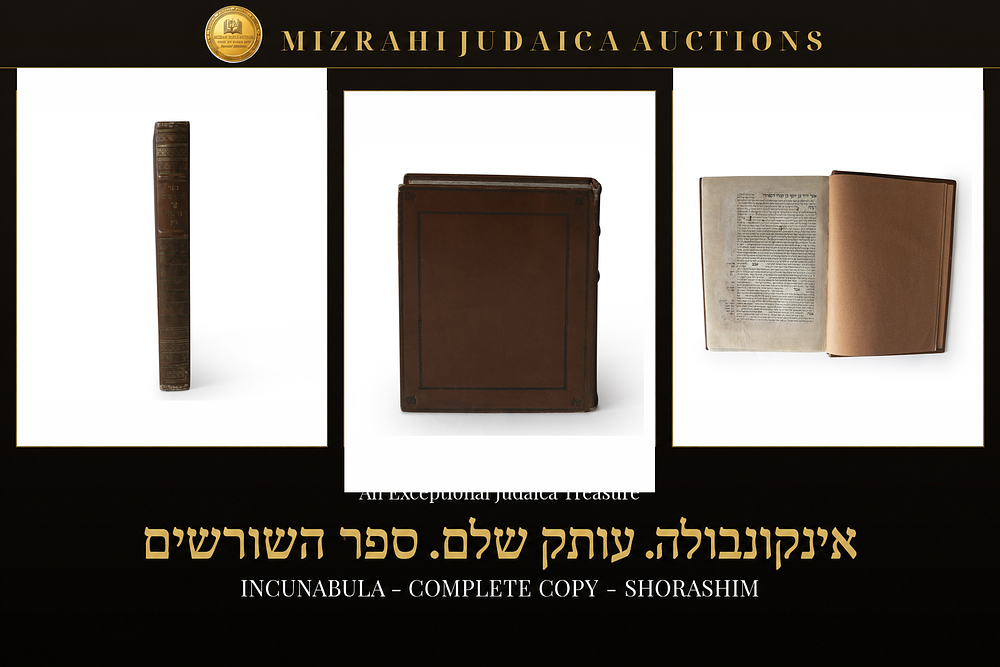
INCUNABULA. COMPLETE. Sefer HaShorashim. R. David Kimchi (Radak; 1160-1235). Edited by R. Samuel ben Meir Latif. Naples, Elul 1490. - Radak's monumental Sefer HaShorashim, one of the foundational works of Hebrew philology and biblical exegesis. Originally composed as the lexical portion of the author's Mikhlol, the Shorashim rapidly assumed an independent status and became the indispensable dictionary of Biblical Hebrew for generations of scholars. Organized alphabetically by Hebrew roots and illustrated with hundreds of scriptural citations, it furnished students and commentators with a systematic guide to the language of Tanakh, securing its place as one of the most influential Hebrew reference works ever printed. Issued in Naples under the editorship of R. Samuel ben Meir Latif, this incunable appeared less than two decades after the Roman editio princeps and reflects the extraordinary demand for Radak's lexicon during the earliest years of Hebrew printing. The work would remain the standard Hebrew dictionary for centuries, shaping both traditional Jewish learning and the study of Hebrew among Christian Hebraists. An extensively studied copy, preserving a substantial corpus of early scholarly annotations throughout, including precise biblical references, lexical clarifications, and extensive manuscript vocalization of Radak’s text. The latter raises a tantalizing possibility. A copy of Radak’s commentary to Nevi’im Aharonim (Soncino, 1486), formerly owned by R. David de Pomis, is likewise extensively vocalized in manuscript. De Pomis, scion of the celebrated Italian Jewish Min ha-Tappuhim family, was a remarkable Renaissance figure: rabbi, physician and philologist, whose eventful career eventually brought him to Venice. There he published his celebrated Tzemach David (1587), a pioneering Hebrew-Latin-Italian dictionary for which Radak’s Sefer HaShorashim served as one of his principal lexical sources. The extensive vocalization of the present volume thus raises the intriguing possibility that this copy, too, may once have passed through de Pomis’s hands, perhaps even serving him in the preparation of his own lexicographical work. The evidence remains circumstantial, however, and no attribution of the annotations can presently be established. Second edition. 143 leaves (as issued; without title page, as in all incunabula). Multiple leaves with skillfully restored margins and minor repairs. Extensive contemporary manuscript annotations throughout. Bound in later full leather binding.