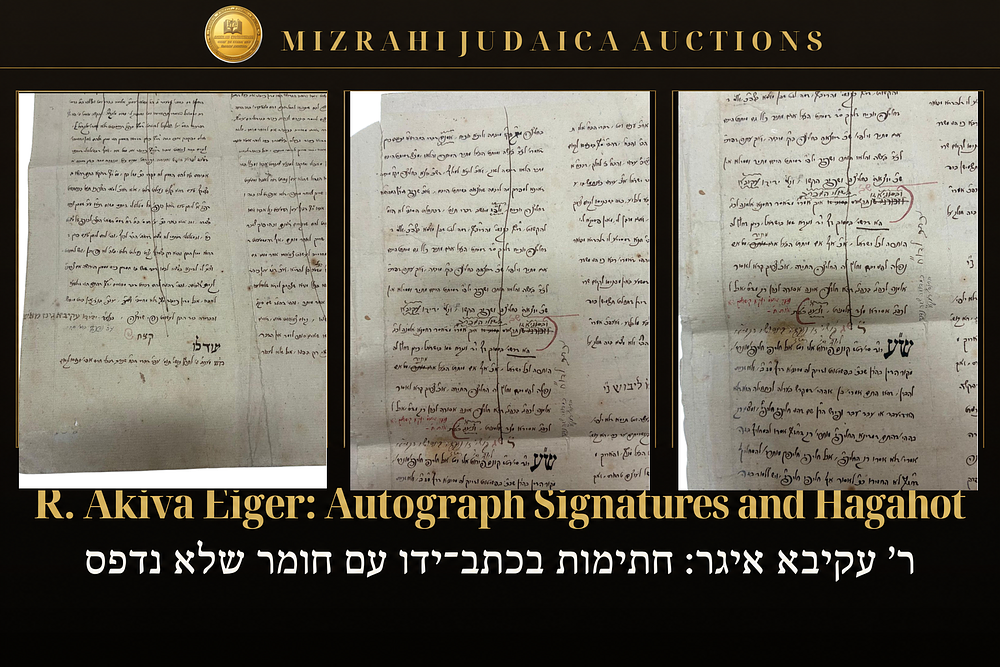
Bidspirit auction | R. Akiva Eiger: Autograph Signatures
R. Akiva Eiger: Autograph Signatures and Editorial Corrections, with Unpublished Material and Fuller Versions of His Printed Writings - Marginal notes and signatures by the Gaon Rabbi Akiva Eiger! The rest of the text is in the handwriting of his son, the Gaon Rabbi Avraham Eiger. An extraordinary manuscript folio from the papers of R. Akiva Eiger, bearing two of his autograph signatures and several corrections and editorial additions in his own hand . The folio preserves responsa and chiddushim at an unusually revealing stage in their transmission, including material omitted from the printed Teshuvot and substantially fuller versions of passages later printed as his glosses to Shulchan Arukh. Among the texts is a responsum to R. Moshe Ze’ev Wolf Margolies of Bialystok, subsequently printed in Shu”t Rabbi Akiva Eiger (I:68), concluding here with R. Akiva Eiger’s striking autograph ידידו עקיבא גינז מא״ש, his name written prominently in square letters. Immediately following is a second piece headed עוד לו, apparently another communication to Margolies. Curiously, this second response was never printed among R. Akiva Eiger’s responsa. Its halachic substance instead surfaced decades later among his glosses to Shulchan Arukh, Yoreh De’ah 135. The manuscript, however, preserves a considerably fuller and more personal version, including its original epistolary language and several lines absent from the printed gloss. The following page offers a remarkable glimpse into the preparation of R. Akiva Eiger’s writings for publication. An original heading עוד לו, together with the place-name שעדליץ, was crossed out and replaced with להרב מ׳ ליבוש נ״י. The mysterious “R. Leibush” has been identified with the young R. Meir Leibush Malbim , an alluring possibility: the future Malbim was already an acclaimed young scholar during R. Akiva Eiger’s lifetime and is known to have sought and received his approbation for Artzot HaChaim. The identification, however, does not appear to have been conclusively established. Here the manuscript is particularly valuable: its discarded שעדליץ apparently records an early mistaken attempt to identify the recipient, subsequently corrected before publication. This responsum was ultimately printed in Shu”t Rabbi Akiva Eiger (I:156), but the present manuscript continues beyond the printed text. After signing ידידו עקיבא , R. Akiva Eiger added further material under the autograph notation בשולי המכתב. These additional lines were omitted from the published responsum. Beside them appears another autograph intervention, the wonderfully characteristic וצע״ג כעת . The familiar צע״ג of R. Akiva Eiger has become almost proverbial in the beit midrash; here one encounters it not as a printed gloss but directly from his pen, the added כעת capturing the scholar still reconsidering his own words. At the bottom of the same page begins another substantial passage, introduced by the conspicuous heading ש״ע. Here again the manuscript preserves considerably more than was ultimately published: a truncated form of the discussion later appeared among R. Akiva Eiger’s glosses to Yoreh De’ah 216. Thus, within a single folio, texts followed strikingly different paths into print: one became a published responsum; another disappeared as correspondence but survived, abbreviated and reshaped, as a Shulchan Arukh gloss; another responsum was printed while R. Akiva Eiger’s own marginal addition was left behind and resurfaced in Chiddushim collections; and yet another fuller discussion was reduced to a shorter gloss. The transformations visible on this folio are particularly striking in light of R. Akiva Eiger’s own instructions for the publication of his writings. In letters printed by his sons in the introduction to the Teshuvot, R. Akiva Eiger gave them surprisingly broad latitude in arranging his papers. Questions need not be reproduced in their original form; their essential point could be extracted, personal addresses and titles removed, and where several responses treated the same subject, material from one could even be incorporated into another. When his son proposed selecting the responsa and arranging them according to the order of the Tur, R. Akiva Eiger expressly approved. He explained why such reshaping did not trouble him. His letters were not composed as finished literary units intended for publication. A responsum might contain a valuable discussion only loosely connected to the question that occasioned it; at other times he deliberately wrote at length out of affection for the correspondent, or even to cheer a questioner whom he knew to be suffering. Such material was worth preserving on its own merits: “אמרתי בלבי ימצאו מנוח במקום אחר”, “I said in my heart, they will find a resting place elsewhere.” The present folio offers a remarkable illustration of precisely that fluidity. Material originally written as correspondence is preserved here in fuller, personal form,