Bidspirit auction | VENICE. 1576. PEREK SHIRAH. BEIT
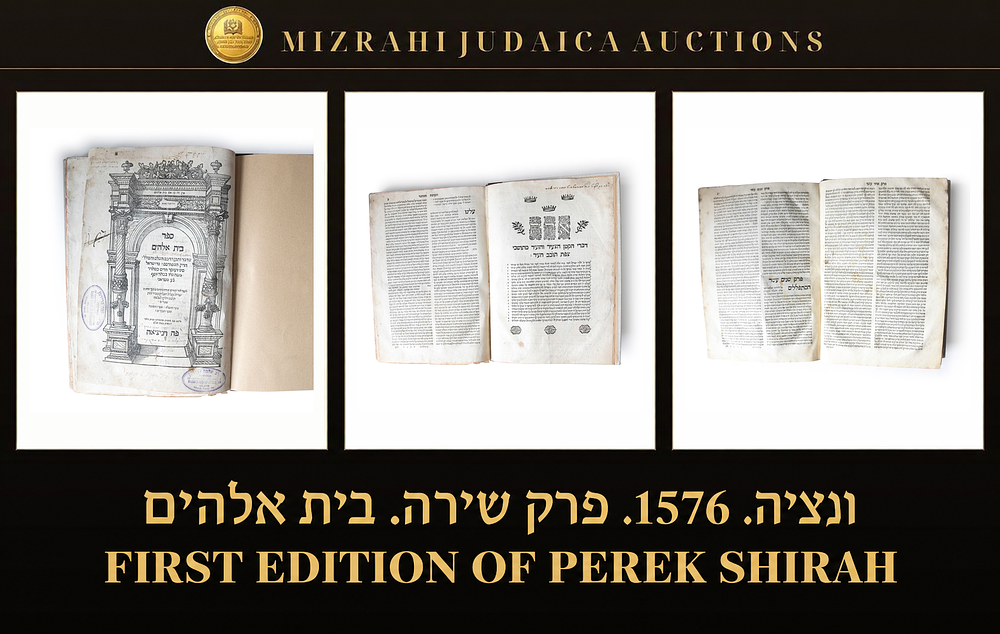
VENICE. 1576. PEREK SHIRAH. BEIT ELOHIM. R. MOSHE DI TRANI (MABIT). - VENICE, 1576, FIRST EDITION WITH THE FIRST PRINTING OF PEREK SHIRAH. R. Moshe b. Yosef di Trani, the Mabit (1505–1585). Venice: Giovanni di Gara, 1576. First edition, printed during the author's lifetime. One of the great works of religious thought to emerge from sixteenth-century Safed. Beit Elohim is the Mabit's ambitious attempt to give order to the inner architecture of Jewish life, arranged around three “gates” by which one enters the House of God: prayer, repentance, and the foundations of faith. Drawing together teachings on Providence, Eretz Yisrael, Torah, prophecy and redemption, the work transforms material scattered through earlier derash and mussar literature into a remarkably coherent religious vision. Particularly striking is the Mabit's conception of Eretz Yisrael, where even such physical realities as climate, rainfall and the produce of the Land become expressions of man's dependence upon and relationship with God. The volume opens with an unusual series of voices from the world in which it was produced. A prefatory composition by R. Baruch b. R. Eleazar Ha-Kohen, a resident of Safed, identifies its author through an acrostic. The Mabit's own introduction is followed by two striking poetic compositions, apparently his own: a שיר הלציי על עשר ספירות, on the Ten Sefirot, followed separately by על י״ג עקרים, rendering the Thirteen Principles of Faith in verse. Their appearance side by side, at the threshold of a work otherwise ranging freely across mussar, derash, theology and philosophical reasoning, is a particularly evocative glimpse of the intellectual world of Safed. The first edition is also visually inventive . On ff. 44b–45a appears a remarkable two-page typographical representation of the Luchot, incorporated directly into the discussion of the arrangement of the Ten Commandments, with differences of scale and disposition becoming part of the printed exposition itself. Elsewhere the book preserves unusually candid traces of its journey from manuscript to press. At the end of f. 67b the text simply announces כאן חסר בהעתקה, “here [the text] is missing in the copy, ” leaving visible in the finished book a lacuna inherited from the material supplied for printing. The volume culminates with the first appearance of Perek Shirah in print , complete here in its ten leaves and accompanied by the Mabit's important commentary. His interpretation confronts the mysterious premise of Creation itself “singing, ” seeking to understand the praise of animals, plants and the inanimate world through the purpose and divine benefit embodied in Creation. The decision to append the complete text to Beit Elohim brought Perek Shirah and its interpretation into the world of print and gave the commentary a circulation unavailable to its manuscript predecessors. The Venetian press itself makes a final appearance in the concluding material. R. Yitzhak b. Gershon Treves records his role in the preparation of the edition and leaves an extraordinary glimpse behind the doors of the Hebrew printing house: the work was carried out by gentile laborers who continued arranging the printing on Shabbat, when Jewish supervision was absent. The title page, meanwhile, proudly advertises that the book was printed “with the letters of Bomberg”, an evocative link to the great earlier age of Venetian Hebrew printing. This copy bears substantial early manuscript annotations, particularly striking at the opening of Sha'ar HaTefillah, where an early Italian hand surrounds the printed text with dense marginal commentary . Title page with early ownership inscriptions, including קנין כספי יעקוב(!) חנוך ברוך יצ״ו, and later stamps of Rabbi Shlomo Friedman, Tel Aviv, Achad Ha'am 89. Folio. 120, [6], 10 leaves, complete with the final ten leaves of Perek Shirah. Later cream cloth boards with brown quarter-leather spine, raised bands, blind-tooled ornaments and Hebrew lettering. Architectural woodcut title-page border. Age staining throughout. Only a few minor wormholes, professionally repaired.. Overall a substantial and compelling copy, enlivened by early scholarly use. References : Pachter, Haburot ve-hibburim 145-153; Beit-Arié, Perek Shirah (Ph.D. diss., Hebrew University, 1966), 22–24, 95. Provenance : The collection of Abraham Lieberman, Flatbush, Brooklyn NY