Bidspirit auction | TASHBETZ. She’elot u-Teshuvot Tashbetz. Amsterdam,
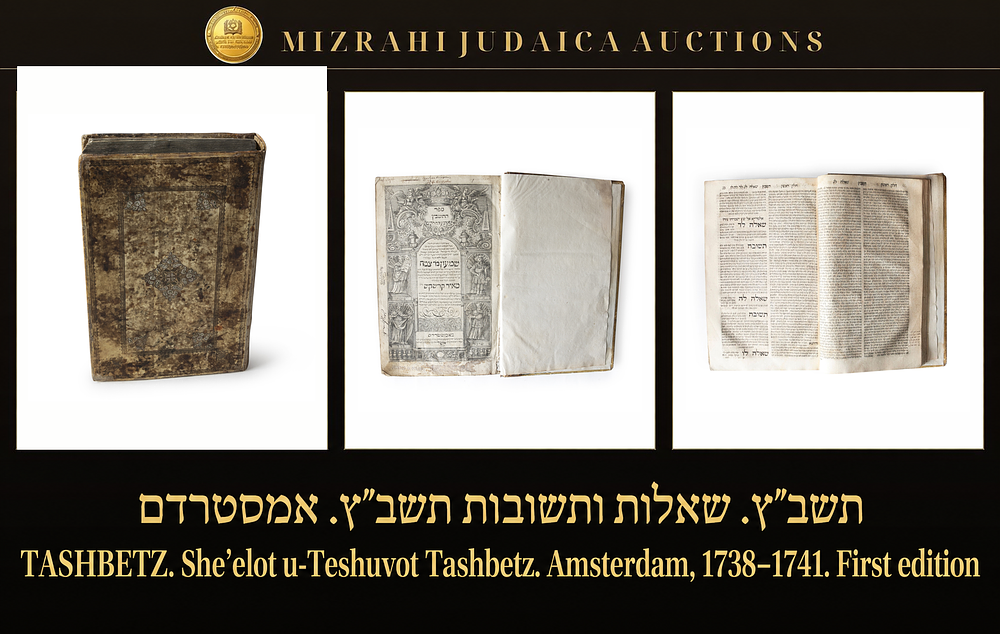
TASHBETZ. She’elot u-Teshuvot Tashbetz. Amsterdam, 1738–1741. First edition. - Although revered for centuries as one of the great responsa collections of Sephardic Jewry, the Tashbetz remained in manuscript for nearly three hundred years after the death of its author, Rabbi Shimon ben Tzemach Duran (1361–1444). The present Amsterdam edition marks its long-awaited first appearance in print, preserving not only the responsa of the foremost halachic authority of medieval North African Jewry, but also Chut Ha-Meshulash, the companion collection spanning three generations of the illustrious Duran family. Its publication finally made accessible a work that had profoundly influenced Sephardic halachic literature long before it ever reached the press. The story of the edition is as remarkable as the work itself. Repeated efforts to publish the Tashbetz met with frustration for decades. An early attempt by R. Shalem Nehemias came to a tragic end with his murder before the project could be completed, leaving the manuscript once again without a publisher. When the undertaking was later revived under the leadership of R. Meir Crescas, it encountered further, almost ironic, delays; during his fundraising travels, influential patrons, captivated by his scholarship and personality, repeatedly prolonged his stay through generous hospitality, unintentionally postponing the work's publication. Undeterred, Crescas spent nearly a decade (1734–1742) traveling through North Africa, Italy, France, England, Holland, Germany, and the Ottoman Empire, securing approbations, subscribers, manuscripts, and financial support. His efforts became one of the earliest large-scale campaigns devoted to preserving the literary heritage of North African Jewry and ultimately brought one of its foundational works from manuscript into print. Modern bibliographical scholarship has shown that this first edition possesses one of the most fascinating publication histories in Hebrew printing. Through meticulous examination of title-page woodblocks, cancel leaves, and gathering structure, researchers demonstrated that the differing title pages found among surviving copies do not represent separate editions, as had long been assumed, but successive states of a single edition whose publication plan evolved while already on press. Originally conceived as a two-volume work, the edition was repeatedly reorganized during production, leaving behind a bibliographical puzzle that remained unsolved for more than two centuries. Remarkably, the solution lay not in newly discovered documents but in the physical books themselves: progressive wear and alteration to the engraved title-page borders enabled researchers to reconstruct the sequence in which the various states were printed. The present copy preserves the engraved architectural general title dated תק״א (1741) depicting Moses, Aaron, David, and Solomon , followed by the celebrated lion title to Chut Ha-Meshulash and the three sectional title pages to its respective divisions. Equally noteworthy is the contemporary decorated vellum binding, preserved in its original form. The distinctive mottled vellum bindings found on many surviving copies of the first edition have long been known among collectors as the edition's ”fish-skin” bindings, although whether they are in fact fashioned from fish skin or from specially prepared vellum remains the subject of scholarly debate. Whatever their precise composition, their characteristic appearance has become one of the visual hallmarks of the edition. A charming tradition, recorded by R. Rahamim Nissim Palachi, attributes the unusually handsome printing and binding of the Tashbetz to the author's lifelong reverence for books, relating that R. Shimon ben Tzemach Duran habitually covered the volumes before him with a fine cloth while studying. Significantly, an unusually large proportion of surviving copies continue to retain these original bindings, a rare circumstance for an eighteenth-century Hebrew book. Condition : Contemporary decorated vellum. Minor marginal annotation on Part I, fol. 22b. Small tear to the lower left corner of Part I, fol. 89. An attractive, internally consistent copy preserving one of the principal bibliographical states of this celebrated first edition. References : Dan and Gita Yardeni, Alei Sefer 10, pp. 119–132; Kattan, Resp. Tashbetz (1998), introduction; Palachi, Yafeh la-Lev YD 277:3 Provenance : The collection of Abraham Lieberman, Flatbush, Brooklyn NY