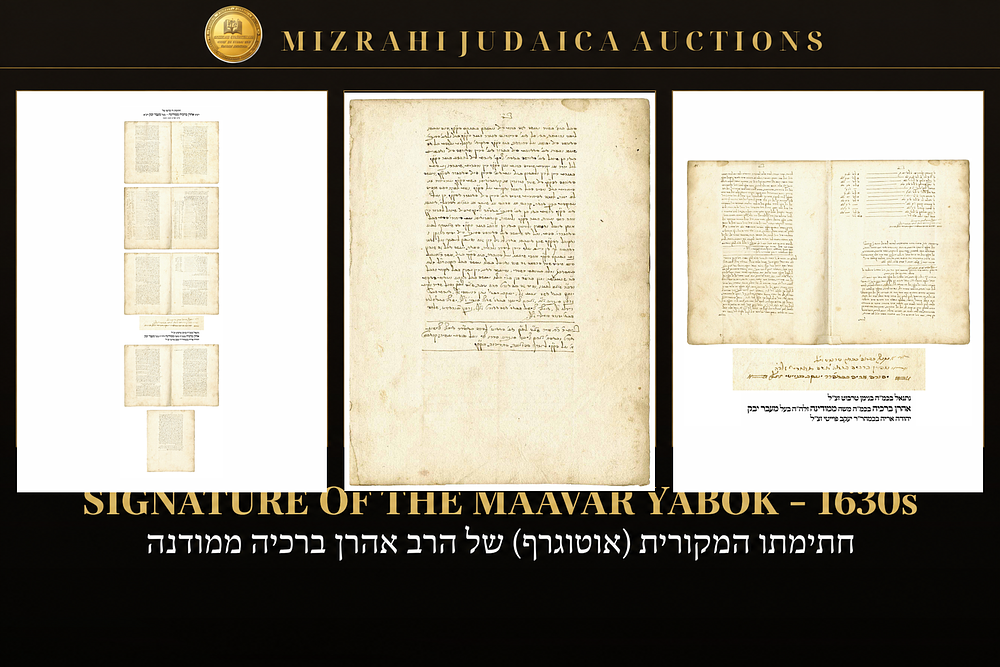
Bidspirit auction | SIGNATURE OF THE MAAVAR YABOK
SIGNATURE OF THE MAAVAR YABOK PROTOCOLS OF THE RABBINICAL COURT OF MODENA — AUTOGRAPH SIGNATURE OF RABBI AHARON BEREKHIAH OF MODENA. Modena, late 1630s. - SIGNATURE OF THE MAAVAR YABOK PROTOCOLS OF THE RABBINICAL COURT OF MODENA — AUTOGRAPH SIGNATURE OF RABBI AHARON BEREKHIAH OF MODENA. Modena, late 1630s. Background to the manuscript: A Christian censor issues a demand. The leaders of the Jewish community formally acknowledge it. Aging officials ask that their sons assume their duties. Three distinguished rabbis are appointed to divide the community’s tax burden; household after household is entered into the ledger, each with the sum assessed against him. Elsewhere, litigants select arbitrators and bind themselves in writing to accept their judgment. Together, they preserve the machinery of a seventeenth-century Jewish community at work. The rabbinical court of early modern Italy was more than a tribunal for questions of ritual law. It operated within an elaborate system of communal government in which rabbinic judges, lay officers, tax assessors and appointed arbitrators administered much of Jewish life. Civil disputes could be submitted to Jewish arbitration by agreement of the parties, precisely the function served by the shtarei berurin preserved here, while communal enactments and internal discipline gave rabbinic decisions practical force. The Italian rabbi functioned within, and not above, this organized communal structure: his authority intersected continually with that of elected lay leaders and the surrounding Christian state. The first docket records a demand originating with the official Christian censor: the community was to nominate a suitable “מזקק”, the Jewish expurgator responsible for locating and removing passages prohibited by ecclesiastical authority. The communal leaders’ receipt of the notice is then formally documented. The entry belongs to a particularly fraught moment in Modenese Jewish history. The papal Inquisition had assumed jurisdiction over professing Jews in Modena and used the control and expurgation of Hebrew books to penetrate deeply into communal and intellectual life. In 1636, only shortly before these proceedings, leading Jewish scholars and merchants, including R. Aharon Berekhiah himself, were interrogated for possessing prohibited books. Other minutes record the quieter transitions upon which communal life depended. The aging Gershon Sanguinetti could no longer perform his public duties in Asolo, and authorization was sought for his son Menahem to serve in his stead. At the same session, a similar request was presented on behalf of Yosef Saba, to be replaced by his son Shlomo. In a few concise lines, the protocol captures formal authority passing from father to son through the deliberate approval of the court and communal leadership. The manuscript then opens into an imposing fiscal record. Three men are elected as official “מבררים” and assessors of communal dues: Rabbi Nethanel ben Benjamin Trabotto, Rabbi Aharon Berekhiah ben Moses of Modena, and Rabbi Judah Aryeh Poggetto (פוייטו), also known as Leone Poggetti. A long roll follows, listing the members of the community and the amount imposed upon each. The names and figures continue across successive pages until the completed assessment is authenticated by the three rabbis, each signing in his own hand. At their head stood R. Nethanel Trabotto of Modena (1568–1653), one of the commanding Italian halakhic authorities of his generation. Born in Ascoli and educated in Pesaro and Ferrara, he settled in Modena while still a young man and remained there for more than sixty years. He eventually served as rabbi of the community and head of its yeshivah, wielding an authority that extended far beyond the city. When communities elsewhere were divided over taxation, rabbinic appointments, synagogue music or fiercely contested halakhic questions, Trabotto was repeatedly summoned to intervene. While serving as an eminent local dayan, Trabotto simultaneously functioned as regional authority whose judgments were sought from Mantua to Senigallia. The subject of this protocol was particularly characteristic of his public career. Trabotto had already participated in disputes over the allocation of communal taxes in Mantua, advised on the legality of committees appointed to assess them, and pressed the community to create a three-man commission empowered to settle claims against it. The present tax roll therefore catches him performing work that lay at the heart of Jewish government: converting a community’s collective obligation into individual assessments, one name and one household at a time. Beside him appears the autograph signature of R. Aharon Berekhiah of Modena, disciple of R. Menahem Azariah of Fano and one of the great Italian kabbalists of the seventeenth century. His Ma’avar Yabbok, first printed in Mantua in 1626, became the classic Jewish guide to illness, death, burial,