Bidspirit auction | DON YOSEF IBN YAHYA, COMMENTARY
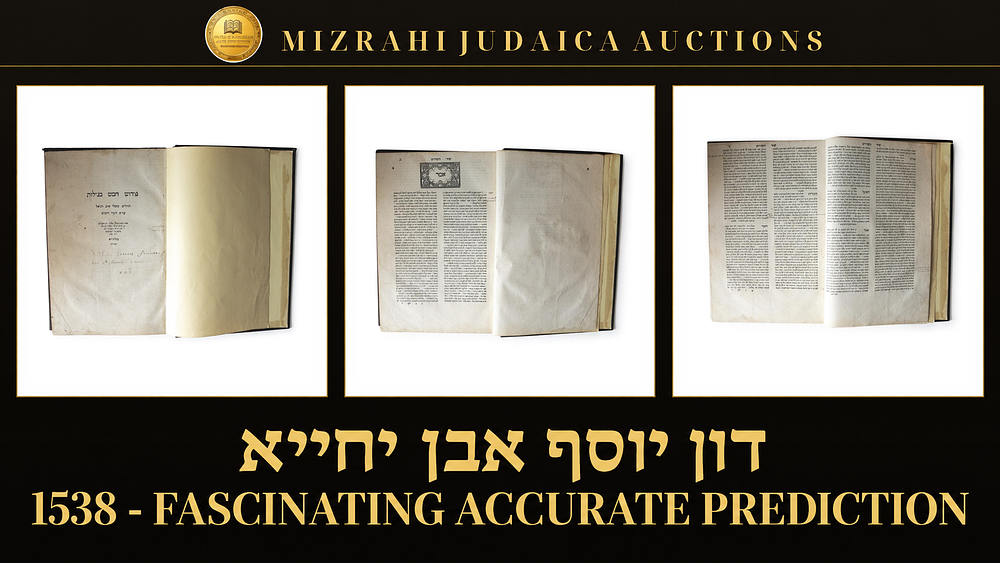
DON YOSEF IBN YAHYA, COMMENTARY ON THE FIVE MEGILLOT AND KETUVIM. Bologna: The Company of Jewish Silk Weavers, 1538. - accompanied by a strikingly accurate prediction of the return of the Jewish people to the Holy Land . The prediction appears on page 110 (קי) of the Bologna edition, in the line beginning with the word באופן: ”באופן כי בסוף החמשת אלפים ושבע מאות שנה לבריאת העולם בקירוב אם מעט אחר כך יבוא קצנו בעזרת ה למען יוכלו לשבת בני ישראל בטח על אדמתם כשלש מאות שנה מהאלף הששי למען יתראה לעין כל היות האמת אתם..... ” ”In the end of five thousand and seven hundred years from creation (equivalent to the year 1940), or a bit before or a bit after, will come the time, with the help of God, that the nation of Israel may settle securely on their land, for approximately 300 years of the sixth millennium...” Printed scarcely five decades after the expulsion of the Jews from Spain, this handsome folio embodies the remarkable rebirth of Iberian Jewish scholarship on Italian soil. Its author, Don Yosef ibn Yaḥya (c. 1494-1539), belonged to one of the most illustrious Sephardic families to rebuild their lives in Renaissance Italy after the expulsions from the Iberian Peninsula. A distinguished biblical exegete, philosopher, and communal leader, Ibn Yaḥya would become one of the principal transmitters of the intellectual legacy of Spanish Jewry to a new generation, while his son, Rabbi Gedaliah ibn Yaḥya, achieved lasting fame as the author of Shalshelet ha-Kabbalah. The volume contains Ibn Yaḥya's commentary to the Five Megillot, together with Tehillim, Mishlei, Iyov, Daniel, Ezra, and Divrei ha-Yamim. It was printed at Bologna by the remarkable consortium of Jewish printers commonly known as the Company of Jewish Silk Weavers - Menahem ben Avraham of Modena, Yechiel ben Shlomo of Verona, and Aryeh ben Shlomo Ḥayyim of Monselice - whose brief but ambitious press occupies a distinctive place in the history of early Hebrew printing. The work later became the subject of an intriguing bibliographical mystery. Certain passages appeared strikingly similar to those found in the writings of the earlier philosopher and preacher Rabbi Isaac Arama , author of the Akeidat Yitzḥak, raising suspicion that Ibn Yaḥya had copied them. Only through painstaking textual analysis was it demonstrated that the opposite was almost certainly true: the passages fit organically within Ibn Yaḥya's commentary, while they sit awkwardly within Arama's. Most likely, a composite manuscript, already containing interpolations from Ibn Yaḥya, was innocently carried into print under Arama's name, transforming the apparent plagiarist into the victim of one of Hebrew bibliography's more fascinating cases of mistaken authorship. This copy possesses an additional layer of historical interest. The title page bears a contemporary Latin ownership inscription, apparently reading Joannis Farineau, Rector S. Marini (identification provisional), while a Hebrew inscription beneath may record the year 1551. Throughout the volume - and especially in the commentary to Tehillim - the margins are filled with extensive Latin annotations by a learned Christian reader , almost certainly a Hebraist or ecclesiastic engaged in the serious study of Hebrew Scripture. Such annotated copies vividly recall the world of Renaissance Christian Hebraism, when professors, monks, and clergy increasingly turned to Hebrew books in pursuit of the biblical text in its original language, often reading Jewish commentators alongside the Church Fathers. Title page with contemporary Latin ex libris and Hebrew ownership inscription. Extensive contemporary Latin marginalia throughout, especially in Tehillim. Pages 108, 109 and 122 reinforced. An unusually evocative witness not only to the transmission of Sephardic biblical scholarship in Renaissance Italy, but also to its reception beyond the Jewish world. Condition : Attractive copy in later cloth binding. Leaves 108-09 and final leaf with old repair and minor text affected. Overall, very good condition. Provenance: The collection of Abraham Lieberman, Flatbush, Brooklyn NY Reference : Sonne, Kiryat Sefer (1930) 279.