בידספיריט | CORNWALL KIRKPATRICK'S POTTER'S RIB, URBANA,
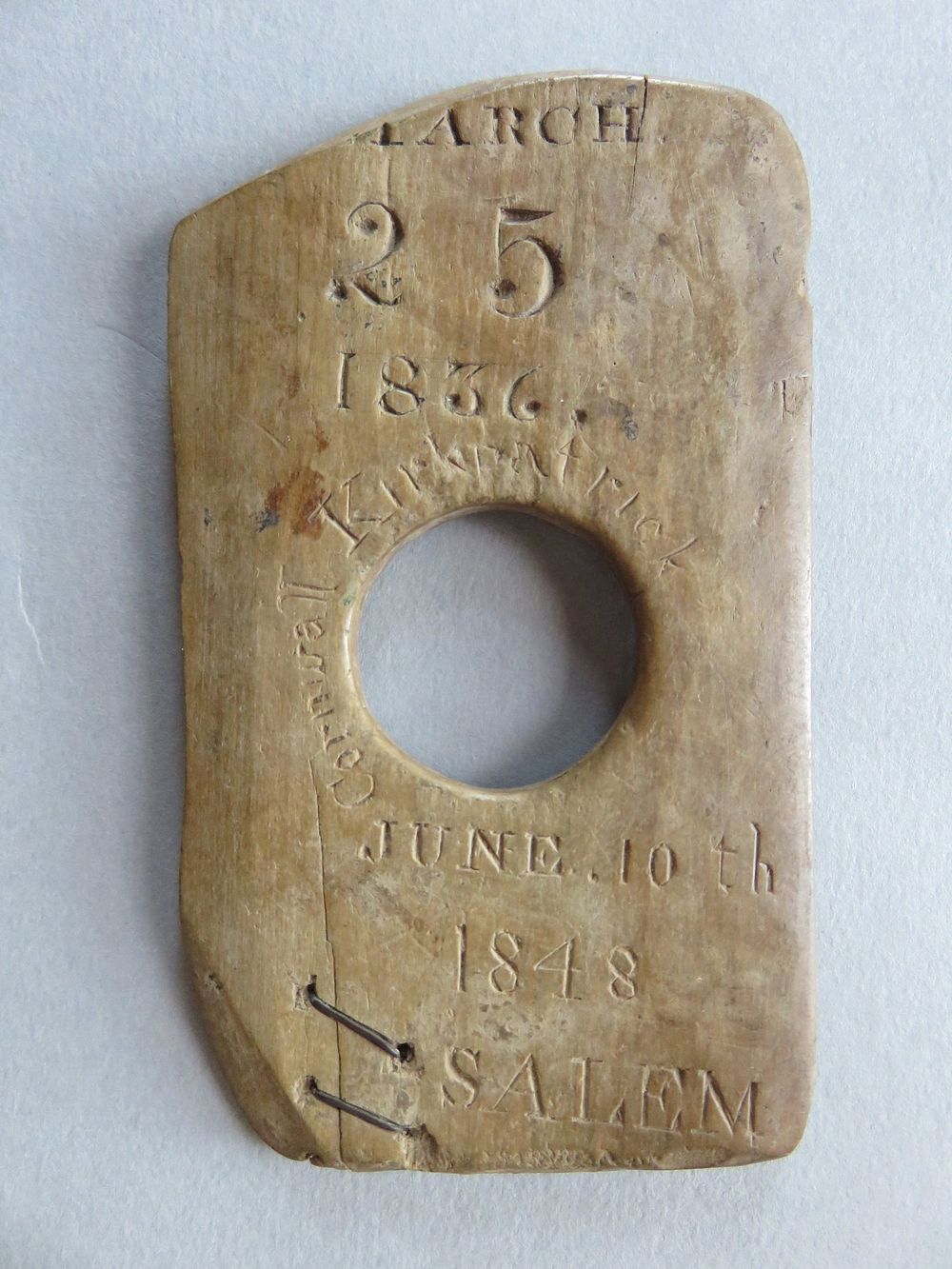
CORNWALL KIRKPATRICK'S POTTER'S RIB, URBANA, OHIO - C. 1836, poplar. Small thin piece, with a central hole, worn edges, and early stapled repair. On one side is incised ”C.K. Urbana OHio” and on the other ”MARCH 25 1836 JUNE 10TH 1848 SALEM” and with ”Cornwall Kirkpatrick” around the center hole. 3.675” long, 2.125” wide. Cornwall Kirkpatrick lived one of those interesting 19th-century lives that rambles across occupations and geography with equal enthusiasm. The lives and work of Cornwall and his brother, Wallace, have been well-documented, perhaps first by Ellen Denker (The Kirkpatricks Pottery at Anna, Illinois, a 1986 exhibition at the Krannert Art Museum), and more recently by Greg Mathis (The Family, Kilns, and Stoneware of Kirpatrick). Cornwall?s grandfather, Alexander Kirkpatrick, was a Revolutionary War veteran, and he moved his family westward after the war, first to Washington County, Pennsylvania, where Andrew Kirkpatrick, Cornwall?s father, was born in 1789. Twenty years later, the family continued inching west, and in 1811, Andrew married Ann Lafever in Knox County, Ohio. The couple had at least nine children, the first five of whom were all sons, and the third of whom was Cornwall Elihu Kirkpatrick, born on December 23, 1814, in Fredericktown, Knox County, Ohio. The 1820 census has Andrew, still shifting westward, in Urbana, Ohio, with a household of ten, five of whom are ?engaged in manufactures.? Cornwall moved around in the 1820s and 1830s, probably receiving training near Cincinnati, and then with his father, before traveling again. In 1836, Andrew and some of the family headed west to Vermilionville, Illinois, leaving young Cornwall in charge of the Urbana shop. Soon thereafter, Cornwall left Urbana and headed back to Cincinnati, where he married Rebecca, the daughter of Alexander Vance, the man with whom he may have trained for a time. The couple lived in Covington, Kentucky for a period, and in 1848, Rebecca died. The following year, Cornwall married Rebecca?s sister Amy, and they moved upriver to the small town of Point Pleasant, where Cornwall had purchased a pottery (that included the cabin in which Ulysses S. Grant). In 1853, Cornwall sold the pottery in Point Pleasant, and in 1854, his brother Wallace married another daughter of Alexander Vance. By 1857, both brothers had moved to Mound City, Illinois, to join their father, and in 1859, the family had moved to Anna and begun the pottery for which they became famous. Cornwall would remain in Anna for the rest of his life, raising his family and running the pottery, as well as becoming very active in local politics and serving as Anna?s first mayor in 1872. He died in 1890, after several years of illness, remembered by the people of Anna as, his obituary noted, ?a good and useful man.? Some of Cornwall?s history is recorded on his potter?s rib. One the front side is ?C.K. Urbana Ohio.? The back side has his full name around the center hole. Above is the date March 25, 1836, and the incising appears to have been done at the same time as the incising on the front side, suggesting that this was the date he began using this rib; however this date roughly corresponds to his return to Urbana and his takeover of the family?s shop there. Clearly, he used this for years after as it was worn down into the date. The incising on second date on the rib, June 10, 1848, and includes his full name on this side of the rib, as if he ?signed? and dated it when he finished using this rib. This date was also in the middle of the upheaval in Cornwall?s life, and the word ?Salem? under the date may well refer to this challenging period. With much of the Kirkpatricks? later pottery being steeped in biblical symbology, it may be that he included the word in relation to the biblical city of Salem, the name of which is rooted in Hebrew and Arabic, meaning safe, peaceful. We may never know whether the dates on the rib commemorate events in Cornwall?s life or simply mark the ?life dates? of the rib, and just as big a mystery is the question of how the rib ended up with the Piatt family in Urbana. Did it return to Logan County soon after Cornwall stopped using it? Certainly, the Piatts and Kirkpatricks would have known each other and transacted business together, but there is no indication of them being so connected that Cornwall would make such a gift to folks from his previous hometown. It is also possible that the rib turned up somewhere later in the 19th or even early 20th century, when William McCoy Piatt, the son of Abram, the builder of Mac-A-Cheek, was collecting, curating, and displaying family heirlooms. Perhaps he saw an opportunity to acquire it then, bringing the rib back to where it started life. In any case, potter?s ribs were typically used up and disposed of, and any rib surviving from a 19th-century pottery is necessarily rare. Here, however, the simple rarity of the rib is surpassed by the notoriety of the potter who used it,