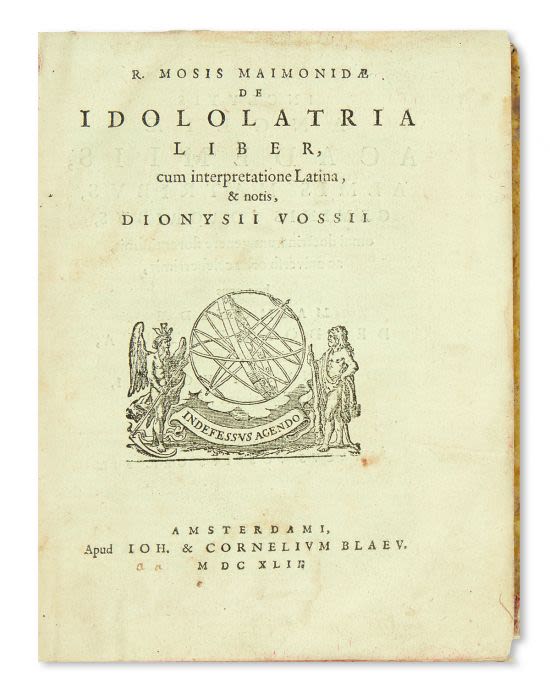
Bidspirit auction | (MAIMONIDES, MOSES). De Idololatria Liber.
(MAIMONIDES, MOSES). De Idololatria Liber. Translated into Latin by Dionysius Vossius. > Gerardi Ioannis Vossii. De Theologia Gentili, et Physiologia Christiana. FIRST EDITION. Hebrew and Latin in parallel columns with occasional Greek and Arabic. On title, printer’s device showing astrolabe flanked by angel and man with Blaeu family motto “Indefessus Agendo.” pp. (12), 174, (1). * (12), 304, (xvii), (19), 305-732, (x), (29). Lightly stained. Contemporary reverse leather, worn, spine distressed. 4to. Amsterdam: Ioh. & Cornelium Blaeu 1642 Dutch Orientalist Dionysius Vossius (1612-33), was the son of the humanist philologian Gerardus Johannus Vossius (1577-1649). Well versed in Hebrew, Latin and Greek, Dionysius studied Talmud with his friend Menasseh ben Israel, whose early work “El Conciliador” he translated from Spanish into Latin (Amsterdam 1633). Here, Dionysius provides a Latin translation of Maimonides's work on idolatry, (Hilchoth Avodah Zarah) from his magnum opus the Mishneh Torah with the main text in Hebrew. The work is bound with his father’s study on the origins and advancement of idolatry and graven images ”De Theologia Gentili.” The preface of Dionysius's volume was written by his brother Isaac Vossius in which he mourns the death of his gifted brother and praises his dedication to high learning. Dutch Orientalist Dionysius Vossius (1612-33), was the son of the humanist philologian Gerardus Johannus Vossius (1577-1649). Well versed in Hebrew, Latin and Greek, Dionysius studied Talmud with his friend Menasseh ben Israel, whose early work “El Conciliador” he translated from Spanish into Latin (Amsterdam 1633). Here, Dionysius provides a Latin translation of Maimonides's work on idolatry, (Hilchoth Avodah Zarah) from his magnum opus the Mishneh Torah with the main text in Hebrew. The work is bound with his father’s study on the origins and advancement of idolatry and graven images ”De Theologia Gentili.” The preface of Dionysius's volume was written by his brother Isaac Vossius in which he mourns the death of his gifted brother and praises his dedication to high learning.