Bidspirit auction | (FABLES). Berachiah ben Natronai HaNakdan.
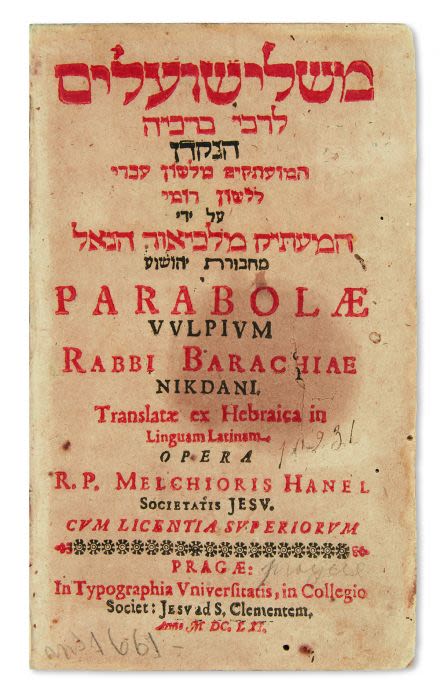
(FABLES). Berachiah ben Natronai HaNakdan. Mishlei Shu’alim [Hebrew version of Aesop’s Fables] > Four other works. Title in red and black. Latin and Hebrew on facing pages. Hebrew in square characters typical of Prague, provided with nikud. Latin translation by Melchior Hanel, introduction by Athanasius Kircher. pp. (16), 436 (mispaginated), lacking frontispiece. Foxed, final two leaves soiled with loss of text. Contemporary vellum. Thick. 8vo. Vinograd, Prague 443 Prague: University Press 1661 The 12th-13th century Hebrew grammarian, translator, and scholar Berechiah's appellation ”HaNakdan” (”The Punctuator”) reflects his professional expertise: adding the vowel-points to Hebrew bibles and prayer books. Born and trained in Normandy, Berechiah worked for a time in England but was so unimpressed by the lack of religious standards within Anglo-Jewry, he determined to produce a collection of ethically instructive animal fables to help remedy the situation. Mishlei Shu’alim (Fox Fables), his most celebrated work, adapts much of its content from the French-language fable collection of Marie de France (c. 1170) and from a now lost Latin version of Aesop. This European Aesopian tradition is married by Berechiah to the biblical and talmudic traditions, with the result that the animals converse in a Biblical Hebrew interspersed with talmudic quotations. The 12th-13th century Hebrew grammarian, translator, and scholar Berechiah's appellation ”HaNakdan” (”The Punctuator”) reflects his professional expertise: adding the vowel-points to Hebrew bibles and prayer books. Born and trained in Normandy, Berechiah worked for a time in England but was so unimpressed by the lack of religious standards within Anglo-Jewry, he determined to produce a collection of ethically instructive animal fables to help remedy the situation. Mishlei Shu’alim (Fox Fables), his most celebrated work, adapts much of its content from the French-language fable collection of Marie de France (c. 1170) and from a now lost Latin version of Aesop. This European Aesopian tradition is married by Berechiah to the biblical and talmudic traditions, with the result that the animals converse in a Biblical Hebrew interspersed with talmudic quotations.