Bidspirit auction | (AUSTRIA). (Edict). Von der zu
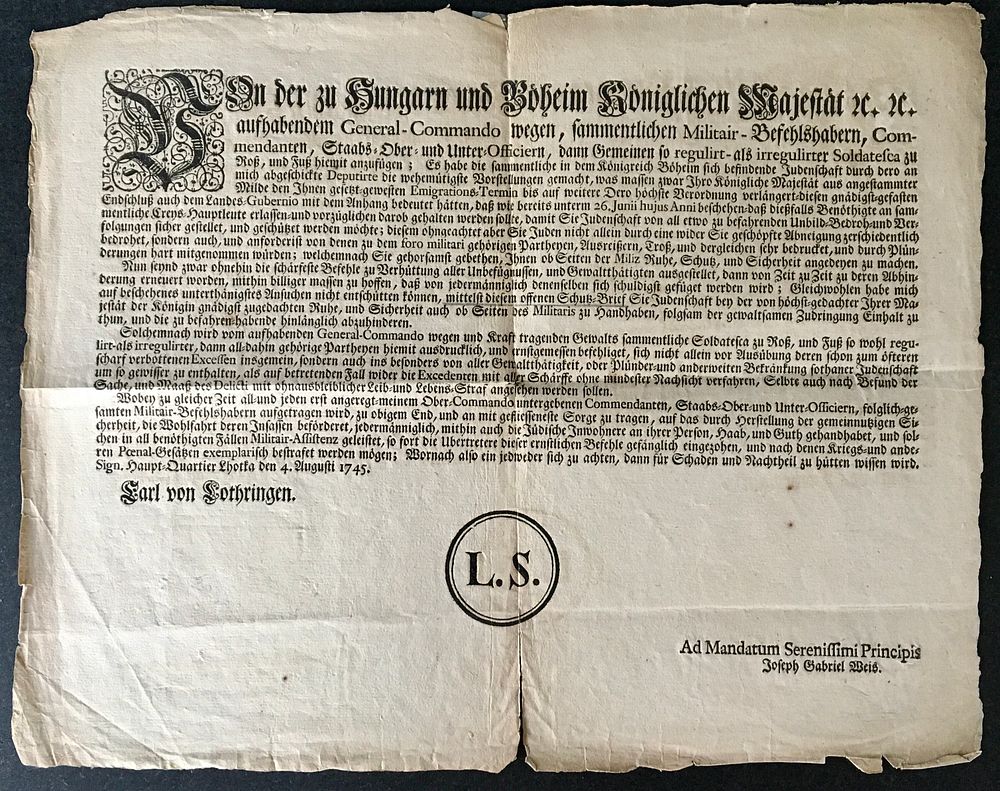
(AUSTRIA). (Edict). Von der zu Hungarn und Böheim Königlichen Majestät etc. etc. aufhabendem General-Commando […] hiemit anzufügen; Es habe die sammentliche in dem Königreich Böheim sich befindende Judenschaft durch dero an mich abgeschickte Deputirte die wehemuetigste. Vorstellungen gemacht, […] damit Sie Judenschaft von all etwo zu befahrenden. Unbild=Bedroh= und Verfolgungen sicher gestellet, und geschuetzet werden moechte. Single page German broadside. Signed Carl von Lothringen. Deep folds, split starting at lower portion. Rectangular folio. Lhotka (Bohemia), 4th August, 1745. This ordinance, issued by the General Command of the Austrian Imperial Army on August 4, 1745, in the name of Maria Theresa of the House of Habsburg, Archduchess of Austria and Queen of Hungary and Bohemia, addresses the conduct of military personnel toward Jewish residents. It responds to reports that Jews in Bohemia had been subjected to mistreatment by soldiers despite prior orders granting them protection and regulating their status. The decree reiterates that all military personnel, officers and common soldiers alike, must refrain from violence, harassment, extortion, and plunder. Jewish inhabitants are to be protected in their persons and property, and any alleged offenses on their part are to be handled through proper legal channels rather than arbitrary action. Violations by soldiers are to be punished severely, and commanding officers are charged with ensuring compliance. The decree thus seeks to curb disorder and reassert centralized authority over both troops and civilian populations. Carl von Lothringen, or Prince Charles Alexander of Lorraine (1712–1780), who signed the ordinance, was a prominent Austrian general and field marshal of the Imperial Army, as well as the brother-in-law of Empress Maria Theresa. The decree must be understood against the backdrop of the turbulent conditions in Bohemia in 1745, during the Second Silesian War (1744–1745), part of the War of the Austrian Succession. King Frederick II of Prussia preemptively invaded Bohemia in 1744 to prevent Austria from reclaiming Silesia, securing his position through major victories. These campaigns brought large troop movements and prolonged instability to the region. In this context of war, shifting power, and military occupation, civilian populations were particularly vulnerable. Economic pressures, including harvest variability and weather-related fluctuations in grain prices, further exacerbated tensions. The decree reflects an effort by the Habsburg administration to maintain order, discipline troops, and protect Jewish communities while reinforcing state authority during a period of crisis. Overall, the edict makes clear that any actions against the Jews must be carefully scrutinized, and any issues concerning their treatment must be reported and addressed with fairness. This approach reflects an effort to uphold justice and prevent any form of exploitation or abuse. The directive is firm in its message, encouraging both restraint and the safeguarding of Jewish rights, with a clear intention to prevent unnecessary conflict or hardship for the Jewish population during this period of military oversight.