Bidspirit auction | (KARAITICA). Kiddush Leil Shimmurim (Karaite
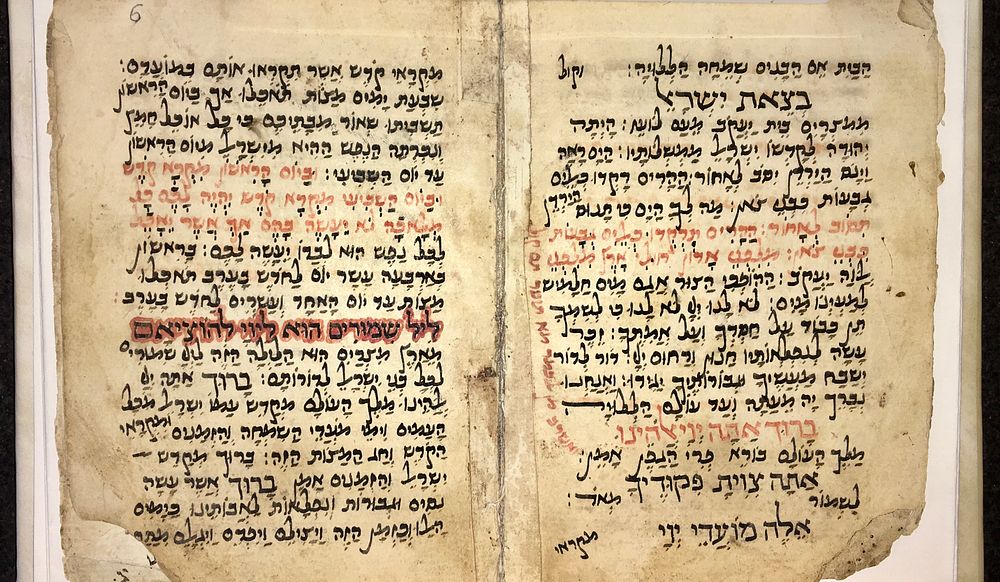
(KARAITICA). Kiddush Leil Shimmurim (Karaite Haggadah). [Egypt, c. 14th century]. * WITH: Hallel LeShabbat HaGadol (Karaite Liturgy for Shabbat before Passover). [Egypt, c. 17th century]. Together, two manuscript volumes: * KIDDUSH LEIL SHIMMURIM: 10 leaves. Written in 19 lines per page in black, red, and brown ink in Oriental Hebrew semi-cursive and square scripts, headings in red ink. Partially vocalized, sometimes deviating from normative, and apparently according to local pronunciation. A single survived quire [no. XII] from a codex (here ff. 1-9) of which the 10th leaf has been lost, + a single leaf (here f. 10) is the 10th leaf of quire XIII from the same codex. The original codex was constructed of quires composed of 5 bifolia or 10 folios, as usual in the Orient; fol. 10v bears the number of the quire in Hebrew letters under the catchword. Oriental-Arabic paper with laid-lines (of different thickness in fol. 1, of which the other half of bifolia is lacking, and the rest of folios) and single chain-lines, at intervals of 25 mm. (f. 1) and 30 mm. (ff. 2-10). Soiled; losses to margins and corners; leaves strengthened at gutter. Title page with owner's note added, probably in the 17th century. Modern vellum, title gilt; black cloth slipcase. (110 x155 mm). * HALLEL LESHABBAT HAGADOL : 32 leaves. Written in 21 lines per page in black, red, and brown ink in Oriental Hebrew semi-cursive and square scripts on seventeenth century Venetian paper, instructions in Judeo-Arabic. Vocalizations, colophon and decorative flourishes to some headings in red ink. Catch-words at foot of verso. Undated colophon, f.31r-31v; additional text in another hand, f.32r-v. Modern foliation in pencil. Stained, edges worn, corners rounded. Modern vellum, title gilt; black cloth slipcase. (110 x160 mm). The Karaites are a Jewish sect which came into being toward the middle of the ninth century and whose original doctrine is characterized primarily by its denial of the Talmudic-Rabbinic tradition. Over the ensuing centuries, however, Karaites also developed a tradition of their own, described by them as sevel hayerushah (burden of inheritance). The Karaite alternative tradition has, over the centuries, occasionally come close to rabbinic tradition. The two manuscripts of the present lot reflect two discrete points in the timeline of the development of Karaite tradition surrounding the holiday of Passover. The manuscript of Hallel for the Sabbath before Passover, according to the rite of Near Eastern (Oriental) Karaites, represents a parallel but significantly different version from that of the Karaites of Byzantium, Crimea and Eastern Europe. This version of the Hallel for Shabbat HaGadol is exceedingly rare, having never been printed. It includes rare liturgical poems, some totally unknown, and others recorded only in a single manuscript in the Firkowich collection in St. Petersburg. According to Karaite religious teacher R. Aaron ben Elijah of Nicomedia (d. 1369) in his work Sefer Gan Eden, the Sabbath before Passover, which occurs more or less on the 10th of Nissan (the date upon which the biblical Israelites prepared the Paschal lamb in Egypt), has the status of a holiday, necessitating the recitation of the Hallel. In addition to the concatenation of Biblical verses and unique liturgical poems that make up the Hallel, the manuscript includes a section (22v-24v) called Ha’Atidot, describing the vision of the future according to the Hebrew prophets (the parallel item in the Byzantine version is called HaNehamot); ff.26r-27v: Kedushah, culminating in a declaration of principles of faith and a credo, testifying to the beliefs of the Karaite faith in its Near Eastern version, differing dramatically from the Byzantine version by virtue of its liberal use of Islamic terminology. The manuscript closes with a poem by a non-Karaite poet, Solomon ibn Gabirol (d. c.1058), and a prayer for atonement, written by a later owner of the manuscript, Abraham Levi, the son of the honorable R. Samuel of blessed memory. Kiddush Leil Shimurim (Kiddush for the Night of Vigils, ) is a Haggadah for Passover according to the rite of the communities of Near Eastern Karaites, probably from Egypt or the Holy Land, with Judeo-Arabic instructions. It is parallel to, but textually different, than the Haggadah according to the rite of Karaites of Byzantium, Crimea and Eastern Europe, called Hallel HaQatan. The present manuscript was once part of a larger codex which would have contained a collection of different works. In addition to the Karaite Haggadah, which is nearly complete, the present manuscript includes a fragment of a very rare poetical work by Moses ibn Ezra, entitled He’Anaq. The Karaite Haggadah, different of course from the Rabbinic, is also in itself not homogenous. There are deep differences between the version and the practice of the Near Eastern Karaite communities and those of the Byzantium,