Bidspirit auction | (OPPENHEIMER, JOSEPH). A RARE AND
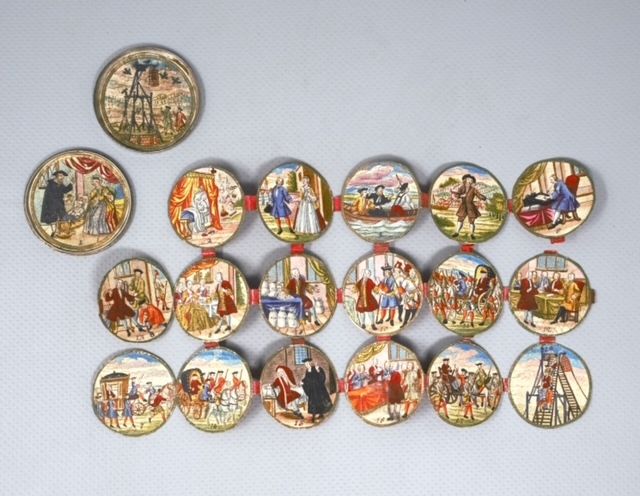
(OPPENHEIMER, JOSEPH). A RARE AND IMPORTANT ”JUD SÜSS” SCREW MEDAL FITTED WITH 19 MINIATURE ENGRAVINGS. Silvered pewter, cast and engraved. Strong colors, slight age wear with minor abrasions and small tears at some joints, one connection (between plates 6 and 12) with an old split. Otherwise in very good preservation, with unusually vivid hand-coloring. Diam: 40 mm. South Germany, c. 1738. Obverse: Bust of Joseph Süß Oppenheimer in profile to the left, rendered in the manner of a court portrait medal. Reverse: The gallows with Oppenheimer’s body displayed in an iron cage, encircled by the derisive legend “Aus disem Vogel Haus schaugt Süs der Schelm hinaus” (“From this birdhouse looks out Süß the rogue”), the term “Schelm” in its 18th-century sense meaning criminal or corpse. Interior: The medal unscrews to reveal an extraordinary 19-part series of hand-colored copper engravings, arranged as a concertina and numbered throughout, illustrating the principal episodes in Oppenheimer’s life. The sequence begins with his birth in Heidelberg and youthful dreams, continues with his rise as financial adviser and courtier to Duke Karl Alexander of Württemberg, scenes of luxury and political influence, and culminates in his arrest, interrogations, imprisonment, attempted conversion, and his infamous execution in Stuttgart in 1738, with the corpse displayed for years as a warning. Context and significance: Joseph Süß Oppenheimer (1698–1738), Court Jew and financial councilor to Duke Karl Alexander, became the victim of political intrigue and virulent antisemitism following the sudden death of his patron. Condemned in what is now recognized as a judicial murder, his case remains one of the most notorious examples of injustice and antisemitic persecution in early modern Germany. The present medal belongs to the group of satirical and defamatory objects produced immediately after his execution, designed to humiliate his memory and reinforce public prejudice. Rarity: Screw medals of this type, with fully preserved pictorial cycles, are among the rarest survivals of 18th-century popular culture and propaganda. Complete examples are preserved only in major institutions such as the Stadtarchiv Stuttgart, the Württembergisches Landesmuseum Stuttgart (Inv. MK 8163), and the Jewish Museum Berlin. Very few reach the market, and those that do are highly coveted for their exceptional combination of medallic art, political history and Jewish material culture. Provenance: European private collection.