Bidspirit auction | LEVI BEN GERSHOM / RaLBa’G,
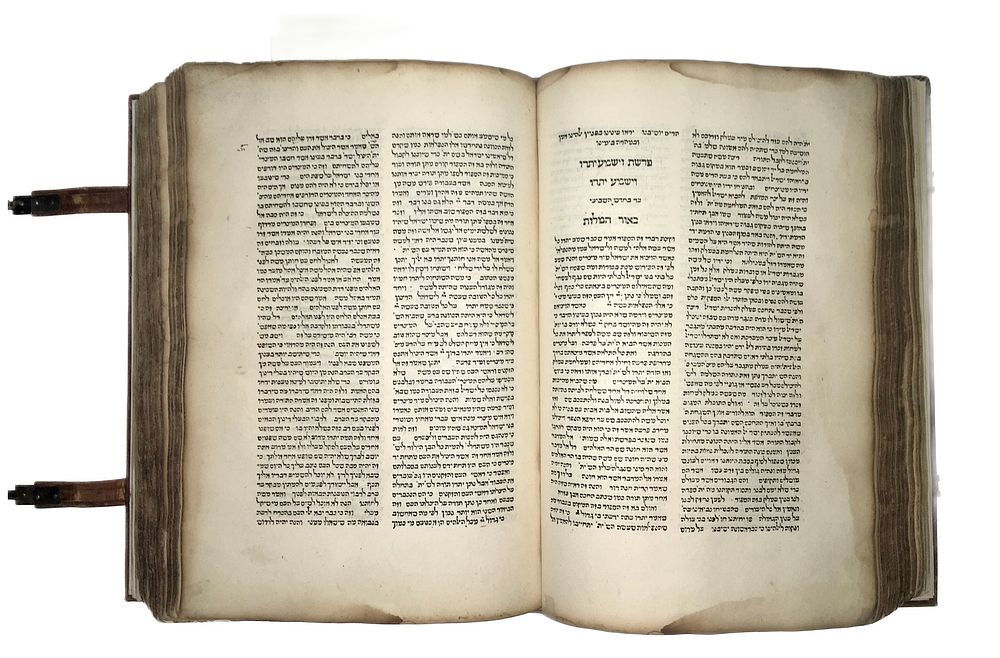
LEVI BEN GERSHOM / RaLBa’G, (Gersonides). Peirush al HaTorah [commentary to the Chumash]. (Mantua or Ferrara?) Abraham ben Solomon Conat with Yedidyah Ha’Ezrachi of Cologne, (1474-76). FIRST EDITION. Printed in double columns in an Italian semi-cursive typeface. Occasional marginal notations. ff. 389 (of 409 - bibliographers dispute precise collation, ranging from ff. 408 (Habermann) to ff. 412 (Vinograd)). This copy lacks ff. 1-7 and the final thirteen leaves (the final leaf with text is f. 409 and ff. 410-412 are blanks). Missing leaves provided here in facsimile. Upper corners of first 24 leaves slightly repaired with a few words in facsimile, slight repair on lower inside corner of f. 389 affecting a few words. Dampstained along margins. Modern finely tooled calf with metal clasps. Thick folio. References: Vinograd, Mantua 6; Goff 69; Goldstein 17; Offenberg 50; Steinschneider, p. 1611, no. 6138, 3; Thes. A10; Habermann, Perakim BeToldoth HaMadpisim HaIvri’im (1978) p. 7, no. 6; Wineman Cat. 11. AN ATTRACTIVE, WIDE MARGINED COPY OF GERSONIDES’ COMMENTARY TO THE PENTATEUCH. The Ralba’g represents the Rationalist School within medieval Bible exegesis: He provides important contributions in such diverse fields as philosophy, mathematics, and astronomy. In this voluminous commentary, the author initially examines the literal meaning of the text before expounding upon philosophical and moral maxims. A specialty of the commentary are the “To’eleth” or moral lessons to be derived from particular passages in the Torah. The Ralba’g / Gersonides (1288-1344), lived in Provence. It is known that he was an eminent halachist, however the bulk of his halachic writings have been lost. See D. Horowitz, Ralbag’s View of a Central Pragmatic Ethical Characteristic of Abraham in: Hazon Nahum, Studies Presented to Norman Lamm (1997) pp. 265-309. Abraham Conat was one of the pioneers of Hebrew printing. The Conats were the first to work as a family unit - Estellina, Abraham’s wife, played a senior role in the management of the press. Conat, a physician, was also active as a copyist of Hebrew manuscripts. Commenting on the beautiful Hebrew font Conat created, Haberman observes: “The Hebrew letters were cut in accordance with his distinctive handwriting, the readers of his generation would not have immediately discerned the difference between his manuscript and a book printed by him.” See A.M. Habermann, Studies in the History of Hebrew Printers and Books (1978), p. 3. See further, L. Pescasio, L’arte della stampa a Mantova nei secoli XV-XVI-XVII (Mantua, 1971), p. 11; V. Colorni, Abraham Conat—primo stampatore di opere ebraiche in Mantova in: La Bibliofilia 83 (1981).