Bidspirit auction | (GERMANY). Edikt, betreffend die bürgerlichen
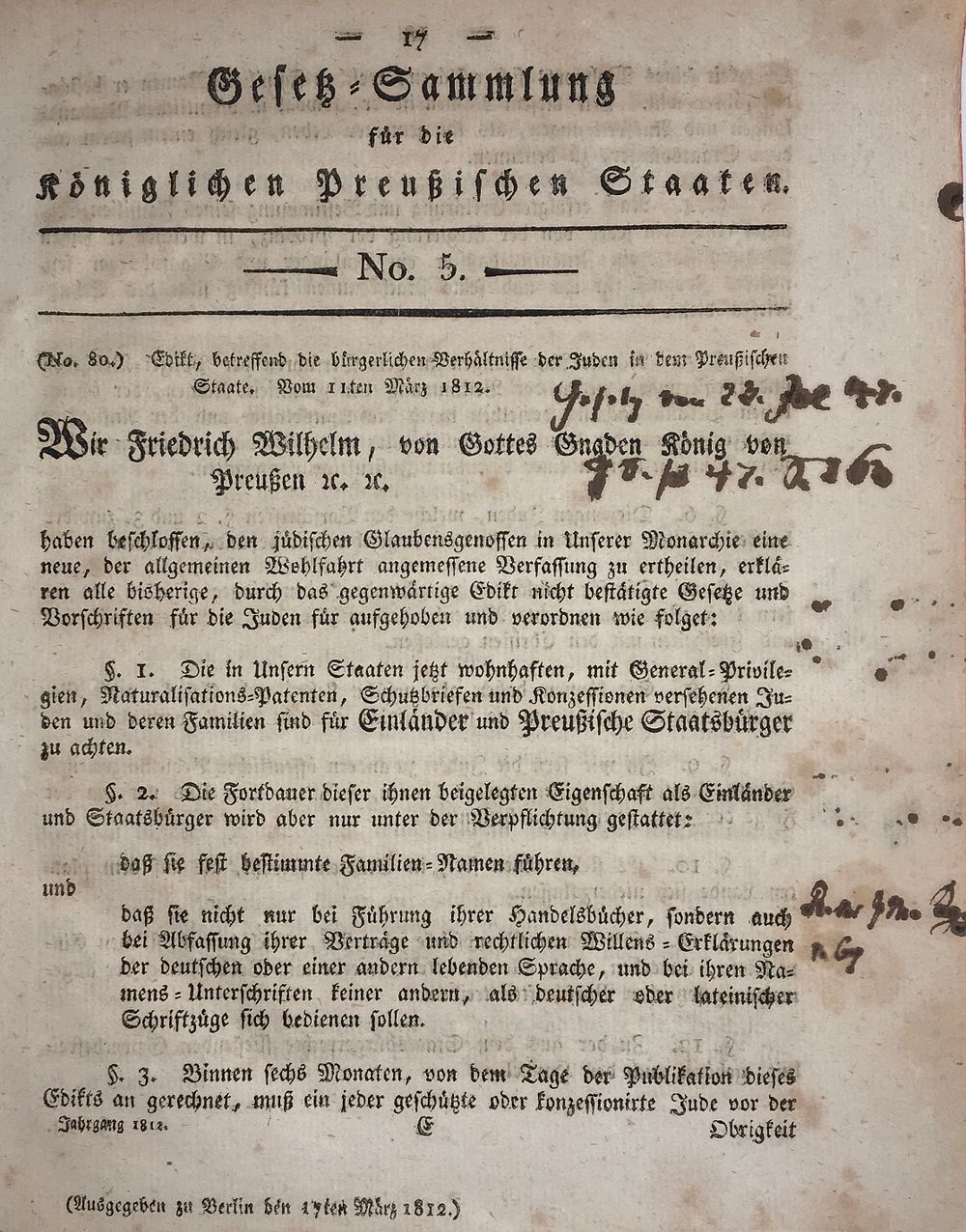
(GERMANY). Edikt, betreffend die bürgerlichen Verhältnisse der Juden in dem Preußischen Staate. Vom 11ten Maerz 1812. Part of: Gesetzes-Sammlung für die Königlichen Preußischen Staaten, no. 5 (no. 80). * Bound with: Königlicher Befehl wegen nicht mehr statt findender Mitveräusserung der Jurisdiktion bei den Domainen und geistlichen Gütern. Vom 20sten Februar 1812. Part of: Gesetzes-Sammlung für die Königlichen. Preußischen Staaten, no. 5 (no. 81). Two German Edicts. pp. 6 and pp. 1. Foxed, marginal ink notes in a contemporary hand. Unbound, spine reinforced with paper strip. 8vo. Berlin, 11th March, 1812. A landmark legal decree concerning Jewish rights. This emancipation edict issued by King Friedrich Wilhelm III (1770-1840) in 1812, addresses the civil status of Jews within the Prussian state. The edict granted nearly thirty thousand Jews in Prussian territories almost identical civil rights as the Christian population. All protected Jews within Friedrich Wilhelm’s domains were declared native residents (“Einländer”) and Prussian citizens. Those obtaining citizenship were required to select permanent family names within six months and conduct their economic affairs in the German language, including contracts and business records, and signing their names in Latin or German script. No further prerequisites were imposed. Following Prussia’s defeat at Jena in 1806 and subsequent territorial losses, the government embarked on comprehensive reforms deemed essential for the state’s survival. These reforms spanned military, administrative, agricultural, economic, and municipal spheres. The primary objective, however, was to dismantle the authority of the estates and establish a society of free citizens. A pivotal aspect of Prussian reform was the pursuit of civic equality for Jews culminating in the 1812 edict. Jews were accorded nearly identical rights as Christians, including residency options, eligibility for teaching positions in educational institutions, unrestricted engagement in trade, and more. Foreign Jews could settle in Prussia upon acquiring citizenship, though they were permitted entry for travel and trade even without it. However, prohibitions on holding public office and complete military service persisted, with the king reserving the right to amend these aspects of the law in the future, despite strong advocacy for full Jewish emancipation by figures like his state chancellor, Karl August von Hardenberg, and other liberal officials. Although equality in these domains remained largely unfulfilled for decades, the edict stands as one of the most significant legislative acts of its time in German states not under French rule. It was applicable solely to the four provinces under Prussian dominion in 1812: Brandenburg, Pomerania, Silesia, and East Prussia. In other Prussian provinces, such as Posen, at least twenty-two laws concerning Jewish status remained in force, leading to a complex array of restrictions for Jews. References: Irene A. Diekmann, ed., Das Emanzipationsedikt von 1812 in Preußen: Der lange Weg der Juden zu „Einländern“ und „preußischen Staatsbürgern“ (De Gruyter, 2013). David Sorkin, Jewish Emancipation: A History Across Five Centuries (Princeton University Press, 2021).