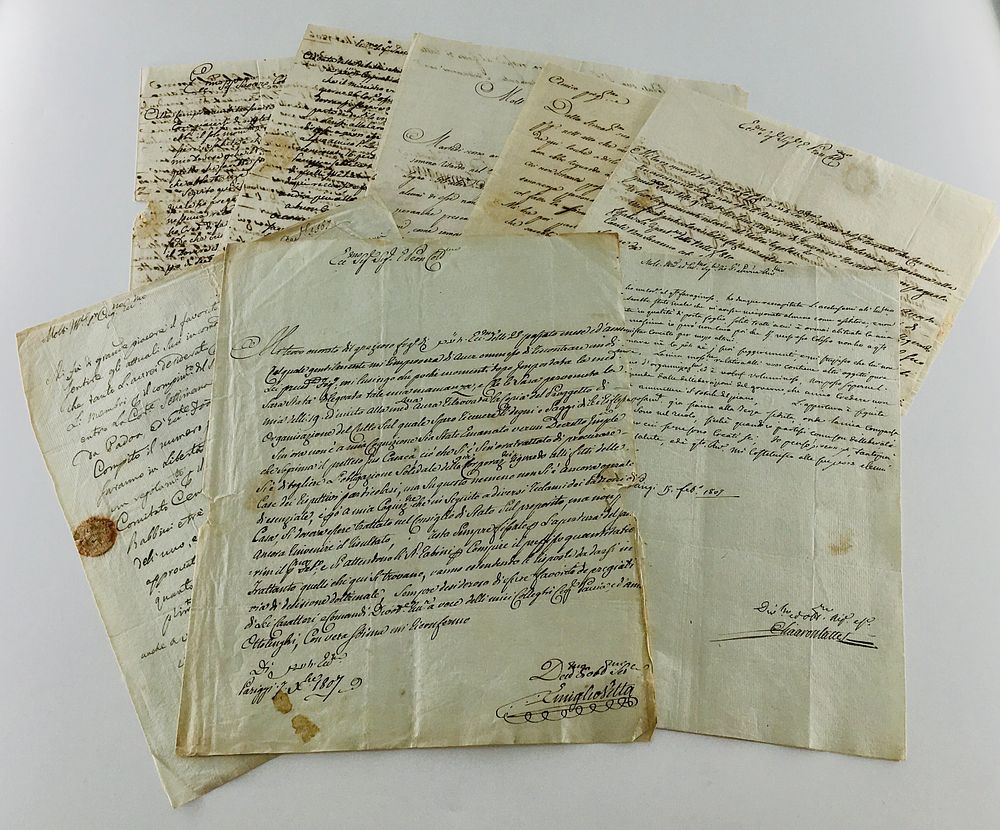
Bidspirit auction | (FRANCE / ITALY). (Napoleon Sanhedrin).
(FRANCE / ITALY). (Napoleon Sanhedrin). Group of eight Autograph Letters Signed, written to Rabbi Moise Zecut Levi de Veali, by various Italian rabbinic members of Napoleon's Assembly of Notables. Texts in Italian, French and Hebrew. 1-2 pages each. Most folded, with autograph address panel on verso. Few stains, one with marginal tear affecting few words. 4to. Paris, 1806-07. Contents: * 1. Written by: Donato Ottolenghi (the son-in-law of R. Moise Zecut Levi). Ottolenghi writes that although the date of the Assembly is not yet established, a prime location at the Hotel de la Ville has been chosen. The pomp and luxe of the selected location appears to have convinced Ottolenghi that “the Hero of the Universe” (Napoleon) greatly admires the Jews and aims to grant them full equality. 23rd July, 1806. * 2. Written by: Donato Ottolenghi. Includes a copy of letter from a minister in which the date of the first session, July 26th, is given. Informs that Mosè Formiggini wrote to Jacob Lazard asking him to prepare accommodations as one of the 16 Jews from Italy who have been nominated to the Paris Assembly. They anticipate that the first meeting will only have nominal participation from the Italians. He says that it will take a long time and expects to be in need of more funds. On the reverse is the letter from the Ministry of the Interior, giving the time and place, as well as the Order that the Assembly will have a president, secretary, and three observers. The questions the Emperor has will be communicated. The purpose is to make the Jews useful citizens and remove existing misunderstandings. 24th July, 1806. * 3. Written by: Mosè Formiggini. Confirms his arrival in Paris and the difficulties of the carriage journey he took along with the other Italian deputies. At the Assembly they were unable to participate in discussions as much had already been decided. 28th August, 1806. * 4. Written by: Mosè Formiggini. He received a letter through his son-in-law (of Moise) who is leaving Paris and who also spoke to him about ”your [i.e., Rabbi Moise Zecut Levi de Veali’s] appointment.” Eventually he will get busy on site at the Assembly, and he will communicate further on its matters. 8th September, 1806. * 5. Written by: Elia Aron Lattes. He writes that he delivered the letter to His Excellency [Rabbi David] Sinzheim, and complains about his confirmation as president of the Assembly. References to a plan to be approved by the government. The opening of the Assembly is now in its third session. 1st February, 1807. * 6. Written by: Emiglio Vitta. He mentions exchanges of letters and Jewish initiatives in Casale at the opening of the Sanhedrin. 13th February, 1807. * 7. Written by: Emiglio Vitta. He refers to delays in the correspondence concerning a Organizzazione del Culto, about which he shall make observations. There is talk of legislation on houses, but nothing appears to have been done. The opening of the Sanhedrin is set for February 1st and the rabbis are expected to complete the questions. The rabbis already present are discussing the answers to be given ”in the process of doctrinal decision.” 7th December, 1807. * 8. Written by: Buonoventura Modena. After a preamble on health he communicates that the final members to complete the Sanhedrin have not yet arrived (G. Ariani from Mantua, G. Finzi from Padua, G. Foa from Venice, and four delegates from Holland). The number for the Worship has been completed. There will be local consistories composed of two rabbis and three lay people, and a Central Committee in Paris with two rabbis and two laypeople. 9th December, 1807. Summary: To consolidate his conquest of much of Europe, Napoleon carefully planned how to place all existing institutions in Europe under his control. To execute this for religious institutions, he required the creation of a system called Consistories, which combined religious and lay-led groups, together with those government employees responsible for religious doctrines and practices. After setting up this system for Catholics and then Protestants, Napoleon turned his attention to the Jews resident in his territories. To begin with, he called for the creation of an Assembly of Notables, a French carryover institution from before the Revolution of 1789, where, on occasion, the king would gather aristocrats, religious leaders, powerful laymen, and intellectuals, to address matters of state. In 1806 Napoleon had the Jews convene such an assembly. The representatives were Jewish leaders stemming from across France, as well as Italy, and the areas of Germany conquered by Napoleon. They gathered to consider and respond to questions the French posed concerning the loyalty of Jews to the modern state. The answers provided, if approved, were to lead to the creation of Consistories for the Jews. Each would be responsible for some 2,000 Jews,