Bidspirit auction | (RUSSIA). Government Decree. Printed with
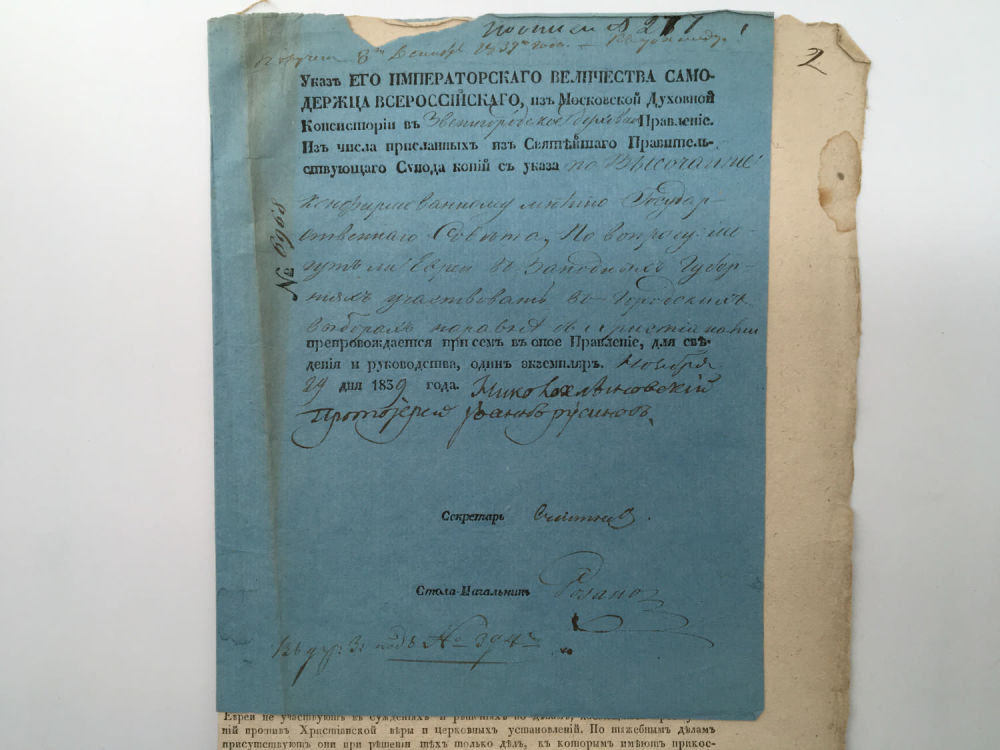
(RUSSIA). Government Decree. Printed with MANUSCRIPT ENTRIES. Two pages. Tall folio. Moscow, 1839. EDICT GRANTING JEWS OF RUSSIA CONDITIONAL RIGHTS TO BE ELECTED TO CITY COUNCIL. “While Prince Dolgoruki's proposals regarding the restriction of Jewish electoral rights were under consideration in St. Petersburg, an independent law was enacted in 1836 that limited the election of Jews in the western governorates to one-third of the total number of municipal officers. Subsequently, in 1839, a new law was passed as a result of Prince Dolgoruki's representations. According to this law, in any western governorate, Jews could only be represented in municipal organizations to the extent of one-third of the total number of municipal officers, and only Christians were eligible to act as chairmen. Jews were excluded from positions such as borough president, city mayor, considered either exclusively reserved for Christians or inappropriate for Jews due to the nature of their duties. Apart from membership in town councils and magistracies, Jews could only be elected as aldermen, deputies of house commissions, and other less significant positions. The law also mandated separate elections for Jewish and Christian representatives. However, in practice, this law led to even greater limitations. The fact that Jews were excluded from participating in the election of Christians to positions reserved for Christians alone, contrary to the law, had a significant impact. This interpretation of the law effectively stripped the Jewish population of any influence in the election of higher officials, which had a negative impact on the relationship between the latter and the Jews. As a result of the law of 1839, Jewish participation in various aspects of municipal government was minimized. However, when the Kahal was abolished in 1844, these institutions gained special significance for the Jews as they were entrusted with the administration of matters that particularly affected the Jewish community. The law of 1835, which initially granted equal electoral rights to Jews and Christians, applied to the entire Jewish population of Russia. In contrast, the subsequent restrictive laws of 1836 and 1839 were specific to the western governorates. Nonetheless, the statement specifying that these laws were intended only for the western governorates was omitted from the 1842 code of laws. Consequently, similar limitations were occasionally observed in other governorates.” (JE, Vol. VIII, p. 555).