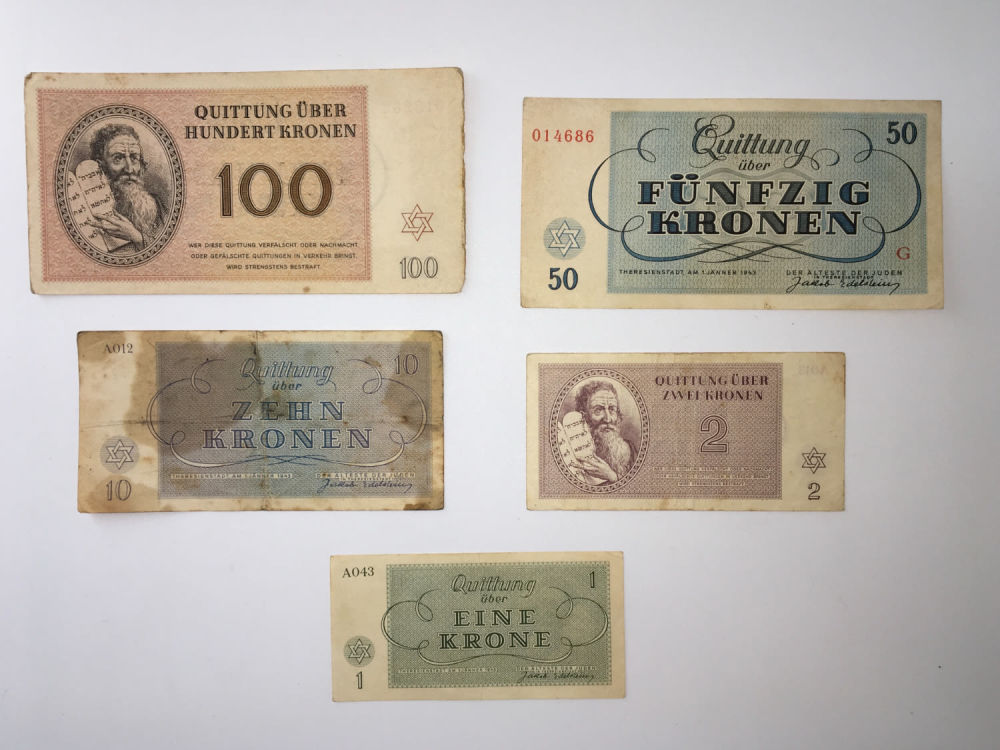
Bidspirit auction | (HOLOCAUST). Concentration camp currency from
(HOLOCAUST). Concentration camp currency from Theresienstadt (Terezin), Czechoslovakia. GROUP OF FIVE NOTES. Denominations of 1, 2, 10, 50 and 100 krone. All feature a portrait of Moses holding the Ten Commandments in Hebrew. Five separate notes. Theresienstadt, 1943. On November 24, 1941, the Germans established a Jewish ghetto in the fortress town of Terezin, Czechoslovakia. Known by its German name, Theresienstadt, it functioned both as a ghetto and transit camp to the Auschwitz extermination camp. Newly arrived prisoners were forced to exchanged all their money for these banknotes once they entered the ghetto. One German Mark was exchanged for Ten Theresienstadt Kronen, although of course, they had no value outside of the ghetto. This all served as a further device to isolate and dehumanize (and rob). The Ghetto currency was designed by Czech artist Peter Kien, who was later killed in Auschwitz. On the front of each bill was an engraved portrait of Moses holding the Ten Commandments in Hebrew. ”When Kien initially submitted his designs, Reinhard Heydrich objected to the fact that Moses looked Aryan, thus the notes were modified to show Moses with more strongly stereotyped Semitic features. Heydrich also demanded that the hand of Moses cover the commandment that stated ”Thou Shalt not Kill.” See E. J. Sterling, Life in the Ghettos During the Holocaust, 2005. See also: https://holocaustcenter.jfcs.org/findingaids/19881037terezincurrency.html.