Bidspirit auction | LILIEN, EPHRAIM MOSHE. Die Bücher
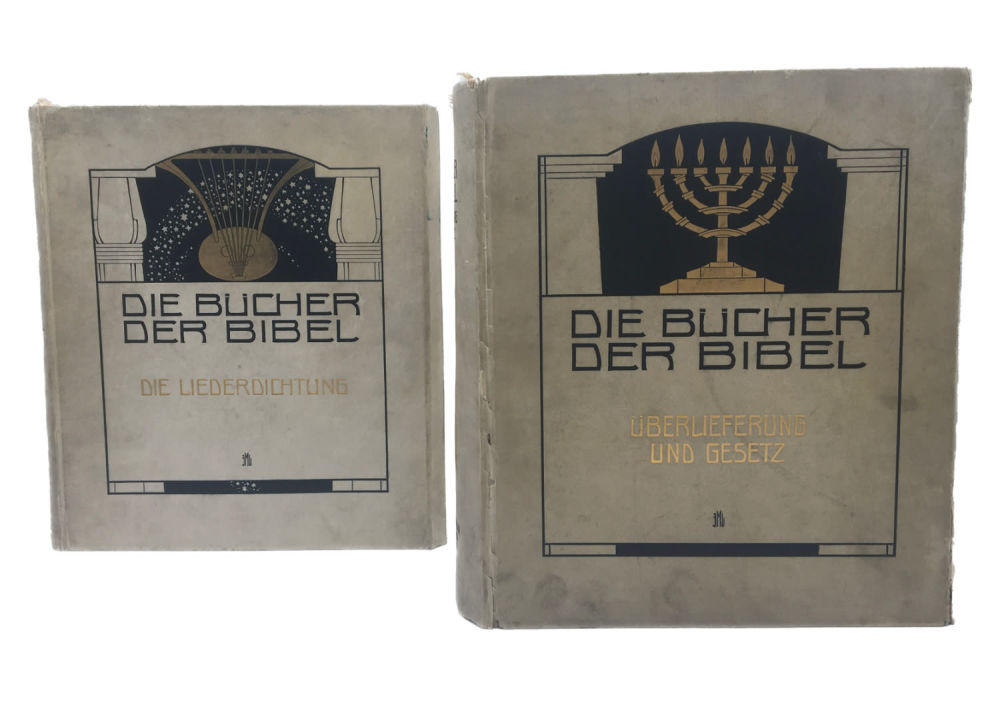
LILIEN, EPHRAIM MOSHE. Die Bücher der Bibel. Volumes I and VI. LUXURY ISSUE, all published. Ferdinand Rahlwes (editor); Ephraim Moses Lilien (illustrator); EduardRuess (translator). LUXURY FIRST EDITION. Bound in FULL VELLUM. Two volumes - complete. SIGNED AND NUMBERED BY LILIEN. * Vol. I: Überlieferung und Gesetz: Das Fünfbuch Mose und Das Buch Josua [“Tradition and Law: The Five Books of Moses and The Book of Joshua.”] pp. 552 (1). * Vol. VI: Die Liederdichtung: Die Psalmen, Die Klagelieder, Das Hohelied [“The Poetry: Psalms, Lamentations, Song of Songs.”] pp. 327 (1). Printed on special thick laid paper. Illustrated endpapers, half-title and double title pages (the latter printed in red and black). Decorative initials. Profusely illustrated with impressive black and white drawings by Lilien. Text in German. Top edges gilt, other edges deckled. Braunschweig, Georg Westermann, 1908, 1909. EXTREMELY RARE COPY OF THE LUXURY VERSION OF THE FIRST EDITION OF DIE BÜCHER DER BIBEL, LILIEN’S MASTERPIECE AND A PINNACLE OF EARLY ZIONIST ILLUSTRATION. Published by Westermann in parallel to the standard edition. Supposedly published by Westermann in 100 copies in parallel to the standard edition, research leads us to conclude that the actual number of published copies of the luxury version was significantly lower, at most circa 20 copies, and very likely less. EXTENSIVE RESEARCH HAS MANAGED TO LOCATE ONLY ONE OTHER EXTANT SETS OF THIS LUXURY EDITION. WorldCat locates no copies in any of the world's institutional collections, including at the National Library in Jerusalem, nor could we locate any copies in the recognized leading Lilien collections worldwide. A TRULY SCARCE ITEM. Westermann had initially planned to publish Die Bücher der Bibel in 10 volumes, however only volumes 1, 6 and 7 were actually published (in 1908, 1909 and 1912, respectively). One theory is that volume 1 consists of the originally planned volumes 1 through 5, which explains the numbering of the following two published volumes (6 and 7). Volume 7 was the last published. In the luxury version format, both extant sets consist of only volumes 1 and 6. Thus we presume that towards the end of the series' publication cycle, Westermann decided both to end the publication of the entire series with volume 7, and also, not to publish the final volume 7 in the luxury version format. These decisions were probably for financial reasons, perhaps because the series turned out to be less successful than originally envisaged. Given the cost of publication of the luxury version, it stands to reason that Westermann would reach a financial decision to not publish it. The scarcity of the luxury version of Die Bücher der Bibel is supported by the fact that the only mention we could locate of it in the early Lilien literature is in the catalog of ”Graficzne Prace EM Liliena [“Graphic Works by EM Lilien”], Lilien's first-ever exhibition, which took place in Lvov in 1914. The exhibition catalogue includes the following brief text describing the exhibition display, under a section titled 'Publishing houses (displayed on the tables)': ”Works by the artist decorated with drawings, initials and frames: the Bible in Luxury, Popular and School editions:” (page 44). EPHRAIM MOSES LILIEN (1874-1925) was an Art-Nouveau illustrator and printmaker particularly noted for his art on Jewish themes. He is considered the first Zionist artist and one of the finest Jewish illustrators of the 20th century. Born in Drohobycz, Galicia, Lilien studied painting and graphics at the Krakow Academy of Arts and in Vienna and Munich, moving to Berlin in 1894. He was a chief contributor to the avant-garde magazine Die Jugend. From the late 1890s, Lilien became an ardent Zionist, believing in the future homeland of the Jewish People in Eretz Israel. He met Theodor Herzl at the Fifth Zionist Congress in Basel in 1901. In 1904, together with Boris Schatz, Lilien became dedicated to the establishment of the Bezalel School of Arts and Crafts in Jerusalem. He was one of the two artists to accompany Schatz to Eretz Israel when they immigrated there in 1906. Although Lilien’s stay in the country was short-lived, he left his indelible stamp on the creation of an Eretz Israel style. His work concentrated on Jewish and Zionist themes, reinterpreting traditional Jewish motifs within a contemporary Art-Nouveau style by placing biblical subjects in the Zionist context and Oriental settings conceived in an idealized Western design. In the first two decades of the century, Lilien's work served as a model for the Bezalel group. Lilien illustrated several books, including Juda (1900) and Lieder des Ghetto [Songs of the Ghetto] (1903). His magnum opus is Die Bücher der Bibel [The Books of the Bible] (1908-1912), offered here.