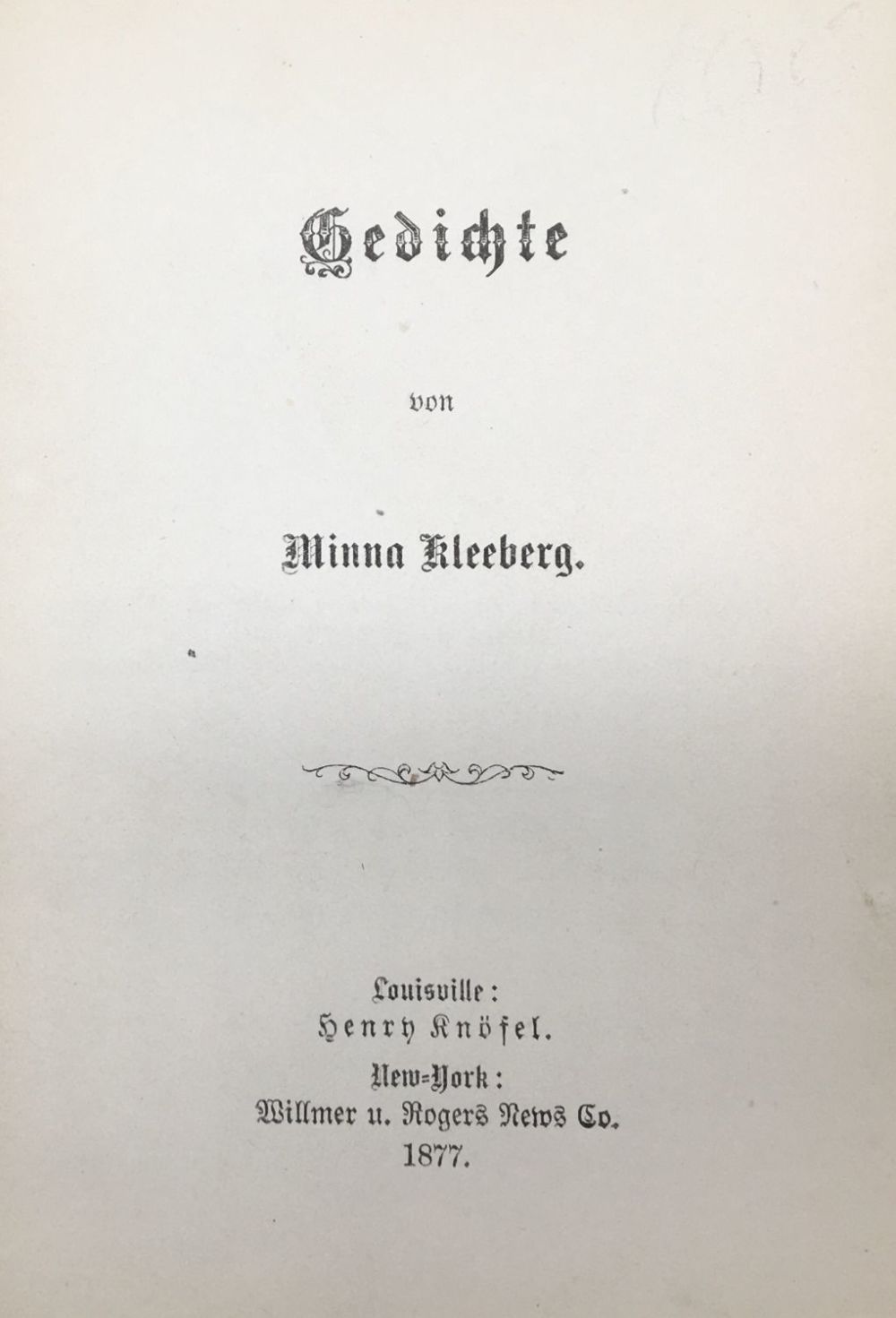
Bidspirit auction | KLEEBERG, MINNA. Gedichte. FIRST EDITION.
KLEEBERG, MINNA. Gedichte. FIRST EDITION. German text throughout. A FINE COPY. pp. 12. Lightly stained. Original printed salmon wrappers, small portion of lower outer corner chipped. 8vo. Singerman 2793. Louisville, Henry Knöfel, &, New-York, Willmer u. Rogers News Co., 1877 SCARCE FIRST EDITION OF POETRY BY AN AMERICAN RABBI’S WIFE. THIS COPY, IN ORIGINAL BINDING AND IN FINE CONDITION. Married to Rabbi Leopold (Levi) Kleeberg, Minna (Cohen) Kleeberg (1841-77) moved from Germany to the United States after her husband accepted the position to serve as rabbi of Congregation Adath Israel in Louisville Kentucky. Publicly acclaimed for her written advocacy for broad social causes, under her husband’s influence, her poetry turned to liturgical creations, while continuing to serve as a vehicle for social expression. In America Minna took up interest in public and patriotic matters, among her themes were: The Fifteenth Amendment (which granted African-American men the right to vote), the emancipation of women, and the cause of liberty and democracy. Jewish national and religious feelings were equally a source of inspiration. The aspersions cast upon Jews by Richard Wagner and Theodor Billroth she repelled with indignant vigor. Her children and the joys and sorrows of family life were also notable themes of her verse. Minna Kleeberg was best known to the American Jewish community for her liturgical hymns which appeared in the most widely used Jewish hymnal in 19th-century America, Isaac M. Wise’s Hymns, Psalms and Prayers (Cincinnati, 1868). Ten German hymns by Kleeberg form the largest number by any poet. They celebrate the Torah, human aspirations, faith, and the Festivals. Less than two years after settling in New Haven, to where her husband had been called from Louisville, Minna Kleeberg died, on the last day of 1878. In his eulogy for his departed wife, Rabbi Kleeberg recalled: “Almost from her childhood she complained of the subordinate position which tradition and custom assigned to woman. Upon her thirteenth birthday and the following Sabbath, she shed bitter tears that she was not, like Jewish boys of her own age, entitled to take part in the public reading of the law, and by this rite be solemnly consecrated to the cause of Israel…” See A.J. Karp, From the Ends of the Earth, Judaic Treasures of the Library of Congress (1991) pp. 177-78.